Copyleaks AI Detector Review vs GPTZero and Winston AI in 2026
Three AI Detectors, Three Lenses: Copyleaks vs GPTZero vs Winston AI
Copyleaks AI Detector Review: How It Compares to GPTZero and Winston AI
Three credible AI detection tools sit on the table, and none of them wins across every dimension. The right pick depends entirely on what your workflow actually demands.
Copyleaks, GPTZero, and Winston AI each occupy a distinct position in the AI detection tools market. Copyleaks uniquely combines plagiarism detection and AI content detection in a single scan. GPTZero built its reputation in academic classrooms and leans hard into that lane. Winston AI targets content marketing and SEO agency workflows with a content-optimization framing. No single tool dominates on accuracy, pricing, false positive safety, API depth, and use-case fit simultaneously.
No universal winner exists here.
Detection accuracy – measures how often the tool correctly identifies AI-generated content
False positive rate – determines how often human-written content gets flagged incorrectly
Dual-functionality – matters for teams managing both plagiarism risk and AI content risk within a single audit workflow
API depth – determines whether enterprise and developer teams can integrate the tool at production scale
Pricing structure – affects scalability for agencies processing variable document volume each month
What Makes an AI Detector Worth Paying For
The Five Metrics That Separate Reliable Tools from Expensive Guesswork
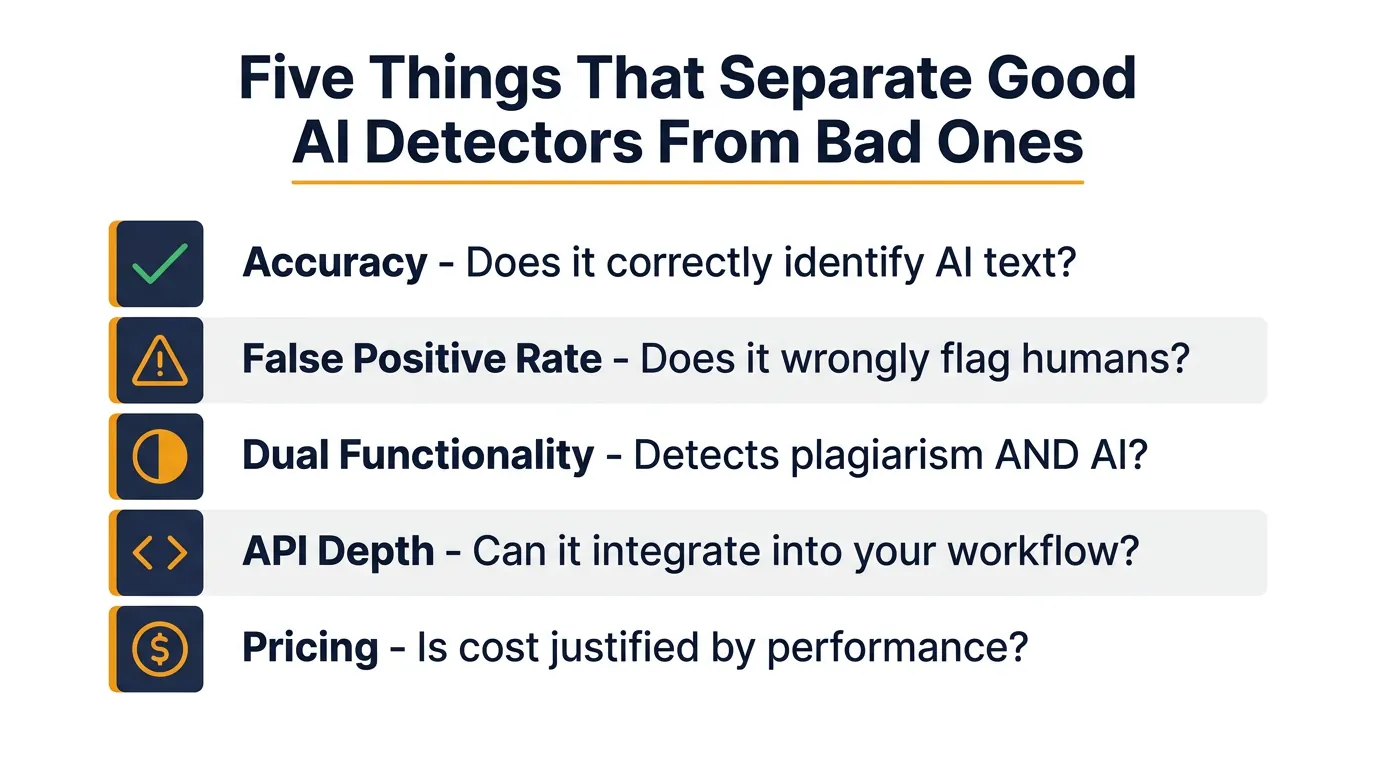
Buying an AI text detector without a clear evaluation framework is a fast way to end up with the wrong tool. Three tools exist at different price points with different strengths, which means structured criteria matter. Five metrics separate reliable options from expensive guesswork.
Five Things That Separate Good AI Detectors From Bad Ones — Evaluation Criteria Diagram
Start with accuracy rate.
Accuracy measures how often the AI writing detector correctly identifies AI-generated content on a consistent basis. False positive rate carries arguably more weight – a tool that wrongly flags human writing creates real operational and reputational damage. (Worth stating plainly, since most buyers focus only on detection power.) Dual-functionality matters specifically for teams managing both plagiarism risk and AI content risk within a single audit workflow. API depth determines whether enterprise and developer teams can integrate the tool at production scale. Pricing structure affects scalability for agencies processing variable document volume each month.
Why the Same Tool Fails Publishers and Passes for SEO Agencies
Academic institutions face a different risk profile than SEO agencies. False accusations of AI-generated writing can trigger disciplinary proceedings with serious consequences.
That asymmetry shifts which criteria matter most in each context. For academic and publishing workflows, false positive rate and plagiarism integration sit at the top of the priority list. An editorial team running dual audits needs both detection functions in one place. SEO agencies prioritize bulk processing speed and affordable per-check cost over institutional-grade false positive safety. Plagiarism and AI detection carry different weight depending on whether your stakes are disciplinary or commercial.
Copyleaks AI Detector Reviewed from the Ground Up
The Dual Detection Advantage Nobody Else Offers
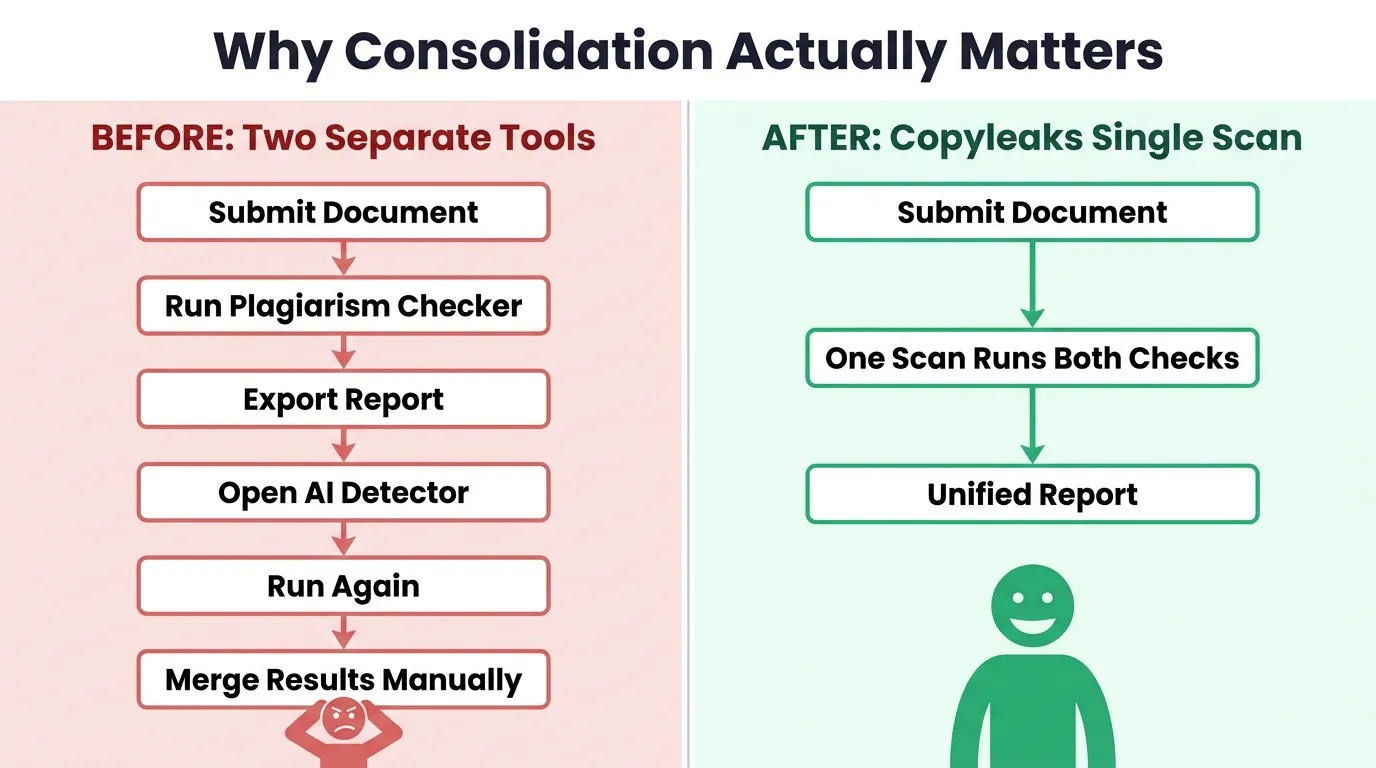
The Copyleaks AI detector is the only tool in this comparison that returns both a plagiarism percentage and an AI-generated content probability from a single scan. For academic institutions and publishers currently running two separate tools, that consolidation matters.
Before vs. After: Two Separate Tools vs. Copyleaks Single Scan Workflow
Copyleaks supports 30+ languages across its detection engine. That multilingual breadth is a significant operational advantage for international academic institutions processing student submissions in multiple languages. The platform integrates directly with major LMS systems including Canvas, Moodle, and Blackboard.
Enterprise and institutional buyers get a dedicated API with webhook support and batch processing endpoints. The sentence-level highlighting feature breaks down which specific passages triggered the AI flag rather than returning a binary verdict. That granularity helps editors and educators make nuanced decisions rather than wholesale rejections. No other tool in this comparison matches the combination of dual-functionality and language breadth at the institutional scale Copyleaks targets.
Dual detection in a single workflow is a genuine structural advantage.
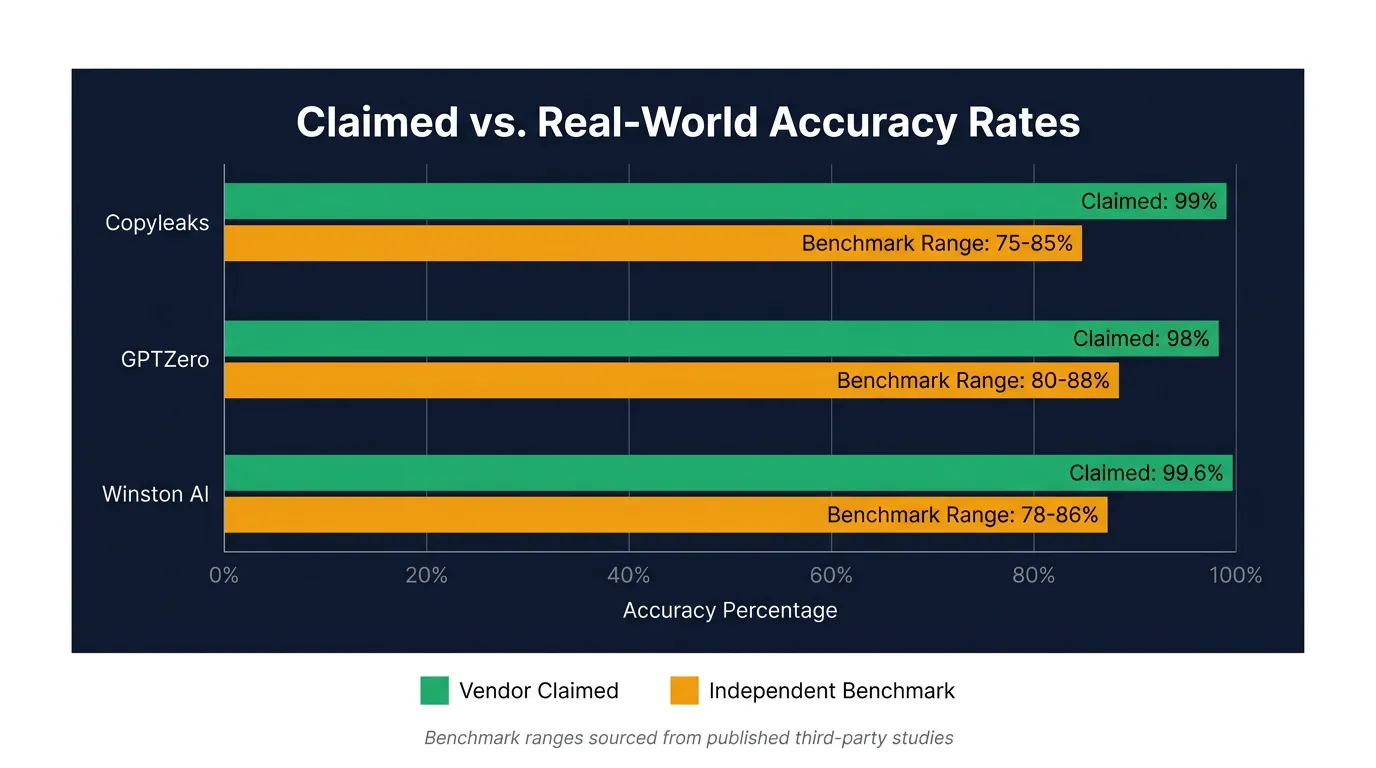
Copyleaks claims a high level of accuracy for its AI content detection, often cited in the 90-99% ranger (Professors on Reddit: Do most people…). Independent benchmark evaluations place practical accuracy somewhat lower depending on content type and degree of AI editing. The tool performs well on minimally edited AI output. Heavily paraphrased or human-edited AI content reduces detection confidence across all tools, and Copyleaks is no exception.
How Accurate Is Copyleaks and Where Does It Struggle
False positives in AI content detection are a known issue, particularly with formal academic writingg. Highly structured human writing can share surface characteristics with AI-generated text, which creates false flag risk in exactly the environment where false positives carry the highest cost.
Sentence-level highlighting partially addresses this by giving reviewers interpretable evidence rather than a single score. Copyleaks performs better on longer documents where statistical patterns have more data to work with. Short-form content and highly technical writing produce less reliable results across all three tools in this comparison.
Copyleaks Pricing Tiers and API Access Explained
Copyleaks uses a credit-based pricing model calculated per page or per word depending on the scan type. Individual plans start around $10.99 per month for limited credits. Institutional and enterprise licensing operates on custom volume pricing negotiated directly with the Copyleaks sales team. The enterprise API tier includes dedicated documentation, webhook support, and CMS and LMS integration options that neither GPTZero nor Winston AI currently match at the same depth.
The higher price point relative to GPTZero and Winston AI is defensible for teams that need dual detection functionality. Paying for Copyleaks AI content detector access makes less financial sense for teams that only need AI detection without plagiarism coverage. That’s the honest cost-benefit calculation for single-use-case buyers.
Cost justification depends entirely on whether you need both detection layers.
Enterprise buyers should request a custom quote. The published credit tiers are not designed for high-volume institutional workflows. API access documentation is publicly available and meaningfully more thorough than what GPTZero currently publishes for developer integration.
GPTZero Reviewed for Academic and Professional Use
Why GPTZero Built Its Reputation in Classrooms First
GPTZero is the most widely adopted ai text detector in the academic segment.
The tool runs on perplexity and burstiness metrics to catch AI-generated content. Perplexity measures statistical predictability in text. Burstiness captures variation in sentence complexity, given that AI-generated prose tends toward uniform length and structure throughout. Both metrics were designed with academic prose in mind, which gives GPTZero a genuine edge in its target environment. Educator-specific dashboards, batch document upload, and classroom management integrations all point to a product shaped around teacher and academic administrator workflows rather than content marketers or developers.
University adoption has generated strong social proof for GPTZero in the academic segment. Published claims from GPTZero cite accuracy rates competitive with Copyleaks for English-language academic content. Independent benchmark evaluations show meaningful performance variation depending on how much human editing the AI content received.
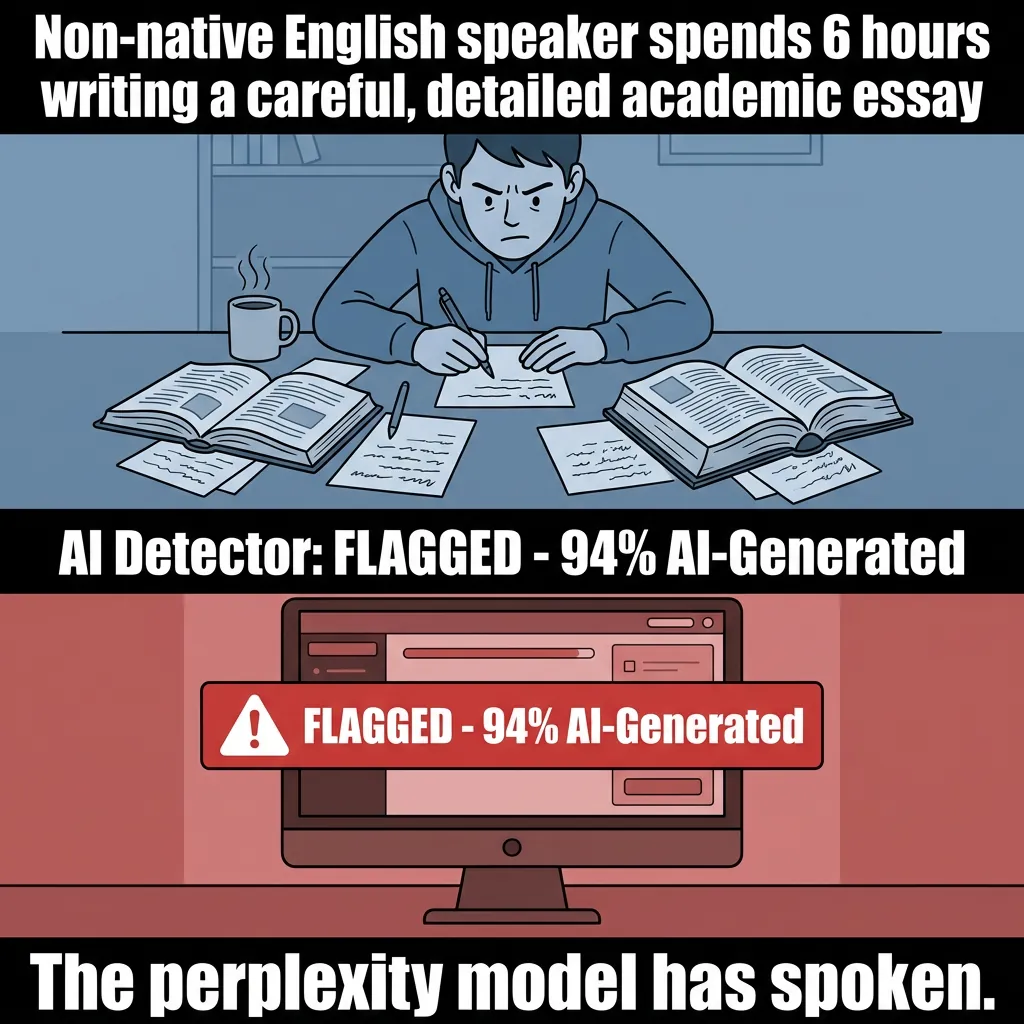
The false positive problem is real and documented. Non-native English writers produce text that perplexity-based models flag at higher rates than native English academic prose. A 2023 Stanford study on AI detection tools found that non-native speaker writing was misclassified as AI-generated at disproportionate rates across perplexity-based detectors, a finding directly relevant to GPTZero’s methodology.
AI Detector Flags Human Essay as 94% AI-Generated – Meme
Batch processing for classroom-scale document sets is available on paid tiers. No plagiarism detection exists within GPTZero. Single-function ai writing detector. Full stop.
GPTZero Accuracy Data and the False Positive Problem
GPTZero offers API access, but documentation depth lags Copyleaks for enterprise integration scenarios. For English-only academic environments with smaller document volumes, GPTZero represents a lower-cost entry point than Copyleaks with acceptable accuracy for the use case.
Non-native English writers, highly structured technical writers, and writers trained in formal academic styles all face raised false positive risk with perplexity-based detection. This is not a minor edge case in a global university environment. Systemic concern. Full stop.
GPTZero offers API access, but documentation depth lags Copyleaks for enterprise integration scenarios. For English-only academic environments with smaller document volumes, GPTZero represents a lower-cost entry point than Copyleaks with acceptable accuracy for the use case.
Winston AI Reviewed for SEO Agencies and Content Teams
How Winston AI Targets the Content Marketing Workflow
Winston AI approaches AI content detection from a content optimization angle rather than a pure detection angle. That framing is both its primary strength and its most visible limitation.
The human score feature gives content teams a percentage target for optimization rather than a binary pass/fail verdict. Readability scoring appears alongside AI detection in the same report, which aligns directly with agency content QA workflows.
Bulk document upload handles agency-scale volume without requiring API integration for most use cases. Chrome extension and Google Docs integration reduce workflow friction for content teams working in standard production environments. Pricing sits at a competitive point for content marketing budgets, with paid plans starting around $18 per month for individual users.
Winston AI is the most agency-friendly option in this comparison.
Published accuracy rates from Winston AI are competitive with GPTZero for standard AI-generated content. (Independent benchmarks across all three tools show variance depending on content type and editing level, worth acknowledging.) Winston AI performs well on standard AI-generated marketing copy and blog content.
Winston AI Accuracy Benchmarks and Known Limitations
False positive rates on heavily structured or formal human-written content are a genuine concern, particularly for long-form editorial content with consistent style.
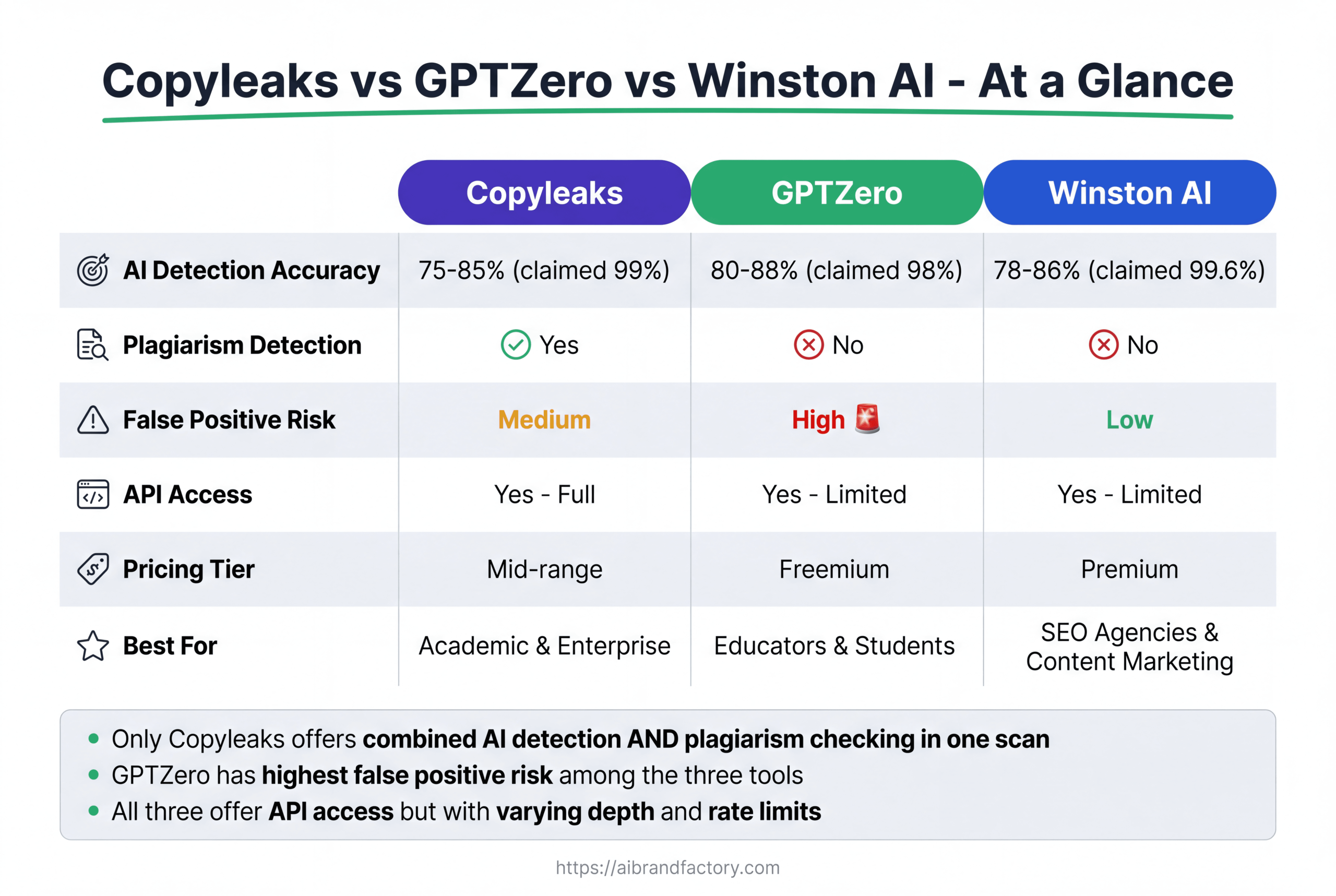
Structured side-by-side evaluation cuts through marketing noise. Three tools built on different architectures demand direct comparison across the five criteria established earlier. Figures below come from official documentation and published benchmarks where available.
Copyleaks vs GPTZero vs Winston AI — AI Detection Tools Compared at a Glance
Winston AI serves agencies well. It serves academic institutions poorly.
Head-to-Head Comparison Across Every Dimension That Matters
The Full Feature and Pricing Comparison Table
Structured side-by-side evaluation cuts through marketing noise. Three tools built on different architectures demand direct comparison across the five criteria established earlier. Figures below come from official documentation and published benchmarks where available.
The copyleaks ai content detector stands alone as the only option combining plagiarism and AI detection within a single audit. GPTZero’s academic-first design surfaces in both its capabilities and its constraints. Winston AI’s agency-friendly UX and readability integration remain absent from either competing product.
Where Each Tool Wins and Where Each Tool Fails
Copyleaks leads on dual functionality, language breadth, and enterprise API depth. It falls short on per-check cost for teams that need AI detection alone, without plagiarism coverage attached.
GPTZero leads on academic workflow integration and classroom-scale tooling. It falls short on false positive safety for non-native English writers, which carries serious weight in global academic environments.
Winston AI leads on agency UX, content optimization framing, and competitive pricing for content teams. It falls short on academic credibility, API depth, and institutional integration options.
The False Positive Problem Nobody Talks About Enough
False positives in academic settings can trigger disciplinary proceedings. Not a hypothetical. A documented consequence of deploying AI detection tools without understanding their error rates. (The stakes in a university context are categorically different from those in a content agency.)
Non-native English writers face disproportionate false positive risk across all three tools. Perplexity-based methods like GPTZero’s carry the highest documented risk for this population. Publishers using the copyleaks ai detector for editorial gatekeeping need the lowest achievable false positive threshold, which means sentence-level evidence review rather than score-based rejection. Agencies running detection for content QA can absorb slightly higher false positive rates than academic users, since the consequence there is a revision request rather than a disciplinary action. No tool in this comparison has resolved the false positive problem completely.
Claimed vs. Real-World AI Detection Accuracy Rates: Copyleaks, GPTZero, and Winston AI
False positive risk is the dimension most buyers underweight before purchasing.
AI BrandFactory Quote Card — False Positive Risk in B2B Buying Decisions
All three tools perform better on known AI-generated content and struggle with heavily edited or paraphrased AI text. That limitation is shared across the category, not specific to any single product.
Which Tool Is Right for Your Specific Situation
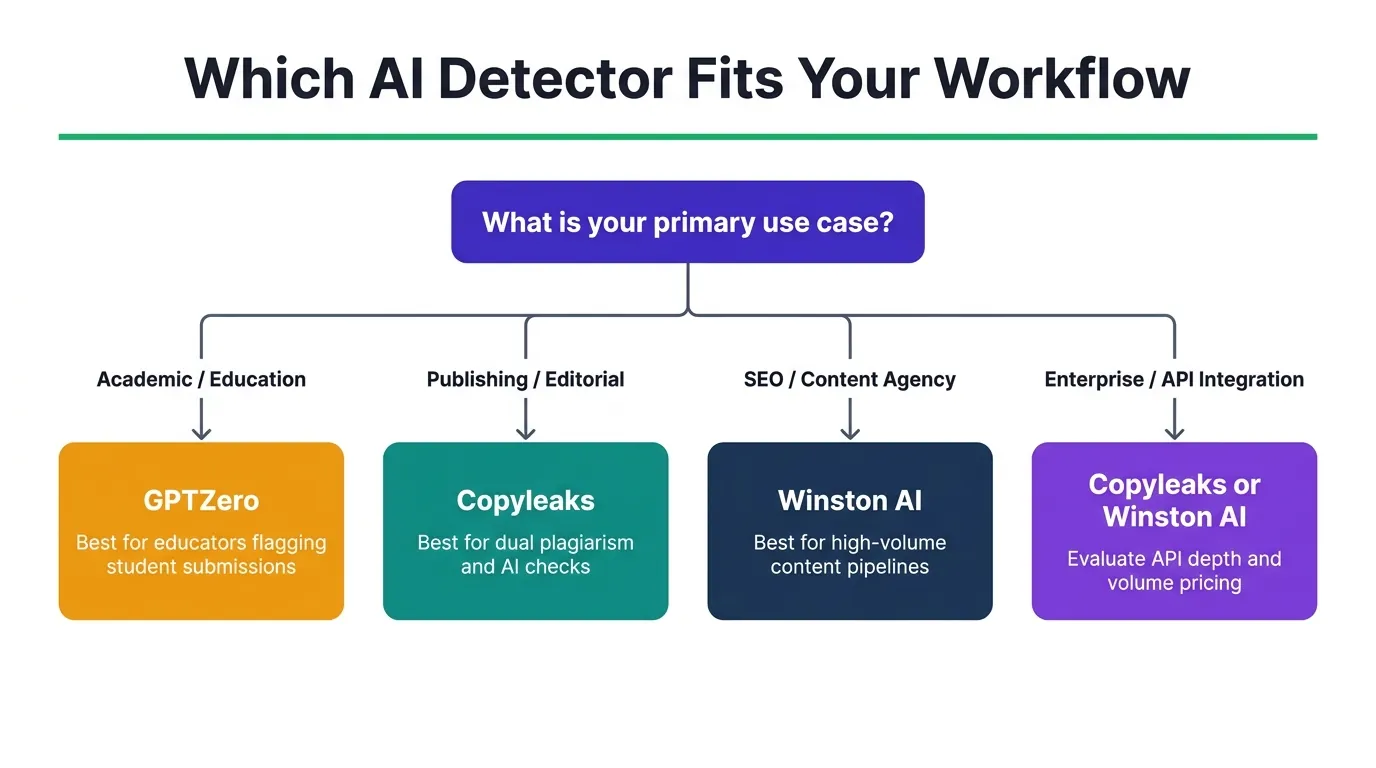
Your workflow determines the right AI content detection tool, not aggregate accuracy scores.
Which AI Detector Fits Your Workflow – Decision Tree Diagram
Academic Institutions and Educators Need This Specific Tool
Copyleaks is widely regarded as a leading tool for academic institutions needing multilingual support.. LMS integration, dual detection, 30+ language support, and enterprise API access address the full institutional requirement set. GPTZero works as a lower-cost alternative for English-only academic settings with smaller document volumes. Both tools require educator training on false positive interpretation before deployment in any disciplinary context.
Skipping that training creates wrongful accusation risk. Academic institutions should establish a formal review process for flagged submissions rather than treating AI detection scores as definitive evidence. False positive rates are not zero on any available tool. That operational reality needs to be built into any institutional AI detection policy before the first submission gets flagged.
Publishers and Editorial Teams Have a Clear Winner
Publishers need a single audit covering plagiarism and AI content. Copyleaks delivers that in one workflow step.
The sentence-level highlighting feature is specifically valuable for editorial teams making nuanced decisions about mixed-content pieces where some sections may be human-written and others AI-assisted. The higher per-check cost is offset by eliminating a separate plagiarism detection tool and the coordination overhead that comes with running two systems. For publishers processing high submission volume, the consolidated workflow justifies the Copyleaks price point over either single-function competitor.
SEO Agencies and Content Teams Get the Most from Winston AI
Winston AI’s human score and readability integration align directly with how agency content QA workflows operate. Lower pricing and bulk document processing suit the variable volume patterns of content agencies. For agencies producing AI-assisted content at scale, detection is only one side of the operational equation. AI BrandFactory addresses the production side directly – its 7-layer humanization system helps content teams produce AI-assisted content that clears detection consistently, rather than fixing flagged content after the fact. A mature AI content workflow treats detection tools and production systems as complementary layers, not competing solutions. Winston AI handles the QA checkpoint; AI BrandFactory handles the production pipeline that feeds it.
Detection and production work together in a complete agency workflow.
Agencies running both systems spend less time reworking flagged content and more time producing at volume.
Enterprise Developers and API-First Teams Should Start Here
Copyleaks offers the most thorough API documentation and integration options of the three tools. Webhook support, batch processing endpoints, and LMS and CMS integrations make it the only enterprise-ready option in this comparison. GPTZero‘s API is functional for smaller-scale integrations, but documentation depth lags behind Copyleaks for complex enterprise pipeline requirements.
The Verdict That Saves You from Buying the Wrong Tool
Three tools, three distinct strengths, no single winner across every dimension. The buying decision comes down to one question: what does your workflow actually need?
Match the tool to the use case.
Copyleaks fits multilingual academic institutions, publishers running dual audits, and enterprise teams that need deep API integration. GPTZero serves English-only academic environments at a lower price point, with accuracy that holds up at classroom scale. Winston AI works best for SEO agencies and content teams that want optimization alongside detection.
Each tool carries a real weakness – Copyleaks on cost for single-function buyers, GPTZero on false positive risk across diverse writer populations, Winston AI on institutional credibility and API depth.
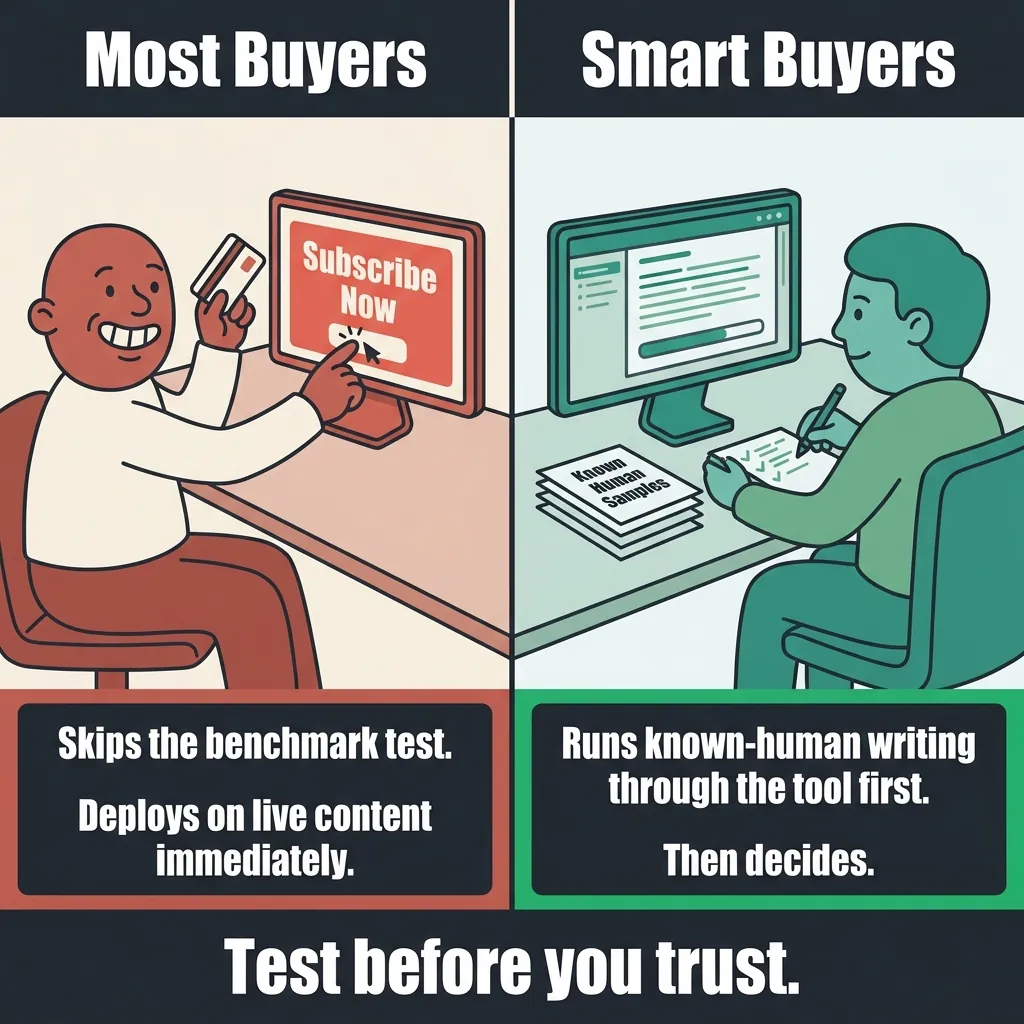
Start with a free trial on whichever tool fits your situation. Run it against known-human writing samples before deploying it anywhere the stakes are high.
Test Before You Trust: Smart vs. Impulsive AI Tool Buyers
That benchmark test matters more than anything else before committing to an AI detection tool. False positive behavior on your specific content type tells you more than any published accuracy figure. (Seriously, test it on your own writing first.) Revisit accuracy benchmarks every year – detection models and the AI writing models they’re tracking both evolve faster than most buyers expect.
No tool stays accurate forever without updates.
Buy for your current workflow. Reassess in twelve months.
Conclusion
Copyleaks – dual detection, multilingual academic environments, and enterprise API requirements
GPTZero – English-only academic settings at lower cost
Winston AI – SEO agencies and content optimization workflows
Test before you commit.
Run any Copyleaks AI content detector, AI text detector, or AI writing detector against a set of known-human writing samples before deploying in a high-stakes context. False positive behavior on your specific content type is the number that matters most.Published accuracy rates are a starting point, not a purchase guarantee. Revisit benchmarks annually as both AI writing models and detection methods continue to shift.
The right AI content detection tool is the one that fits your workflow, your risk tolerance, and your budget. Start there.