
What Is Brand Voice? How to Define and Scale Yours With AI
You read your own content back and don’t recognize it. That’s a sign something’s broken.
Most founders haven’t formally defined their brand voice.
Honestly? That’s normal. But AI is turning generic content into the default, not the exception. This guide gives you a clear framework to define and scale a voice that actually sounds like you.
Start today.
What Brand Voice Actually Is (And What It Is Not)
Brand voice is your brand’s consistent personality in writing.
Think of it as the character behind every word you publish. It shows up the same way in a blog post, an error message, a sales email. It doesn’t shift based on mood or deadline. Without a defined voice, your content changes with every writer, every tool, every draft.
The Difference Between Voice and Tone Most People Get Wrong
Voice is who you are. Tone is how you sound in a given moment.
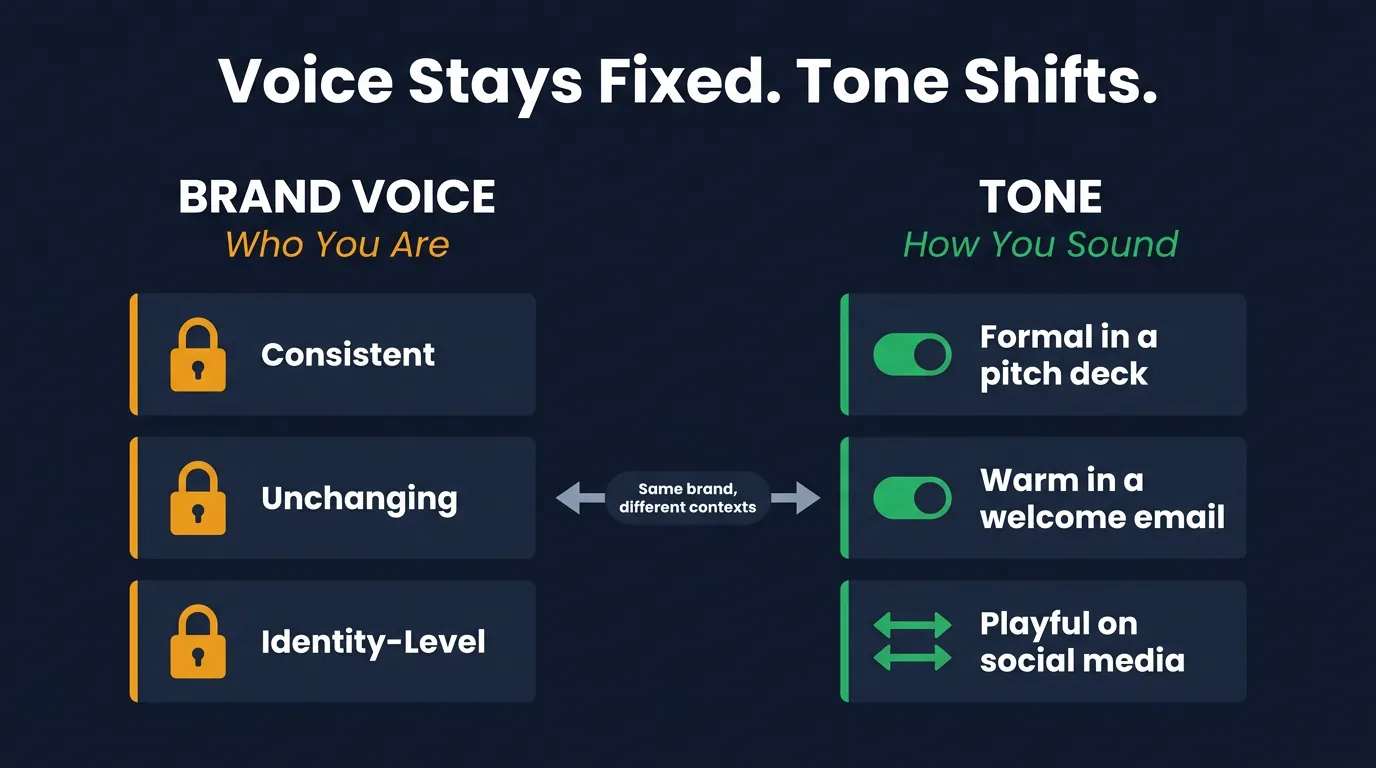
A brand can be warm and direct (voice) while being more serious in a crisis email than in a social post (tone). Mixing up the two sits at the root of most brand identity problems. You end up with content that feels inconsistent even when the logo is the same.
Why Recognizable Brands Sound Instantly Familiar Everywhere
Mailchimp sounds like Mailchimp in a welcome email, a billing notice, and a 404 page. Oatly sounds like Oatly on packaging, on social, and in press releases. Apple sounds like Apple in a product launch and a support article. That consistency isn’t accidental. It comes from defined rules, not guesswork.
Most small brands skip this step entirely. Their content feels forgettable because nothing connects the dots. Consistent brand voice creates recognition without a logo.
The 3-Part Framework That Defines Any Brand Voice
Brand voice has three core components. Get these right and everything else follows.
Component 1 – Personality Traits That Never Change
Personality is the fixed character of your brand. Pick 3-5 adjectives that describe how your brand always shows up.
Direct, curious, slightly irreverent – those traits translate into real writing decisions. “Direct” means short sentences and no hedging. “Curious” means asking questions your reader is already asking. “Irreverent” means you’re allowed to push back on conventional wisdom.
These traits don’t shift based on context.
Component 2 – Tone Range That Matches the Moment
Tone range is the spectrum your brand operates within. Think of it as two poles: how formal versus informal, how serious versus playful. A brand might be 70% casual and 30% formal depending on context. A fundraising email sits closer to formal. A product announcement can be playful.
Without a defined range, writers default to their own voice, not the brand’s. That’s how you end up with content that sounds like five different people wrote it.
Tone range sets the boundaries.
Component 3 – Vocabulary Rules That Do the Heavy Lifting
Vocabulary rules are the most underrated component. They’re also the most specific.
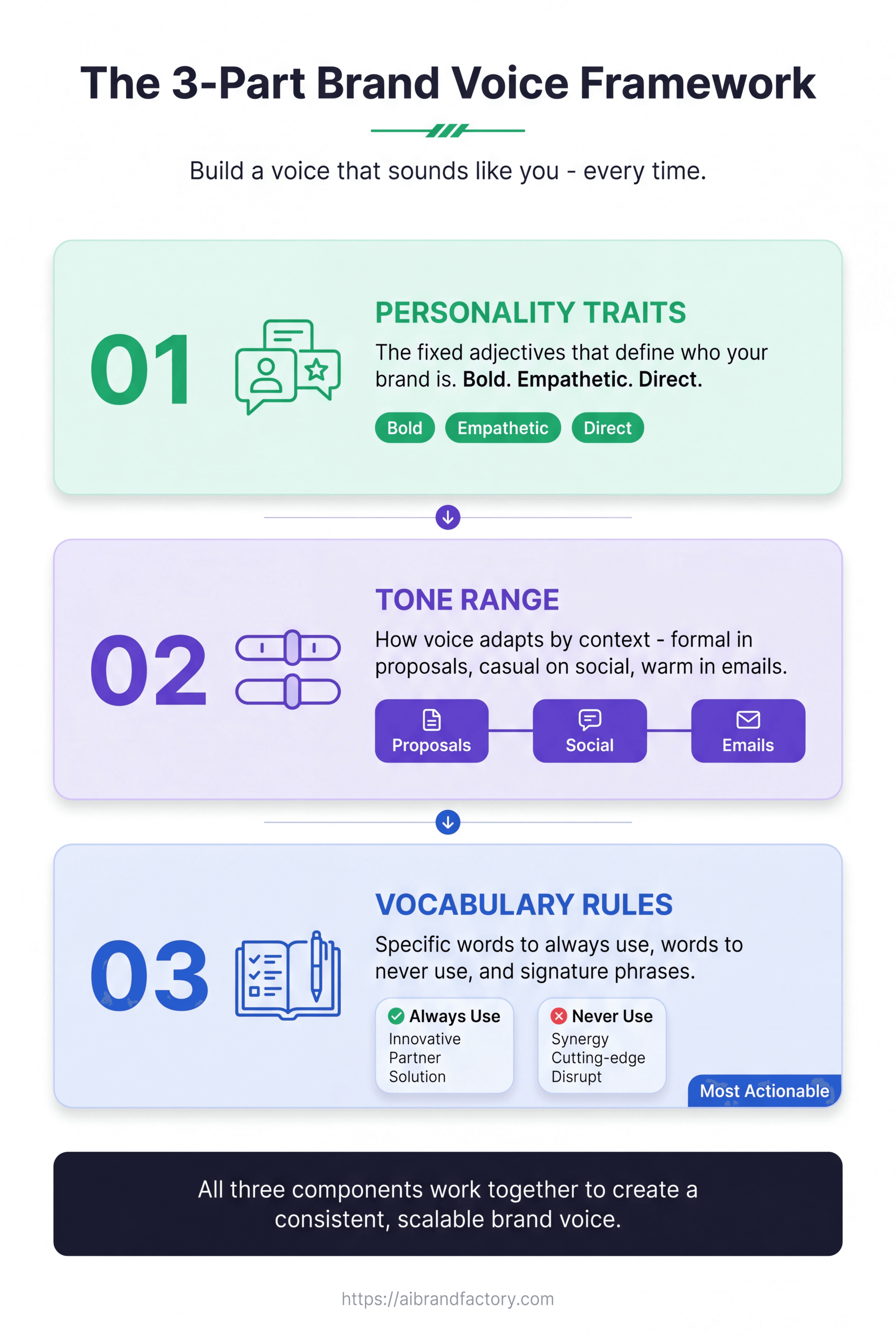
Build two lists. Words and phrases your brand uses. Words your brand never uses. (admittedly, this takes an hour but saves hundreds of hours later.) A fintech brand might ban “simple” and “easy” for compliance reasons. A coaching brand might avoid corporate jargon entirely. These rules are what make your content sound like you, not like a template.
How to Extract Your Brand Voice From What You Already Have
Your voice already exists.
The Content Audit That Reveals Your Real Voice
- Emails
- Social posts
- Proposals, any writing you’re proud of
Scan for recurring words, sentence length patterns, and tonal consistency. Which pieces got the strongest responses? What do they share? The patterns you uncover are your voice, even if you never gave them a name.
Your best content is a voice definition waiting to be written down. Not something you invent. Something you notice, document, and systematize.
Start with what you have.
Don’t wait for a perfect archive before you begin. Two or three solid pieces reveal more than you’d expect.
What to Do When You Don’t Have Much Content Yet
Your speaking voice is a starting point. How do you describe your product to a stranger at a conference? Study brands you admire and pinpoint specific traits you want to borrow or reject. A voice definition written today beats waiting around for more content to analyze.
Start now.
The 18-Field Voice Profile That Makes Brand Voice Scalable
A voice definition scribbled in a notebook won’t scale. Neither will a PDF style guide. The rules need to exist at the point of creation, not sitting in a tab nobody opens.
The gap is structural.
Why a PDF Style Guide Is Not Enough Anymore
Most brands document their voice once and treat it as finished. The style guide gets read during onboarding and forgotten by week three. New writers fall back on their own instincts. AI tools fall back on the statistical average of everything they were trained on. Neither one produces your voice.
The 18-field voice profile fixes this by making voice rules machine-readable and automatically applied.
AI BrandFactory is built around exactly this problem. It’s not a writing tool – it’s a content production system that takes your defined voice profile and applies it automatically across every blog post, ad, carousel, and case study you generate. Set it up once per brand. Every output uses it from that point forward.
What the 18 Fields Actually Cover
- Personality traits
- Tone range
- Vocabulary rules
- Forbidden terms
- Audience profile
- Competitive positioning
- Compliance requirements
Each field is specific enough to constrain AI output without killing creativity. One setup per brand, then consistent output across every format and every team member.
The goal is voice at scale. Not voice in theory.
Why AI Flattens Brand Voice (And the Fix That Actually Works)
AI defaults to the center. It optimizes for coherent, average output.
The Real Reason AI Content Sounds Like Everyone Else’s AI Content
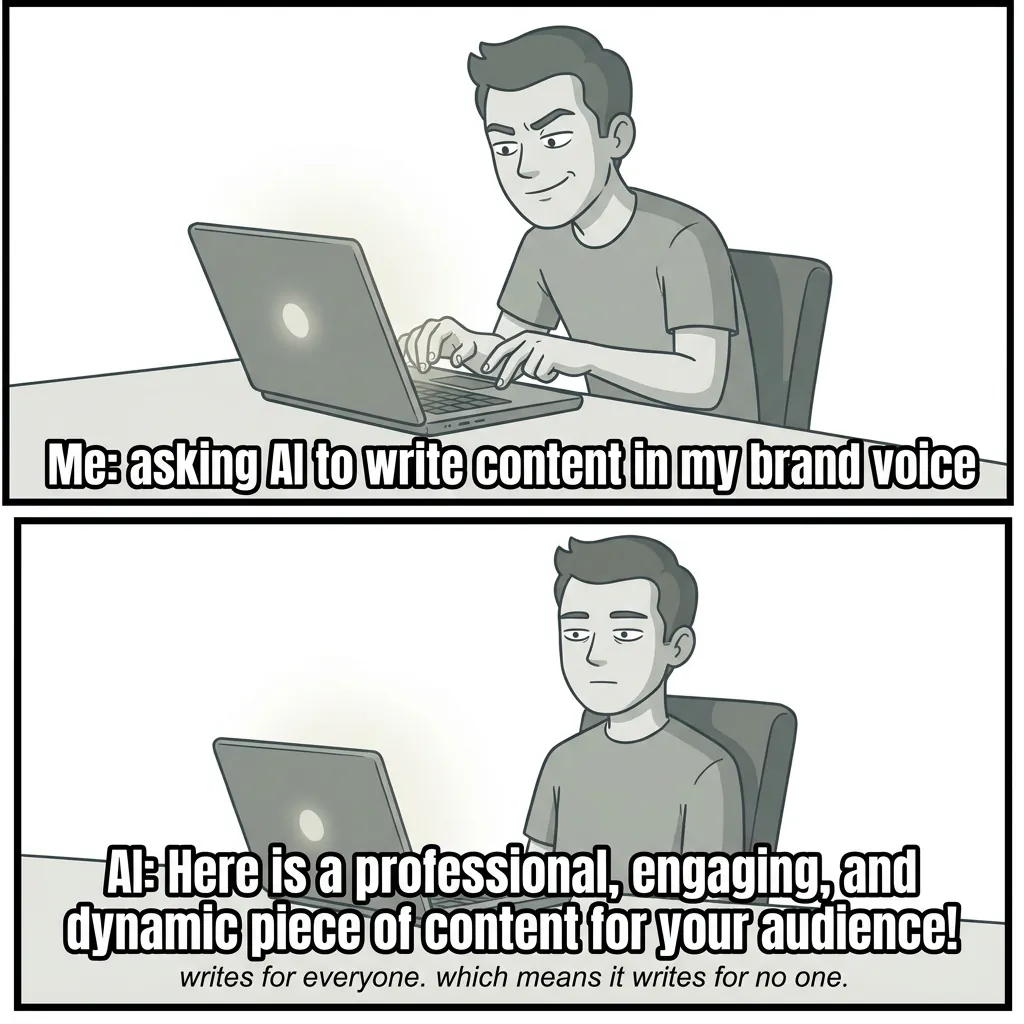
Without specific constraints, every brand gets the same polished-but-generic result. The model doesn’t know you’re direct and irreverent. It doesn’t know you never use the word “solutions.” It doesn’t know your audience rolls their eyes at corporate buzzwords.
So it writes for everyone. Which means it writes for no one. (yup, really.) Every brand ends up with the same noun swapped into the same structure.
This is a structural problem.
How Structured Voice Input Changes What AI Produces
Skepticism is fair. You’ve tried writing better prompts and still got generic output. Valid. Ad hoc prompts produce ad hoc results because the voice drifts with every generation. A thorough voice profile applied at the system level changes what the AI produces at the root.
AI BrandFactory applies your 18-field voice profile to every generation automatically. No re-prompting. No drift. The output sounds like you because the system is built around your rules, not the model’s defaults.
The goal is simple. AI output that sounds like you, not like AI trying to sound like you.
AI is a tool that helps or hurts depending on how it’s set up.
Conclusion
Brand voice isn’t invented from nothing. It already exists in your best work, waiting to be named and given structure.
Define it now.
The three-component framework (personality, tone range, vocabulary rules) converts a vague concept into something operational. The 18-field voice profile takes it from documented to scalable. Get that wrong and AI erases your voice with every generation. Get it right and AI becomes the system that scales it.