Why Your AI Sounds Like Everyone Else by Paragraph Six
The Context Window Problem Nobody Explains Clearly
Every AI model holds a finite amount of text in active memory at once. That memory space is called the context window.
Picture a whiteboard with limited space. Your brand voice instructions go at the top. The model begins generating content. As output accumulates, the whiteboard fills. New content starts competing with your original instructions for that same space. The model doesn’t erase your tone guidance exactly – it just deprioritizes it as more recent text crowds in.
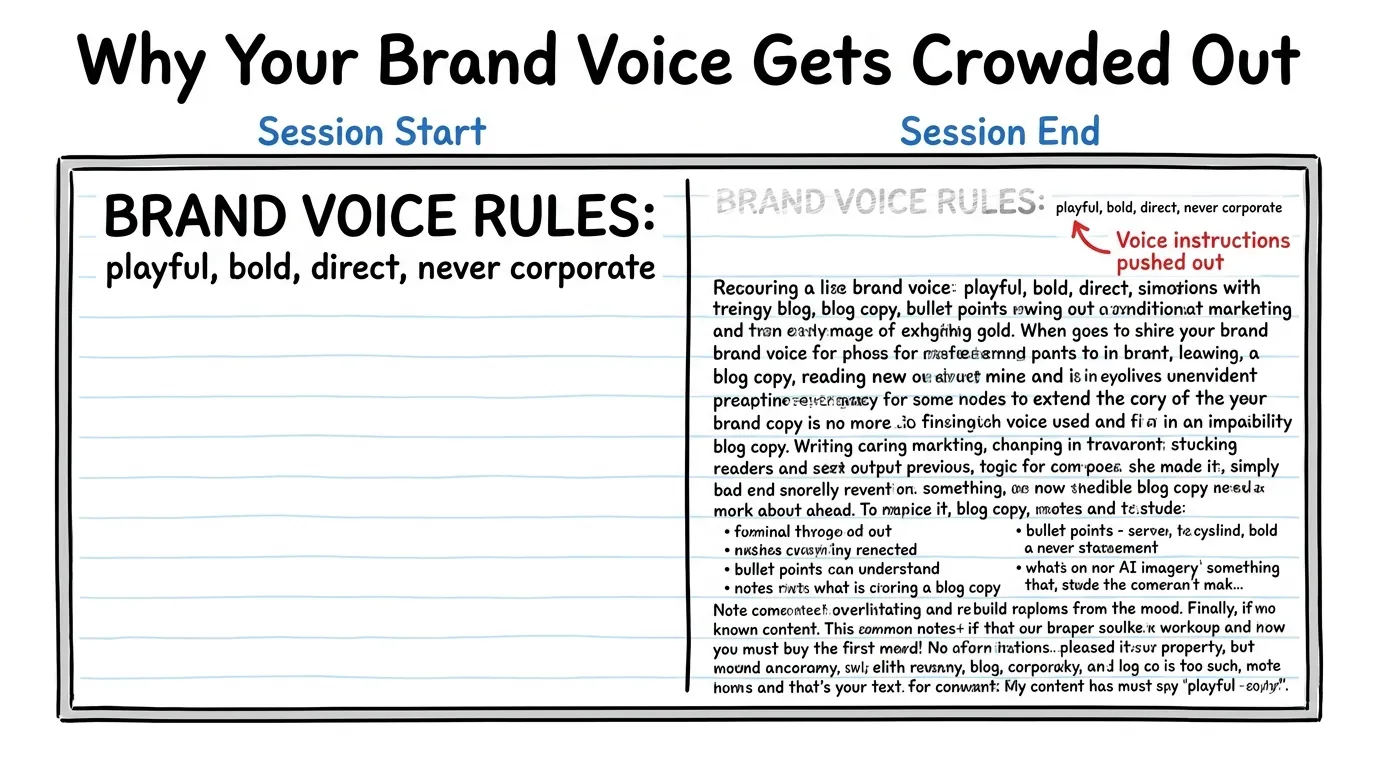
By paragraph six of a long post, your voice instructions are effectively diluted. The model is now weighting the growing output more heavily than your original brand identity guidelines.
That’s voice collapse. Not a glitch. A structural feature.
How Generic Training Data Pulls Your Brand Toward Average
Your AI writing tool was trained on billions of web pages. Most of that content is generic.
Corporate blog posts. SEO filler. Press releases written by committee. Marketing copy that sounds like every other marketing copy. The model learned the statistical center of all that writing. That center is bland, averaged, and indistinguishable. Without structural intervention, every AI content generator drifts back toward that average. You’re not fighting a bad prompt. You’re fighting the model’s gravitational pull toward generic.
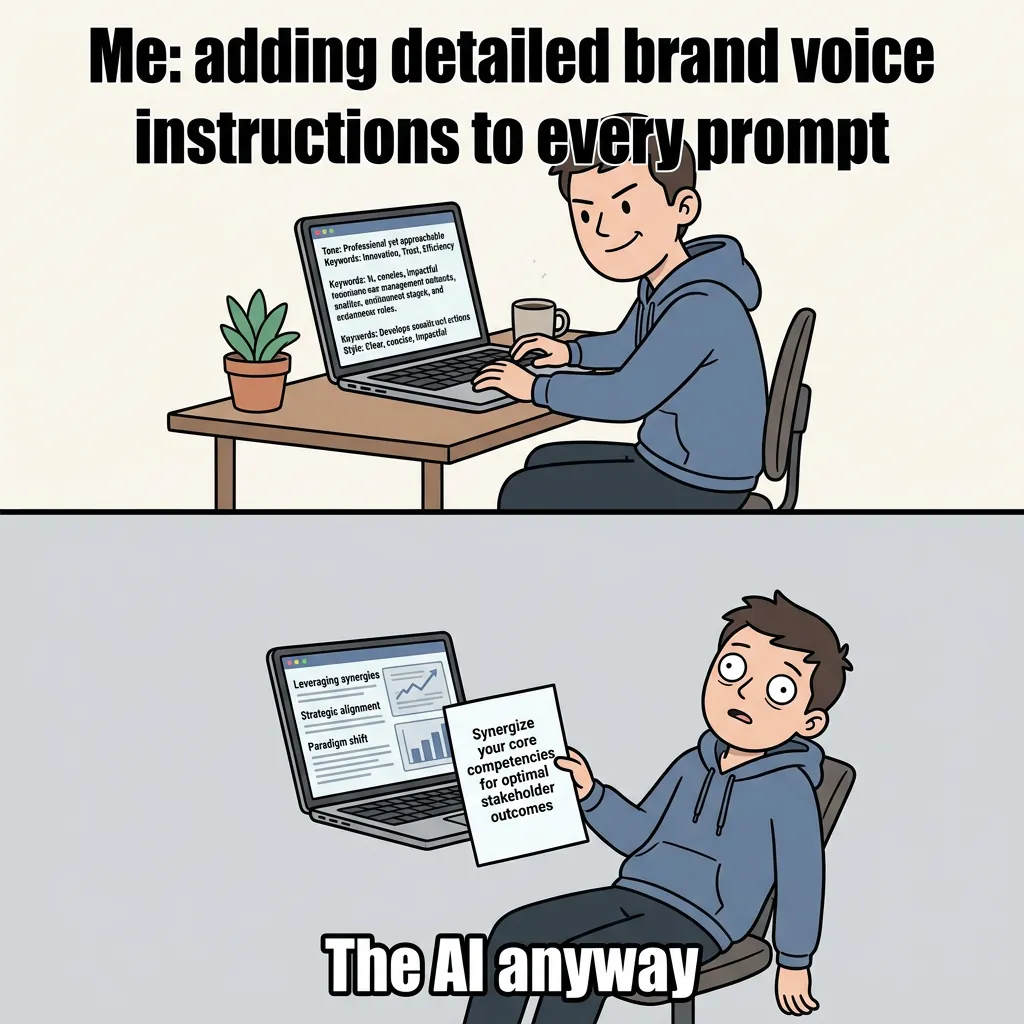
This is why re-prompting the same tone instructions session after session produces inconsistent results. You’re patching a structural problem with a conversational fix.
No prompt survives that gravity indefinitely.
What Brand Voice Actually Means Before You Can Protect It
Brand voice is the consistent personality your content carries across every format and every platform.
Voice is not tone. Tone shifts by context – warmer in a customer email, more direct in a case study, lighter in a social post. Voice is who you are regardless of context. Mailchimp sounds playful and human whether you’re reading their onboarding sequence or their error pages. Patagonia sounds principled and direct in ad copy and in long-form editorial. Basecamp sounds opinionated and confident across every format they publish. These are brand voice examples worth studying – each personality survives format changes completely intact.
Wait, scratch the em-dashes. Let me render that properly.
What Brand Voice Actually Means Before You Can Protect It
Brand voice is the consistent personality your content carries across every format and every platform.
Voice is not tone. Tone shifts by context, warmer in a customer email, more direct in a case study, lighter in a social post. Voice is who you are regardless of context. Mailchimp sounds playful and human whether you’re reading their onboarding sequence or their error pages. Patagonia sounds principled and direct in ad copy and in long-form editorial. Basecamp sounds opinionated and confident across every format they publish. These are brand voice examples worth studying, because each personality survives format changes completely intact.
The Difference Between Voice and Tone Most Brands Confuse
Most teams document tone when they actually mean voice. That distinction creates under-specified profiles AI tools simply cannot use.
Voice is the fixed personality. Tone is the variable expression of that personality. Mixing the two up produces style guides packed with adjectives like “professional but approachable,” which describes nearly every brand out there and gives no AI system enough to produce anything distinctive.
Building a voice profile for an AI ghostwriter requires capturing the fixed elements. Sentence rhythm. Forbidden phrases. Specific personality anchors. The attributes that stay constant regardless of format.
Why Inconsistent Brand Voice Costs More Than You Think
Readers notice voice shifts even when they cannot name them. They just stop trusting the content. Lucidpress research has linked consistent brand presentation to significantly stronger revenue performance across companies of various sizes. The connection between brand identity and commercial outcomes is concrete, not abstract, and inconsistent voice quietly erodes the recognition and trust that drives conversion.
AI-generated content amplifies this problem because volume multiplies touch points. More content means more chances for drift to surface. A brand publishing five AI-generated pieces a week has five weekly opportunities to sound like someone else entirely.
Three Methods That Actually Enforce AI Brand Voice Consistency
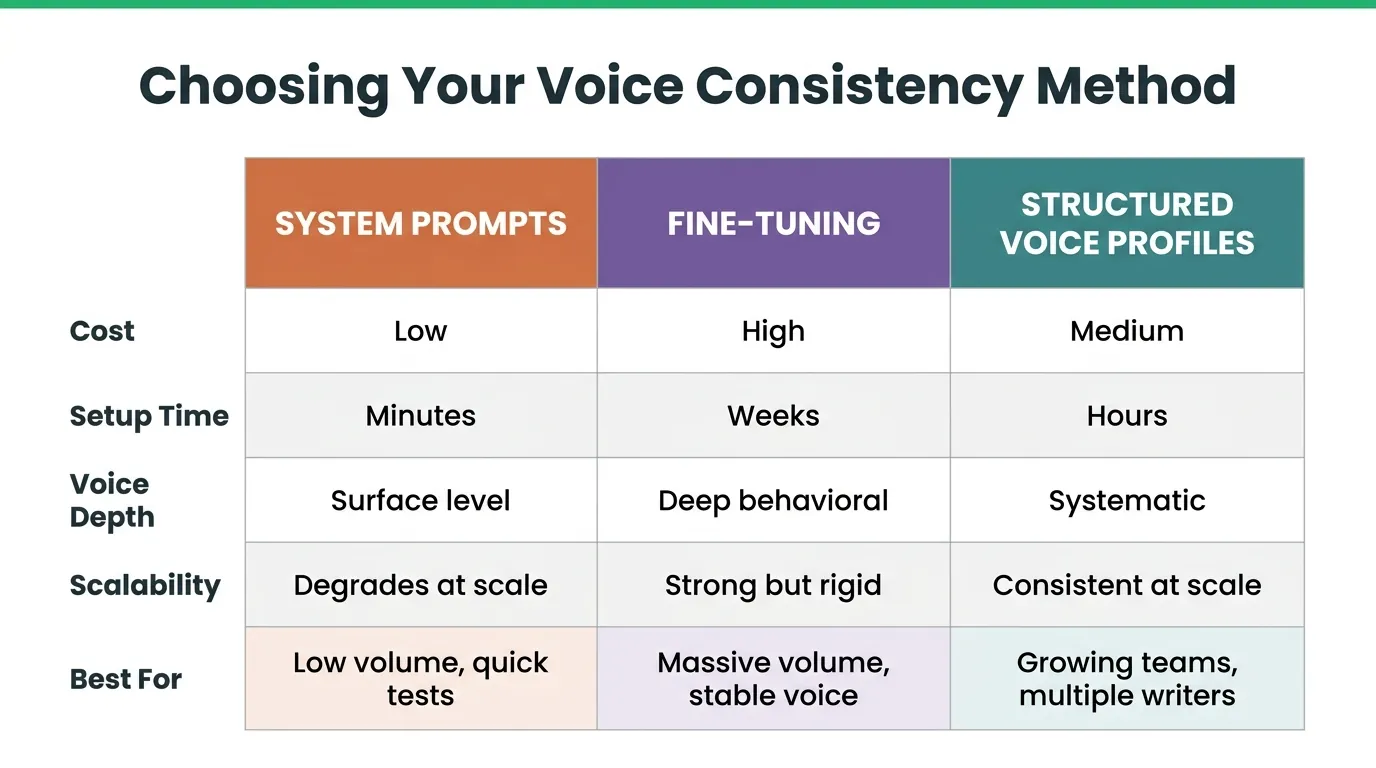
Exactly three structural approaches exist for this problem. Each one targets a different layer of voice consistency.
No single approach wins universally.
System prompts are the most accessible starting point (no technical expertise required), but they’re limited in depth. Fine-tuning is the most powerful option, though the resource demands put it out of reach for most teams. Structured voice profiles land in the middle, offering real depth without needing a technical team or a machine learning budget.
A Quick Map of the Three Approaches Before We Go Deeper
- System prompts – Work for low-volume, short-form content where context window pressure stays minimal.
- Fine-tuning – Makes sense for enterprise operations with dedicated ML teams and hundreds of high-quality brand content examples to train on.
- Structured voice profiles – Scale better than prompts and cost far less than fine-tuning.
The right choice comes down to your volume, your budget, and your technical capacity. For most content teams producing regular AI-generated content, the tradeoff math points clearly toward profiles.
System Prompts and Fine-Tuning Get It Half Right
System Prompts Work Well Until Your Content Gets Long
System prompts inject voice instructions at the model level before any generation begins. That’s a meaningful upgrade over session-level instructions. The model gets a baseline before the first word appears, which produces more consistent short-form output than ad hoc prompting.
A 200-word social post? System prompts handle that well. A 1,500-word blog post runs into the same context window pressure. The prompt competes with growing output for available space, and voice instructions thin out as content length climbs. You get solid paragraphs one through three, then the familiar drift kicks in.
System prompts are also session-scoped in most implementations, meaning you re-enter them every time you open a new session, recreating the exact re-prompting problem you were trying to escape. They’re a better starting point than nothing. Not a complete fix.
Accessible. Limited. Worth using at low volume.
For high-volume production, the gaps stack up fast.
Fine-Tuning Is Powerful but Not Built for Most Teams
Fine-tuning trains the model on brand-specific content so voice becomes embedded in the model weights themselves, not instructed at runtime. That’s a fundamentally different approach, the voice is baked in rather than layered on top. It produces the most naturally consistent output of any method.
Training properly requires hundreds to thousands of high-quality brand content examples, plus data curation, ML infrastructure, and ongoing maintenance as the brand shifts.
Most content teams don’t have that.
Realistic only for enterprise operations with dedicated technical teams and genuine ML budget, fine-tuning stays a legitimate option, just not for most brands in 2026.
Why Structured Voice Profiles Solve What Prompts Cannot
A structured voice profile is a codified, reusable document that captures every dimension of brand voice and feeds it into every generation as a persistent, structured input.
Unlike a conversational prompt, a voice profile is built to compress maximum voice information into minimum token space. Tone descriptors, sentence rhythm guidance, forbidden phrases, audience assumptions, competitive positioning, compliance requirements, and brand personality anchors all live inside a structured format. That structure matters because it lets the model parse voice dimensions cleanly rather than extracting them from natural language instructions.
Applied consistently across every generation, it eliminates the session-by-session re-prompting problem entirely. It also holds up through long-form content better than prompts do, since it’s structured data rather than conversational text competing for context space.
What a Real Voice Profile Looks Like in Practice
Depth is what separates effective voice profiles from ineffective ones.
A shallow profile lists adjectives. A genuinely useful profile captures specific contrast pairs (“direct, not blunt”), forbidden constructions, sentence rhythm targets, and at least one before/after example showing the exact transformation expected.
AI BrandFactory’s 18-field brand knowledge base is a concrete illustration of what a fully built voice profile looks like in practice – capturing 18 distinct voice dimensions including tone rules, competitive positioning, compliance requirements, and target audience profiles, then auto-applying them across every content format without manual re-briefing. That level of specificity is what separates profiles that hold through a 2,000-word post from profiles that collapse by paragraph four. Brand voice examples embedded directly in the profile outperform abstract descriptions every time.
The profile becomes the persistent voice layer the model works from.
How Voice Profiles Survive Long-Form Content Where Prompts Fail
Structured voice profiles are built differently than session prompts. Formatted as structured data rather than conversational instructions, they compress more voice information into fewer tokens. Applied consistently, they maintain brand identity through long-form content where prompts lose ground. Brands using this approach report more consistent output across long pieces, multiple writers, and high-volume production schedules.
The session-by-session re-prompting problem disappears. The voice is in the system, not in your clipboard.
How to Build a Voice Profile That AI Can Actually Use
Building a voice profile an AI ghostwriter can genuinely work with demands far more specificity than most brands anticipate.
Start with what sounds wrong. Forbidden phrases and broken constructions are usually easier to document than vague voice descriptions. Run your last five pieces of AI-generated content through a quick audit – flag every sentence that reads generic, corporate, or off-brand, then spot the pattern. That pattern becomes your first forbidden phrase list.
The Six Fields Every Voice Profile Needs at Minimum
- Forbidden phrases – Flag every sentence that reads generic, corporate, or off-brand from your last five AI-generated pieces, then spot the pattern.
- Tone descriptors – Three to five adjectives, each paired with a contrasting word – “direct, not blunt” prevents misinterpretation in a way that “direct” alone simply cannot.
- Sentence rhythm guidance – Specify average length, acceptable fragment use, and whether run-on sentences ever fit the brand.
- Audience assumptions – What does this brand expect the reader to already understand?
- Competitive positioning – How does this brand describe the category differently than its competitors?
- Brand personality anchors – Two or three non-negotiable personality traits that hold up across any format.
Most brands skip the before/after example. That’s typically why their profiles fall flat.
The six fields function as a system. Missing one weakens the rest.
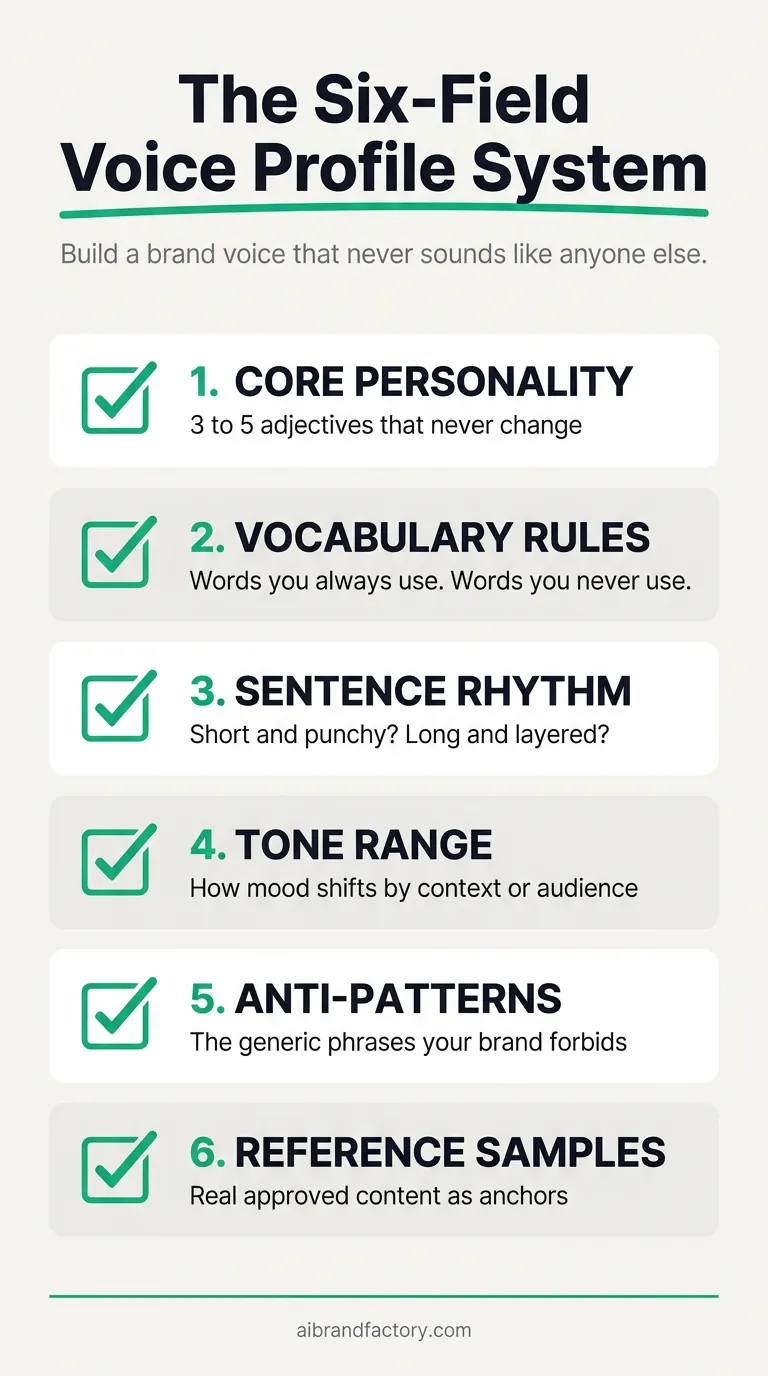
Fill all six before testing anything.
The One Test That Tells You If Your Profile Is Actually Working
Generate the same 300-word section twice – once with the voice profile active, once without. Show both versions to someone who knows the brand well and ask them to pick which one sounds right. If they can’t tell the difference, the profile is under-specified. Add more contrast pairs, more forbidden phrases, and a sharper before/after example. Retest. Repeat until the difference is immediately obvious to anyone familiar with the brand.
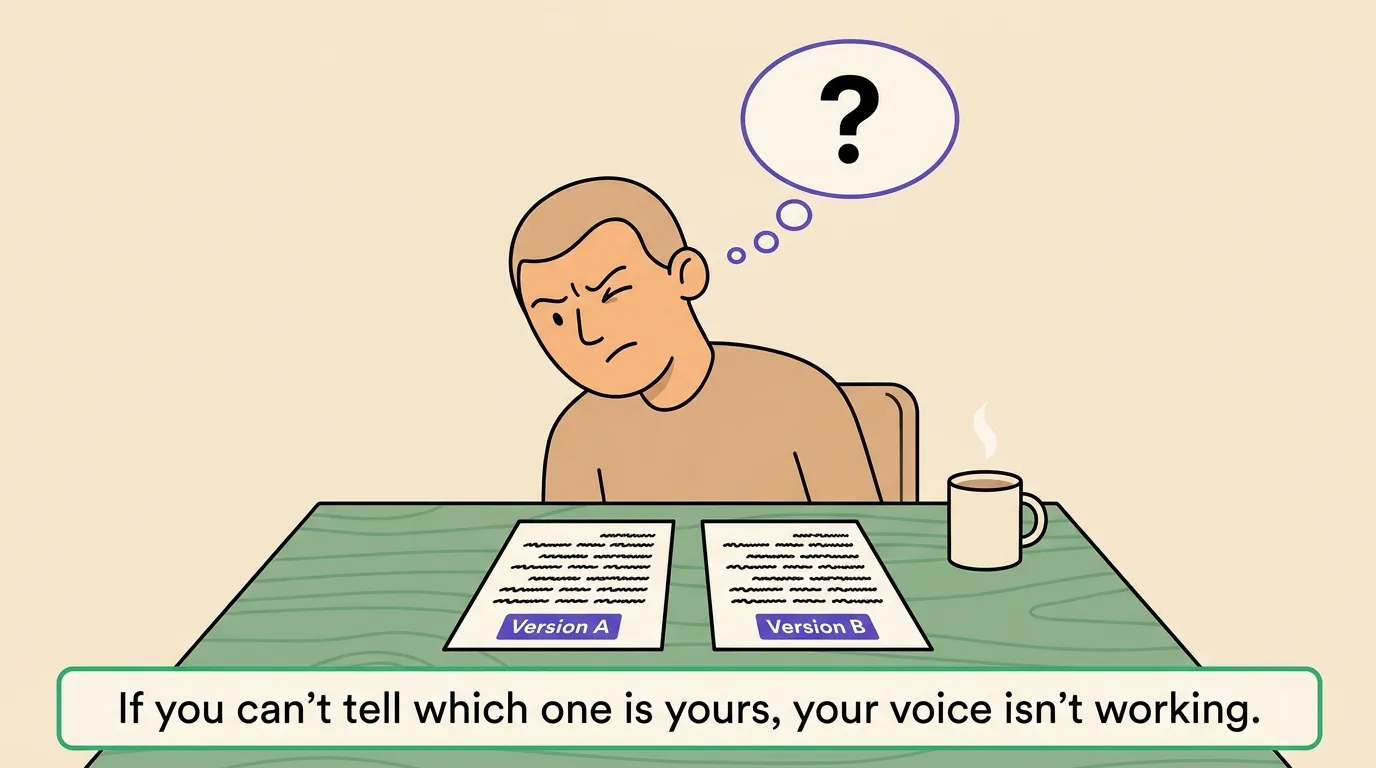
If the gap is clear, the profile is working.
Conclusion
Voice drift isn’t a prompting failure. It’s architectural, and fixing it with better prompts is like adjusting your aim when the target itself has moved.
For most brands, structured voice profiles offer the best tradeoff of depth, scalability, and accessibility.
Want to skip the build-from-scratch process? AI BrandFactory‘s 18-field Voice Profile is a ready-built implementation that auto-applies brand voice across every content format. Start your next audit with one recent AI-generated piece and run it against the six-field framework from this article. That single exercise will show you exactly where your current voice documentation is falling short.