Introduction
You run your content through an AI detector. Red screen. Every sentence flagged, your entire workflow suddenly in question. Detection happens because AI models produce specific, identifiable patterns – not because AI itself is the problem. Knowing how to humanize AI text means knowing how to strip those patterns out, systematically and consistently.
This guide covers exactly that.
Start with the diagnostic: nine tells that get content flagged every time. Then the manual fix process, step by step. Then the automated path for anyone running more than a few pieces per month.
Not theory. Working method.
What AI Detectors Are Actually Measuring When They Flag Your Content
The Perplexity Score That Exposes Predictable AI Phrasing
Detectors don’t read your content the way a human does. They measure statistical predictability, and AI text is extremely predictable.
GPTZero uses a metric called perplexity to catch this. Low perplexity means the next word was obvious, which means AI probably wrote it. Human writers make unexpected word choices constantly, jumping registers, reaching for the weird synonym, breaking the expected pattern. AI models default to the most probable next token, every single time, across every sentence. That consistency is exactly what perplexity scoring catches. A human writing about “quarterly revenue” might suddenly say “the money math didn’t work” – an AI almost never would. GPTZero flags the predictability gap between those two approaches.
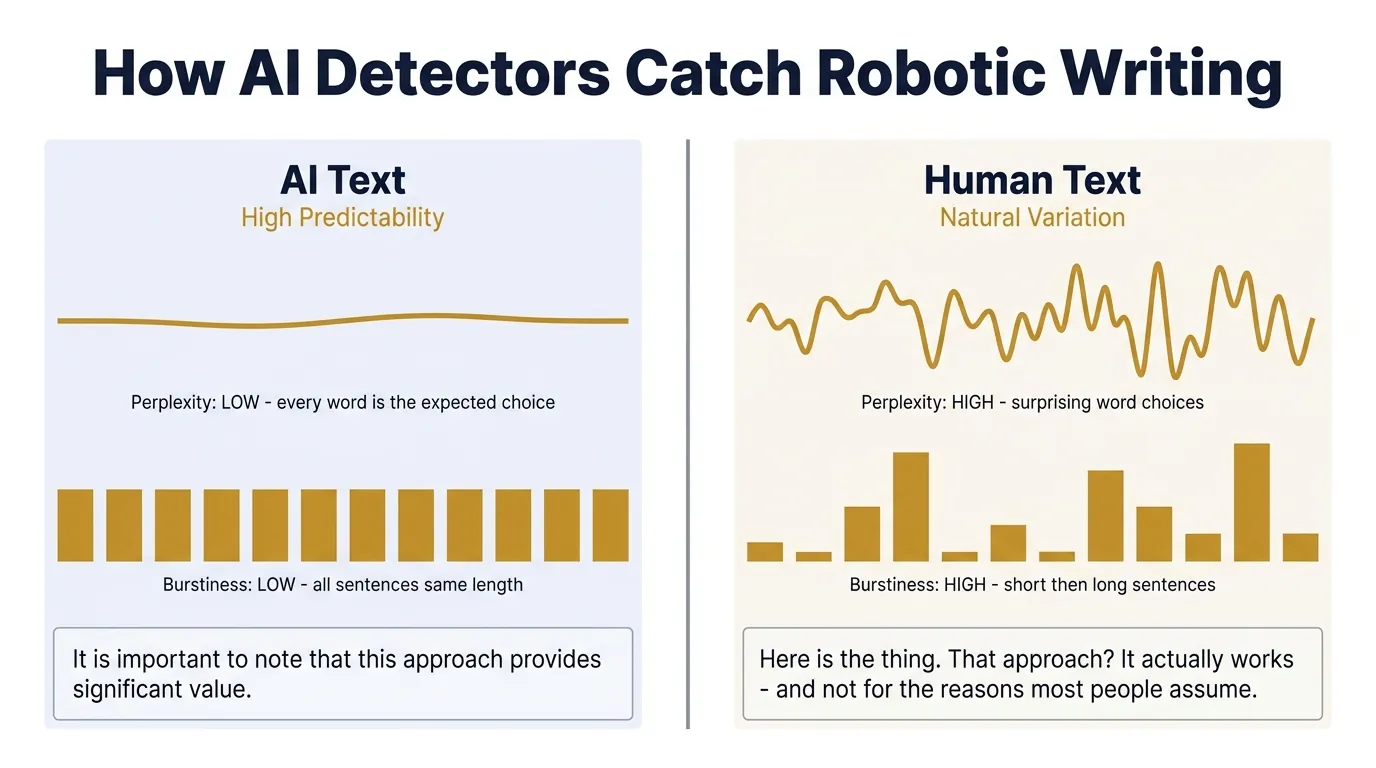
Perplexity is the primary signal. Burstiness is the second one.
How Burstiness Gives Away Flat AI Sentence Rhythm
Burstiness measures sentence length variation across a piece of text. AI output clusters sentences around a mean length, producing a rhythmically flat reading experience. Winston AI and Copyleaks both analyze sentence-level patterns to catch this signal. Human writing naturally mixes three-word punches with longer, more complex constructions – the rhythm is genuinely uneven. AI writing feels smooth in a way that is statistically improbable for actual humans.
The 9 AI Tells That Get Your Content Flagged Every Single Time
Em Dashes, Hedge Clusters and the Punctuation Patterns AI Loves Too Much
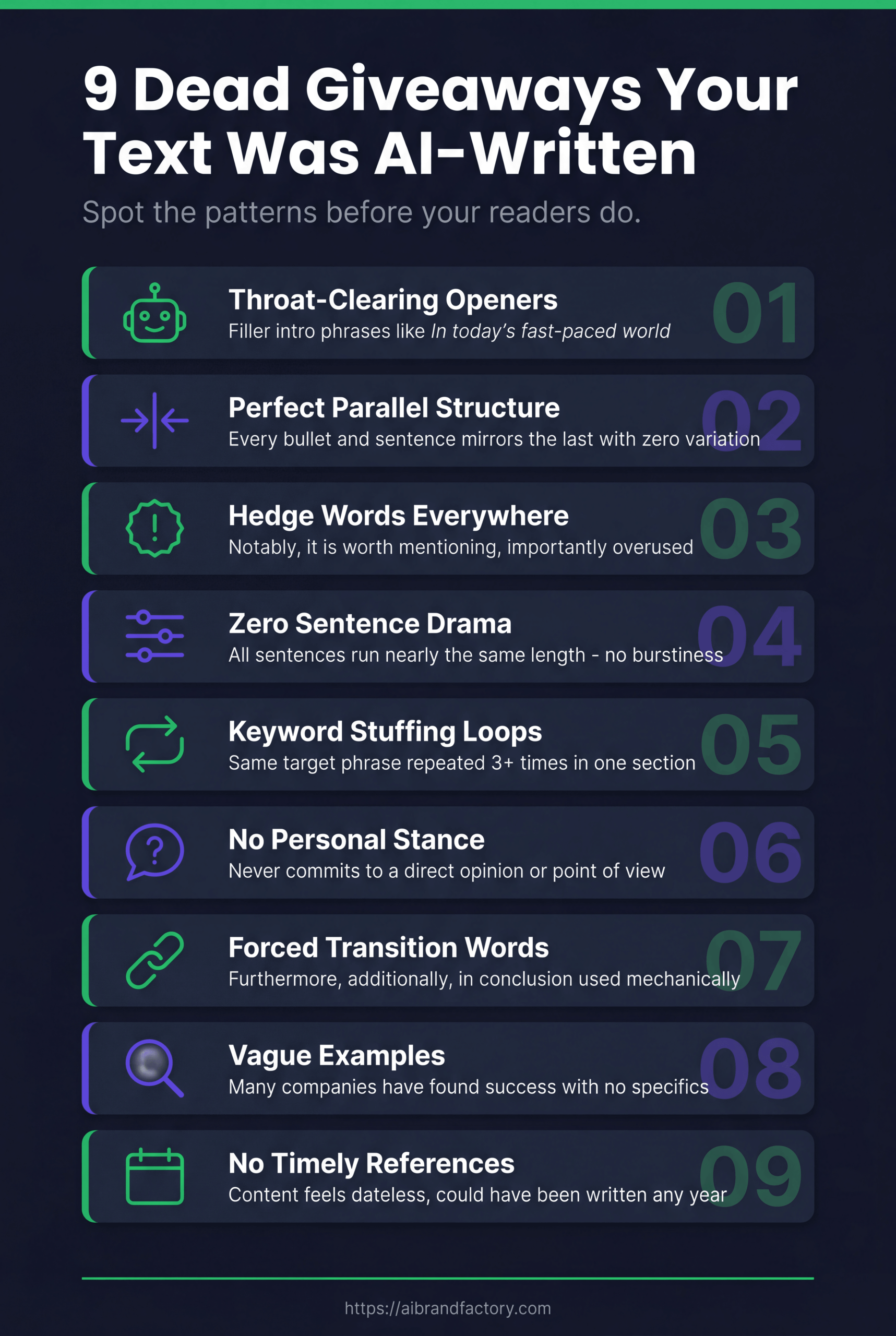
Nine specific patterns drive most detection flags. Know these and you’ll see exactly what to strip out when you humanize AI text. GPT-4 and Claude both default to em dashes at rates no human writer replicates naturally. Scan any raw AI output and you’ll spot them every third or fourth sentence, always deployed for dramatic emphasis, always sitting in the same structural position. That repetition is the signal, not the dash itself.
Hedge clusters come second. Phrases like “it is worth noting,” “it is important to consider,” and “one might argue” pile up in dense sequences throughout AI text. Human writers hedge selectively. AI models hedge constantly, often stacking two or three of these phrases inside the same paragraph. Generic transitions round out the third tell: “furthermore,” “moreover,” and “in addition” show up at rates no human writer would produce across a 1,500-word piece. These three patterns alone account for a large share of detection flags. Fix them and your score drops significantly.
Fix these three first. Fastest wins, full stop.
Symmetrical Lists, Parallel Structure and the Grammatical Tells Nobody Talks About
Parallel structure overuse is among the less-discussed AI writing patterns, but detectors catch it reliably. AI-generated lists contain items of near-identical length and grammatical form, which is statistically improbable in human writing. A human drafting a list of five tips writes them at different lengths, with varying grammatical structures, because they’re thinking out loud rather than producing symmetrical output. AI models generate lists where every item opens with a verb, runs to roughly the same word count, and closes with the same cadence. Filler affirmations are the fifth tell: words like “absolutely,” “certainly,” and “of course” pad AI text as conversational filler. Human writers simply don’t reach for these at the same frequency.
Spot the symmetry. Break it on purpose.
Uniform Sentence Length, Missing Specificity and Passive Conclusions
Uniform sentence length is the sixth tell, and it connects directly to burstiness scoring. AI text gravitates toward vague, generalized claims rather than named individuals or concrete data, and that’s tell number seven. (Admittedly, this one is easy to miss on a quick read, but detectors catch the statistical absence of specificity.) Passive conclusions close out the list: phrases like “it is clear that” or “as we have seen” are hallmark AI section endings that human writers almost never use in the same pattern. These three tells are subtler than em dashes or hedge clusters. They’re also what separates content that almost passes from content that consistently passes.
Nine tells. All removable.
The Manual Humanization Workflow That Actually Removes These Tells
The Cross-Model Rewriting Pass That Strips the Most Obvious Patterns
Manual humanization works. What it requires is a specific process, not some vague instruction to “make it sound more human.”
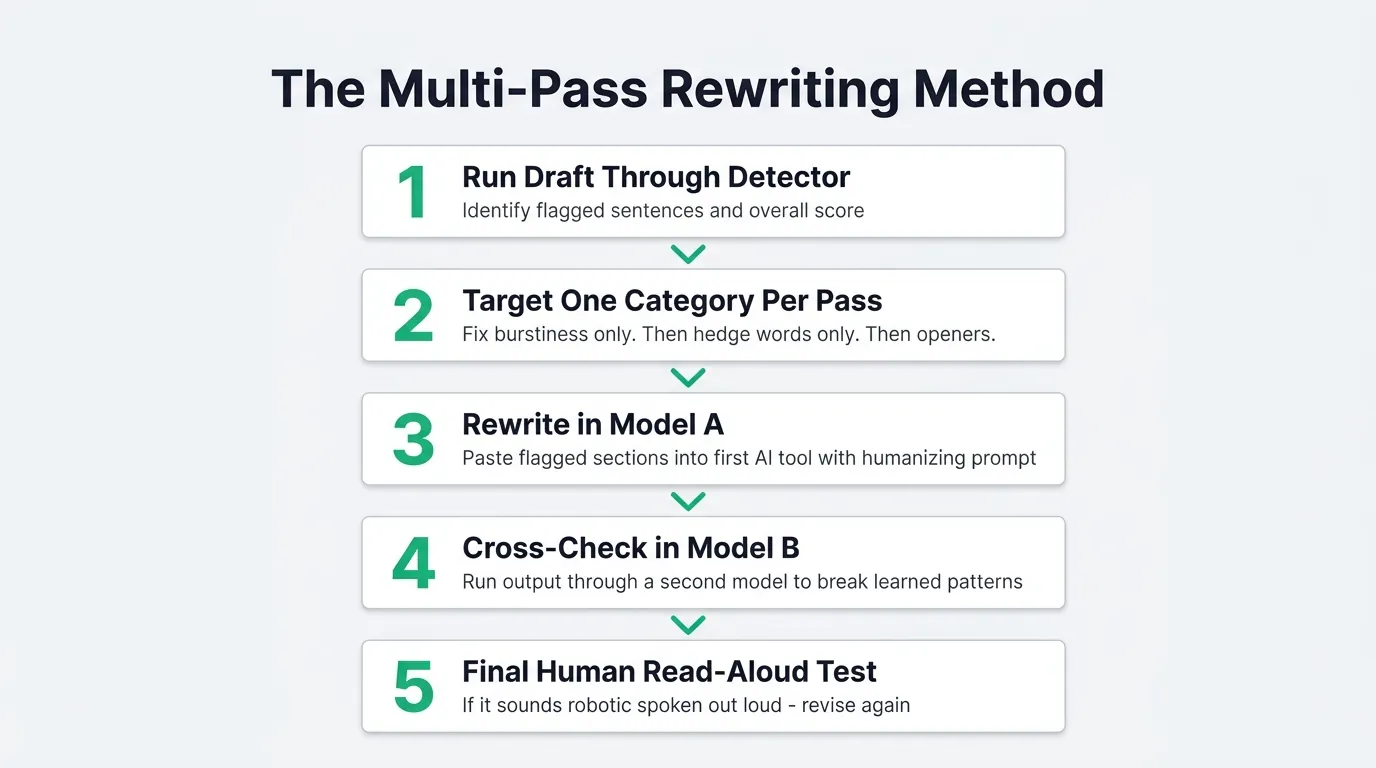
Run your raw output through a second AI model using targeted prompts, one tell category per pass. Prompt one: “Replace all em dashes with commas or periods.” Prompt two: “Vary sentence lengths, add three-word sentences and sentences over fifteen words.” Prompt three: “Remove all hedge phrases including ‘it is worth noting,’ ‘it is important to consider,’ and ‘one might argue.'” Cross-model rewriting consistently produces output that scores lower on detection tools than single-pass generation, because you’re targeting statistical patterns directly rather than hoping a general “humanize this” prompt catches everything. One pass per tell category is slower than one big prompt, but far more reliable.
Target one category per pass. Don’t try to fix everything at once.
How to Verify Your Output Without Trusting Any Single Detector
GPTZero, Winston AI, Copyleaks, and Originality.ai each measure different signals. Use all four, not just one. Originality.ai has documented community reports of false positives on human-written content, with multiple content creators flagging this publicly, so treat Originality.ai as one data point rather than a final verdict. (This doesn’t mean ignore it, it means don’t panic if it flags content that three other tools pass.) When three of four tools pass your content, the remaining flag is more likely a false positive than a genuine detection.
Run all four detectors. Cross-reference the results.
Verification is not optional.
Why Manual Humanization Breaks Down at Scale (And What to Do Instead)
The Hidden Time Cost That Makes Manual Editing Unsustainable
Done properly, humanizing a single 1,500-word post takes 45 to 90 minutes.
At 20 posts per month, that’s 15 to 30 hours of editing time that produces zero new content. The manual workflow also demands consistent skill and sustained attention – one rushed pass misses tells and breeds false confidence, which is actually worse than knowing you skipped the check entirely. Most content teams hit this wall around month two: the process works but doesn’t scale, and the time cost quietly devours the efficiency gain that made AI content appealing in the first place.
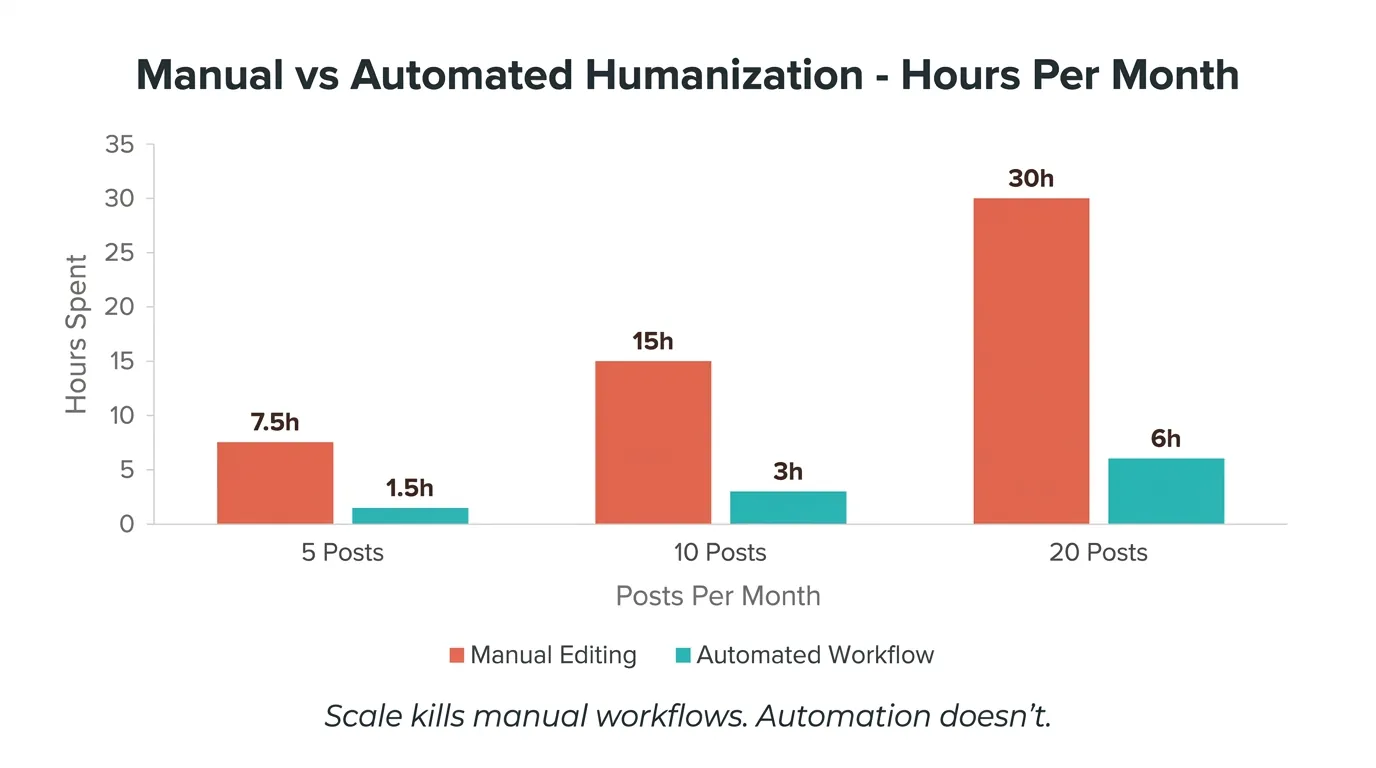
That’s the real problem with manual humanization at volume. Works per piece. Collapses as a system.
What a Purpose-Built Humanization System Does Differently
For writers managing multiple clients or steady monthly volume, AI BrandFactory runs a 7-layer humanization process built specifically for this problem. The before/after output comparisons show removal of em dashes, hedge clusters, symmetrical lists, and passive conclusions in sequence – not in one undifferentiated pass. That’s what separates it from a generic rewrite prompt.
Each layer targets a specific tell type, which is exactly what the manual cross-model workflow does – just automated and consistent across every piece. This isn’t a one-off fix for a single flagged post. It’s designed for content teams and freelancers running 20-plus pieces monthly who need the same result every time without the 45-minute manual pass.
The Honest Truth About AI Detection Tools and Their Limitations
Why No Tool Can Guarantee Undetectable AI Content Every Time
No humanization method is 100% foolproof. Detection tools produce probability scores, not verdicts.
Accept that upfront.
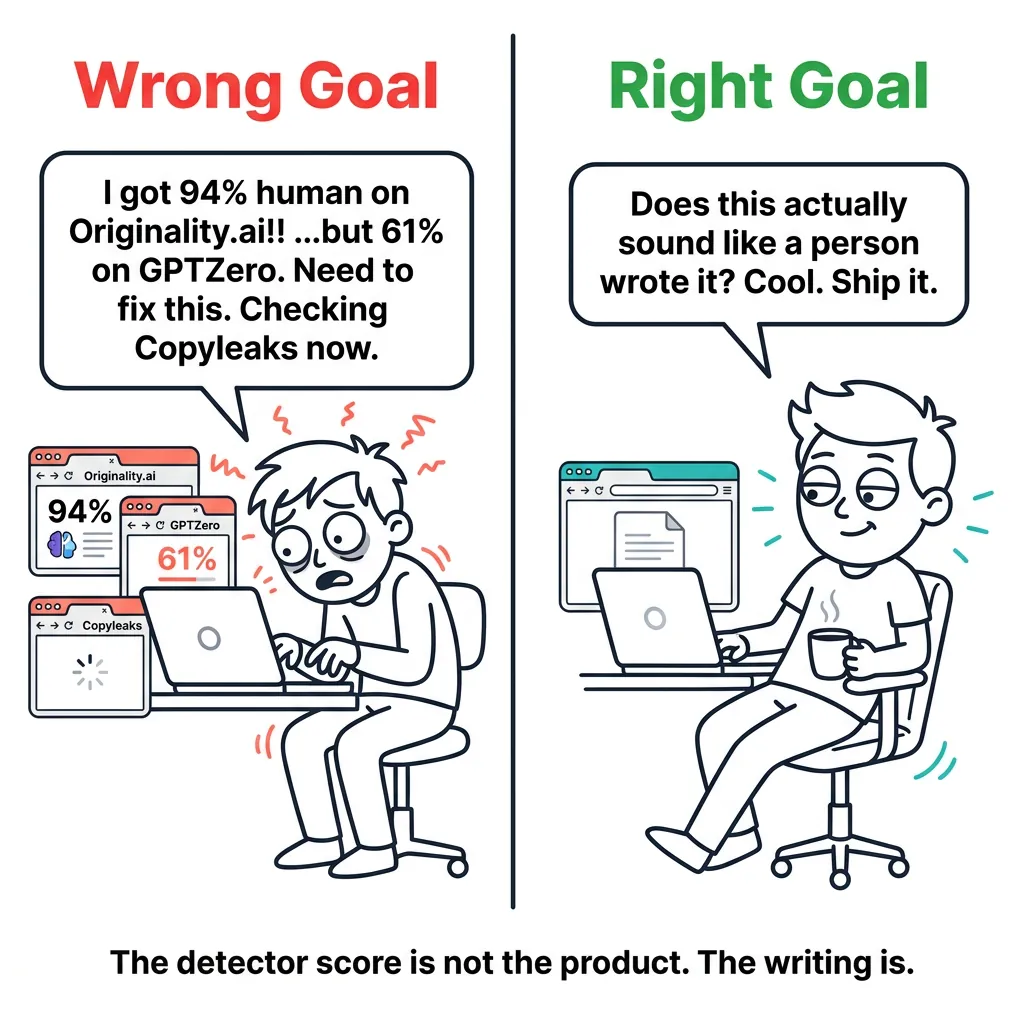
Originality.ai’s reported false positive rate means even clean human-written content can get flagged – which tells you something important about the reliability of any single tool as an absolute judge. Winston AI offers sentence-level highlighting, which makes it more useful for diagnosis than for pass/fail verdicts. GPTZero and Copyleaks each measure slightly different signal combinations, which is why cross-referencing matters. The honest goal isn’t gaming a specific detector’s scoring algorithm. The goal is writing that genuinely reads as human – detection scores are a proxy for that, not the target itself.
Chasing a clean score on one tool is the wrong game. Writing that reads as human is the right one.
The Honest Truth About AI Detection Tools and Their Limitations
Why No Tool Can Guarantee Undetectable AI Content Every Time
No humanization method is 100% foolproof. Detection tools produce probability scores, not verdicts.
Accept that now.
Originality.ai’s reported false positive rate means genuinely human-written content can still get flagged, which reveals something significant about treating any single tool as a definitive judge. Winston AI’s sentence-level highlighting makes it far more valuable for diagnosis than for simple pass/fail calls. GPTZero and Copyleaks each measure slightly different signal combinations, which is exactly why cross-referencing across tools matters. The real goal isn’t outsmarting a specific detector’s scoring algorithm. Writing that actually reads as human is what counts – detection scores approximate that quality, they don’t define it.
Chasing a clean score on one tool is the wrong game. Writing that reads as human is the right one.
Your Action Path Forward Starting Today
Start with an audit. Pull one recent AI-generated piece and scan it against the nine tells listed above. Count the em dashes, find the hedge clusters, check whether your lists are symmetrical. Most writers catch three to five tells on the first pass (yup, really, even content you’ve already lightly edited). That count shows you exactly which manual passes to run first.
Run the cross-model workflow.
Target em dashes and hedge phrases in pass one, sentence length variation in pass two, symmetrical lists and filler affirmations in pass three. Then verify across GPTZero, Winston AI, Copyleaks, and Originality.ai before treating any piece as clean. Three-of-four passing is a reasonable threshold for moving forward.
For anyone running consistent volume, AI BrandFactory’s 7-layer humanization system automates this process at scale. The before/after proof is right there, so check the output comparisons directly rather than taking the claim on faith.
Consistent humanization protects your credibility. Inconsistent humanization is just delayed risk.
Do the audit today. One piece. Nine tells.
Conclusion
Detection is pattern recognition. Humanizing AI text is pattern removal, applied consistently across every piece you publish. Nine specific tells account for most flags – and all nine are removable with the right process.
The process is repeatable.
Detection tools will keep improving, which means the bar for what reads as genuinely human will keep rising. The 9 tells checklist isn’t a one-time fix – it’s a recurring audit. Whether you run the manual cross-model workflow or use an automated system, consistent AI humanization is the only thing that protects your credibility at scale.