How to Write a Newsletter People Actually Read (Using AI to Do It Faster)
The One Newsletter That Gets Opened – Overhead Envelope Composition
Why Most Newsletters Die in the Draft Folder
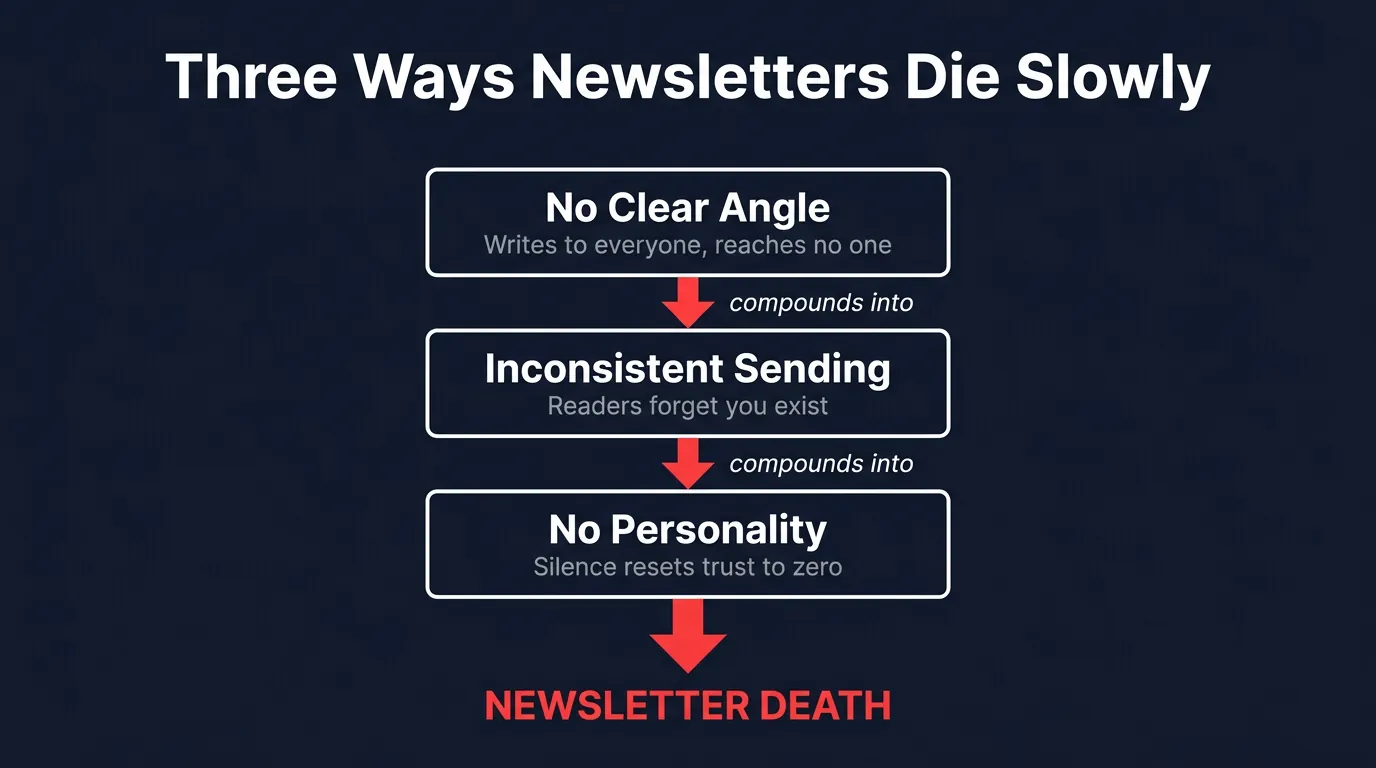
Most newsletters don’t fail because the writer ran out of time. They fail because three specific problems go undiagnosed. Understanding them is the first step toward a newsletter strategy that actually holds.
Three failure modes. That’s it.
Failure Mode 1: No Consistent Voice
You send an email in January that’s warm and conversational. Your February issue reads like a press release. Readers don’t consciously notice the shift – they just feel like they’re hearing from a stranger, and that disconnect erodes trust faster than you’d expect.
Brand recognition compounds over time. Voice consistency is how it compounds.
Failure Mode 2: No Clear Value for the Reader
Painful to hear, but most newsletters are written from the sender’s perspective. The founder shares what they’re working on, what they’re thinking about, what they find interesting. Readers ask one question: “So what?” When the answer isn’t obvious, open rates drop, and readers don’t unsubscribe dramatically – they just stop opening.
Email open rates decline quietly when there’s no clear payoff for the reader’s time. Value means the reader walks away with something usable.
Something they can act on or think differently about.
Failure Mode 3: No Publishing Cadence
Readers form habits around newsletters that show up consistently. Send every Tuesday, and your audience starts expecting you on Tuesday. Miss three Tuesdays, and that expectation evaporates. Founders who send one genuinely good newsletter, get solid replies, then go silent for six weeks – it happens more than you’d think.
That silence resets everything.
Three Ways Newsletters Die Slowly – Failure Mode Diagram
Coming back after six weeks means you’re not picking up where you left off. You’re re-earning attention from scratch. Readers have moved on, filled their inboxes with other voices, and your name no longer triggers recognition.
Cadence isn’t just a scheduling preference – it’s the mechanism through which a newsletter builds momentum. Consistent email marketing compounds the way interest compounds.
Irregular sending destroys that compounding. Full stop.
What Email Marketing Actually Is (And Why Newsletters Are Its Most Underused Asset)
Email marketing gets thrown around constantly, yet rarely defined with any precision. That vagueness creates real confusion about what email should actually accomplish for a founder. A sharper definition changes both how you grow your list and what you put in it.
The Real Definition of Email Marketing for Founders
Email marketing is the practice of using email to build relationships, deliver value, and drive action. That’s it. Three distinct formats fall under that umbrella: transactional emails (order confirmations, receipts), promotional emails (sales, announcements), and newsletters. Most founders treat all three as the same thing. Wrong.
Transactional emails confirm. Promotional emails sell. Newsletters build the relationship that makes the other two perform better. Newsletters are the relationship-building format, not broadcast blasts.
Relationship. That’s the operating word.
When a reader trusts your newsletter, they open your promotional email. When they’ve ignored your newsletter for months, they’ll ignore your launch too. Email marketing for beginners tends to fixate on list size. The metric that actually matters is relationship depth with the subscribers you already have.
The Open Rate Benchmark That Should Change How You Think About Your List
List growth matters. List quality matters more.
Most founders underestimate what they’re sitting on. A thousand people handed over their email address. That’s a thousand people who raised their hand. Treat that seriously.
Research shows that newsletters are among the most commonly used formats in email marketing.. Full stop.
Teh 6-Part Anatomy of a Newsletter People Actually Finish Reading
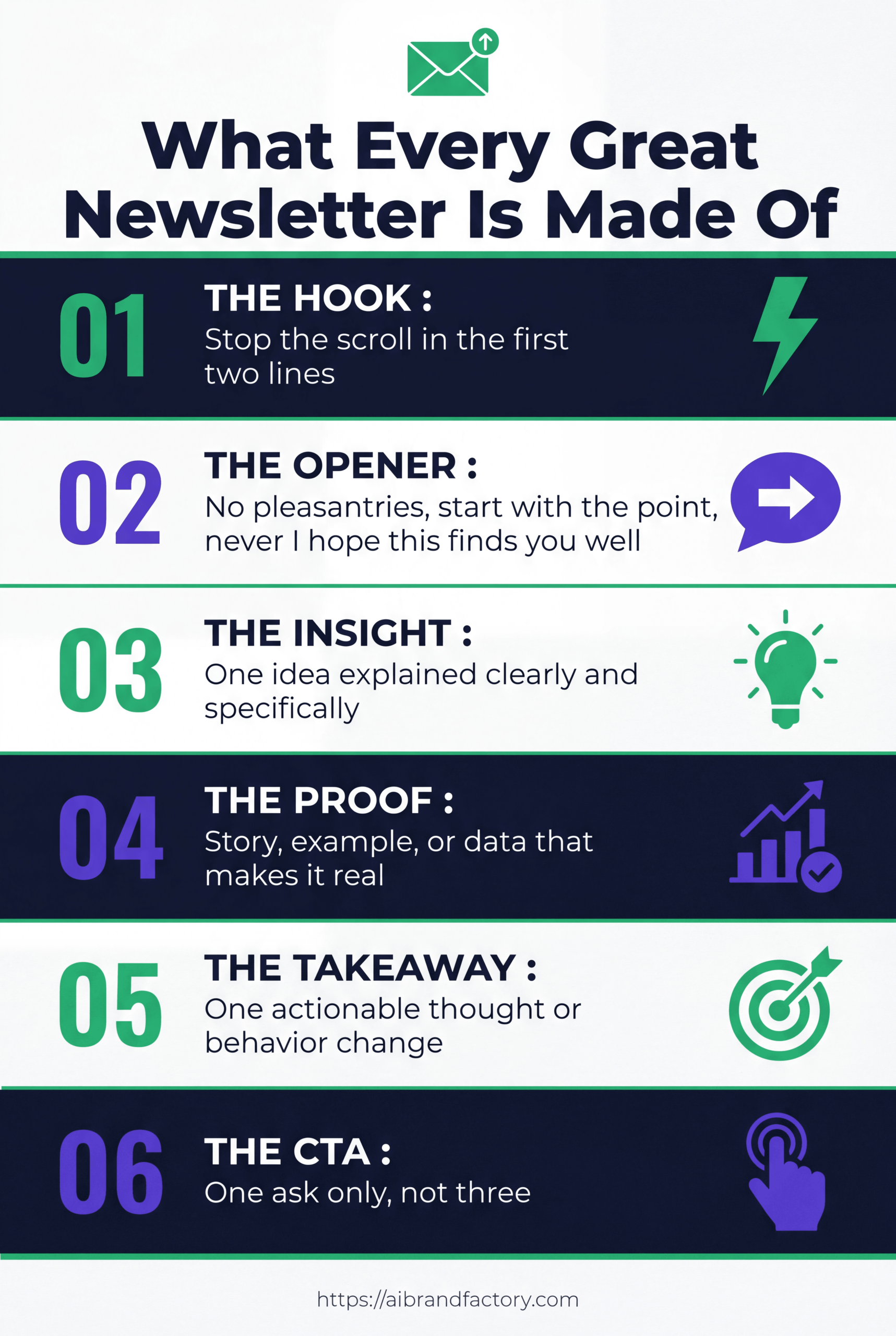
Good newsletters aren’t accidental. They follow a structure that works with how readers actually behave. Each of these six parts has a specific job to do.
Part 1: The Subject Line That Gets the Open
Nothing else matters if the subject line fails. The email goes unopened, the content goes unread, and the relationship stalls. Subject lines under 50 characters perform better on mobile, where the majority of email is now read (according to Studies have shown that shorter subject lines tend to have higher open rates on mobile devices.). Personalization tokens and curiosity gaps consistently outperform generic subject lines.
“What I learned from losing a client” beats “November Newsletter” every single time. The subject line is not a label. It’s a promise.
It’s the only thing standing between your draft and a reader’s attention.
Part 2: The Preview Text Nobody Thinks About
Preview text is the second line readers see in their inbox, sitting right next to the subject line. Most senders leave it blank or let it auto-populate with “View this email in your browser.” Wasted opportunity. Preview text functions as a second subject line, a distinct copywriting moment that most people treat as an afterthought. Write it with intention. Use it to add a second angle on the subject line, not echo it.
Part 3: The Opening Hook That Keeps Them Reading
Your newsletter’s first two sentences determine whether the reader continues. Most founders open with context-setting: “In today’s newsletter, I’ll be covering…” Readers don’t need orientation. They need a reason to keep going. Open with a relatable scenario, a surprising fact, or a direct question. The opening hook must create immediate relevance, and the reader needs to feel “this is for me” within the first ten seconds.
Don’t open with “I hope this finds you well.” Ever.
What Every Great Newsletter Is Made Of – 6-Part Newsletter Structure Infographic
Part 4: The One-Idea Rule That Separates Good Newsletters from Ignored Ones
Newsletters that try to cover five topics give readers five reasons to stop reading. One reader checks out after topic two. Another skims to the end without absorbing anything. The whole thing feels overwhelming before it feels useful.
Focused content reduces cognitive load – the reader can follow one thread to a satisfying conclusion rather than juggling multiple threads at once. One clear idea explored with depth creates a more memorable experience than five shallow points. This isn’t a creative constraint.
It’s a neurological one.
Every newsletter needs a substance anchor. Without one, the content floats – interesting but not credible, engaging but not memorable. A personal story builds emotional connection.A data point builds intellectual credibility. The strongest newsletters use one to set up the other: open with a story that frames a problem, then back it with a number that validates the pattern. That combination is what makes a newsletter worth forwarding.
Part 5: The Story or Data Point That Makes It Worth Sharing
Every newsletter needs a substance anchor. Without one, the content floats – interesting but not credible, engaging but not memorable. A personal story builds emotional connection.A data point builds intellectual credibility. The strongest newsletters use one to set up the other: open with a story that frames a problem, then back it with a number that validates the pattern. That combination is what makes a newsletter worth forwarding.
Part 6: The CTA That Turns Readers into Participants
A newsletter without a call to action is a monologue. One clear ask per issue outperforms three asks because it removes decision paralysis. Reply to this. Click here. Book a call. Share this with one person. Each of those works. All four in the same email? None of them work. The CTA should feel like a natural next step from the content, not a bolt-on pitch tacked to the bottom. When the content earns it, the ask lands.
Consistent newsletter publishing isn’t a willpower problem. It’s a friction problem.
How AI Cuts Newsletter Writing from 3 Hours to 30 Minutes
Consistent newsletter publishing isn’t a willpower problem. It’s a friction problem.
AI doesn’t replace the founder’s perspective. What it does is remove the blank-page paralysis that stops most founders from sitting down in the first place. A structured first draft in the founder’s voice is infinitely easier to edit than a blinking cursor. AI handles the scaffolding so the founder can focus on the substance.
The six-part anatomy gives AI a clear structure to follow, which dramatically improves output quality. Generic AI prompts produce generic newsletters. A specific brief with a clear structure produces something usable.
What AI Actually Does Well in the Newsletter Process
The tasks AI genuinely excels at are drafting, structuring, and tone-matching. Feed it a topic brief and a voice sample, and it produces a structured first draft that follows the six-part anatomy. It suggests subject line variations so you’re not staring at a blank field. It eliminates the startup cost of writing, that ten minutes of mental inertia before the first word appears. AI is a drafting engine, not a replacement for the founder’s judgment. The stories, the opinions, the real insight, those still come from you.
AI handles the structure. You bring the substance.
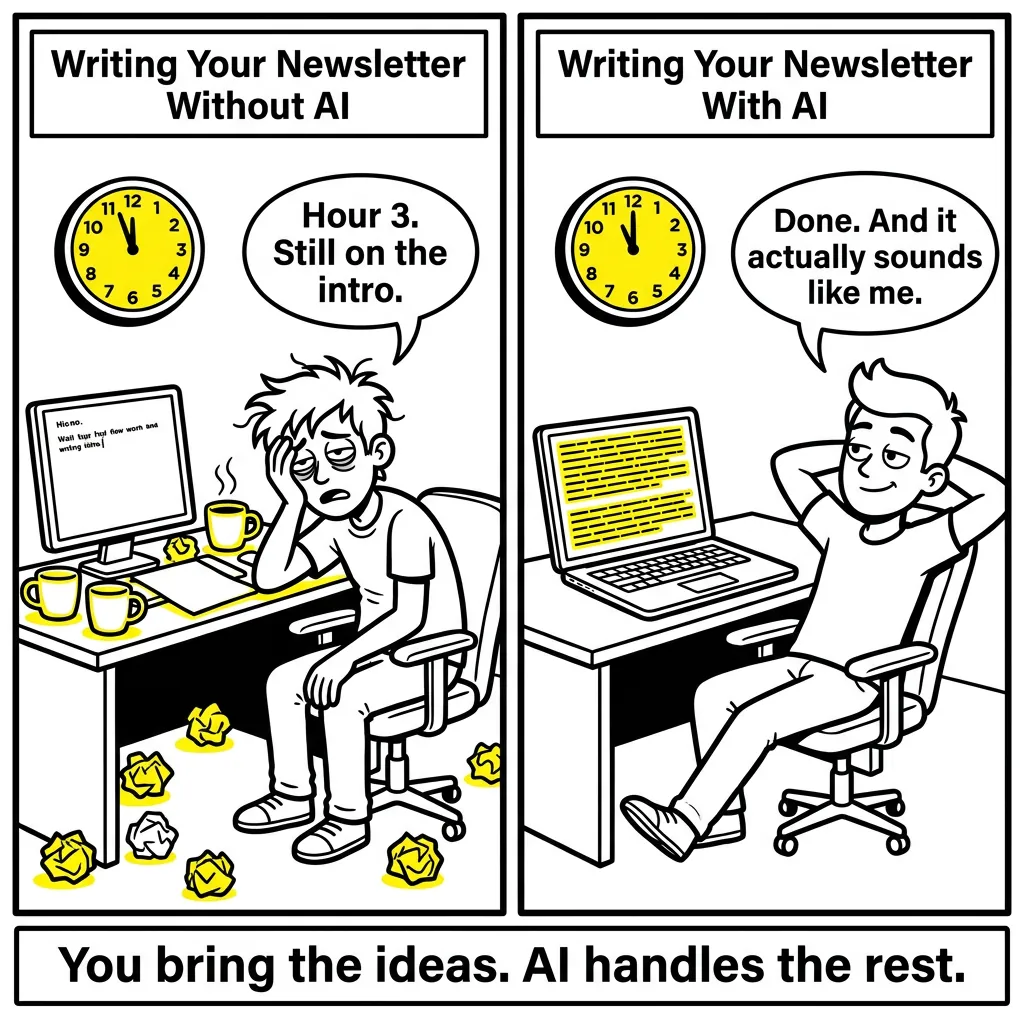
Newsletter Writing: With AI vs. Without AI – Comic Strip
AI BrandFactory‘s Blog Writer generates a 500-word newsletter draft in the founder’s own voice from a single topic brief, solving the voice consistency and time problems simultaneously.
The 30-Minute Newsletter Workflow Founders Are Actually Using
Pick one idea: 5 minutes
Brief the AI tool with that idea and your voice guidelines: 2 minutes
Review and edit the draft: 15 minutes
Finalize the subject line, preview text, and CTA: 8 minutes
The Fill-In-the-Blank Newsletter Template That Solves All Three Failure Modes
Skepticism is fair. You’ve probably tried templates before and found them too rigid, too generic, or too obvious. This one works differently because it’s built on the six-part anatomy, not pulled from some marketing blog’s generic email guide. A structural framework, not a script. Start with it, then make it yours.
Adapt it. Don’t copy it.
The Template Itself
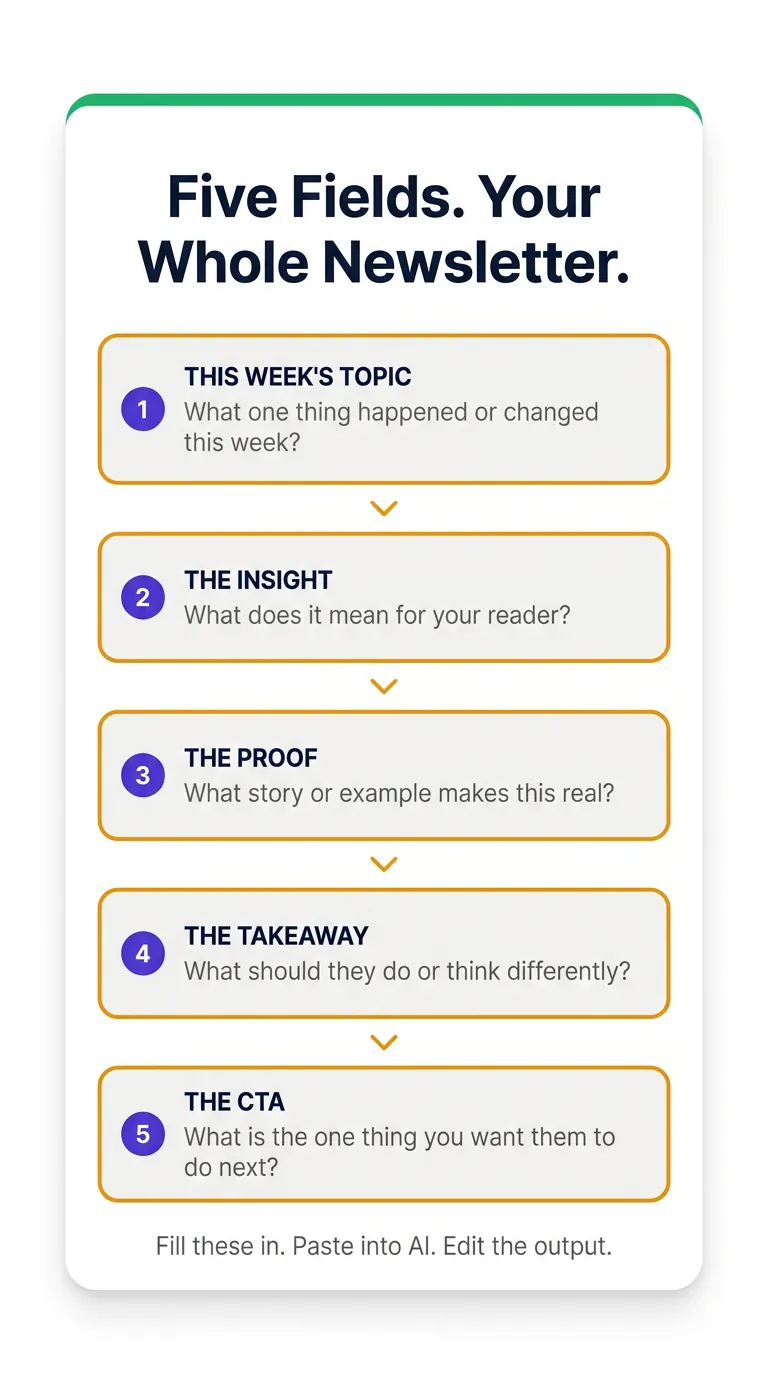
A fill-in-the-blank framework you can put to work right now:
Subject line: [One specific thing your reader will learn or feel after reading this]
Preview text: [A second angle on the subject line – what makes this one worth opening today]
Opening hook: [A one-sentence scenario, question, or fact that makes the reader say “that’s me”]
Body: [One idea, explained with a story or data point, in 200 to 300 words]
CTA: [One specific action – reply, click, book, or share – that follows naturally from the idea]
Five fields. That’s the whole newsletter.
Five Fields. Your Whole Newsletter. — Fill-in-the-Blank Newsletter Template Card
How to Adapt the Template Without Losing Your Voice
AI BrandFactory removes blank-page paralysis for founders by applying this template structure automatically in the founder’s own voice, so the hardest part of sitting down to write is already handled.
The structure is the skeleton. The founder’s voice, stories, and opinions are the flesh. Fill in the template with your specific examples, your specific language, your specific point of view. Read the draft aloud when you’re done.
If it sounds like something anyone could have written, it needs more of you. Generic structure plus generic voice equals a newsletter nobody reads. Generic structure plus a specific, distinctive voice equals something people forward.
AI tools assist with the structure. Founder voice and judgment still matter – they’re the whole point.
Why This Template Fixes the Three Failure Modes at Once
A repeatable structure trains your voice to show up consistently every issue. Readers start recognizing the format, and that format gets associated with your voice over time. The one-idea rule baked into the template prevents value drift – you can’t accidentally cover five topics when the template only has one body field. A repeatable format cuts writing time enough to make weekly sending realistic for a founder with a packed calendar.
Consistent structure solves voice. One-idea rule solves value. Reduced friction solves cadence. All three failure modes addressed by a single framework.
That’s the goal. A system, not a one-time effort.
Your First Newsletter Is the One You Actually Send
Stop optimizing. Start sending.
What is email marketing? It’s a relationship built one issue at a time. The three failure modes, no voice, no value, no cadence, all compound over time in the wrong direction when left unaddressed. The six-part anatomy gives you structure. The template gives you format. AI gives you time. None of that matters if you never hit send. Consistent email marketing doesn’t require a perfect issue, just a sent one.
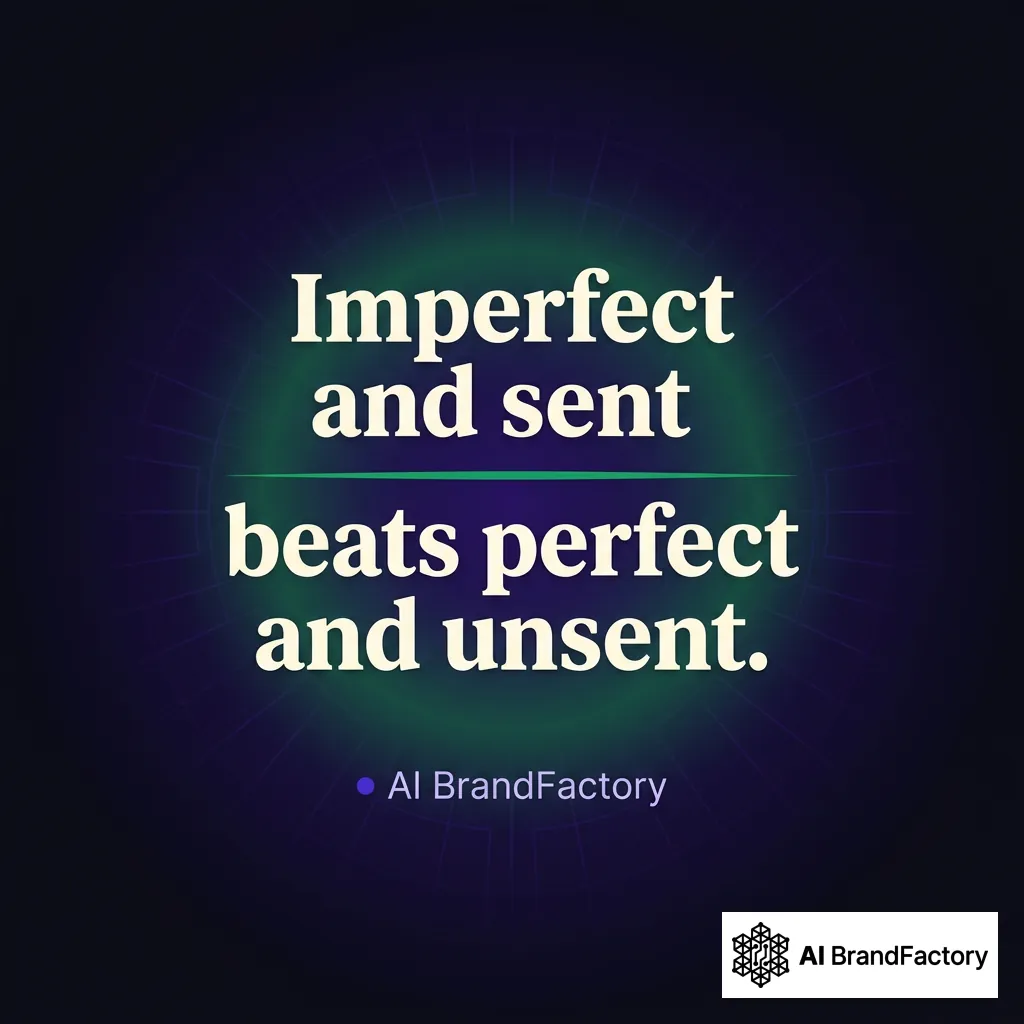
Imperfect and sent beats perfect and unsent.
Your first issue won’t be your best. That’s fine. Every newsletter you send teaches you something about your readers, your voice, and what actually lands. The founders with strong newsletters aren’t the ones who waited until they had something brilliant to say.
They’re the ones who showed up every week with something honest.
Imperfect and Sent Beats Perfect and Unsent – AI BrandFactory Quote Card
Pick one idea from your week
Drop it into the template
Pull up an AI email marketing tool to draft it if you need to
Send it before Friday
One idea. One send. This week.
Conclusion
Structure fixes the voice problem. The one-idea rule fixes the value problem. AI fixes the cadence problem. Those three solutions cover every newsletter failure mode this article addressed. The template gives you a starting point, but your voice and real stories are what make it worth opening.
Drop it into the template, use an AI for email marketing to draft the body, nail your subject line and preview text, and send it before Friday. That’s a full newsletter strategy inside a single workflow. Klaviyo AI, AI BrandFactory, or any AI email marketing tool that fits your voice will take care of the drafting. You own the idea and the send button.
Consistency is the only newsletter strategy that genuinely compounds. Everything else is just content.
Consistency is the only newsletter strategy that genuinely compounds. Everything else is just content.