
You Got Flagged. Now What.
You ran your draft through GPTZero and it came back red. Now you’re staring at a score that says “AI-generated” and wondering where to go from here.
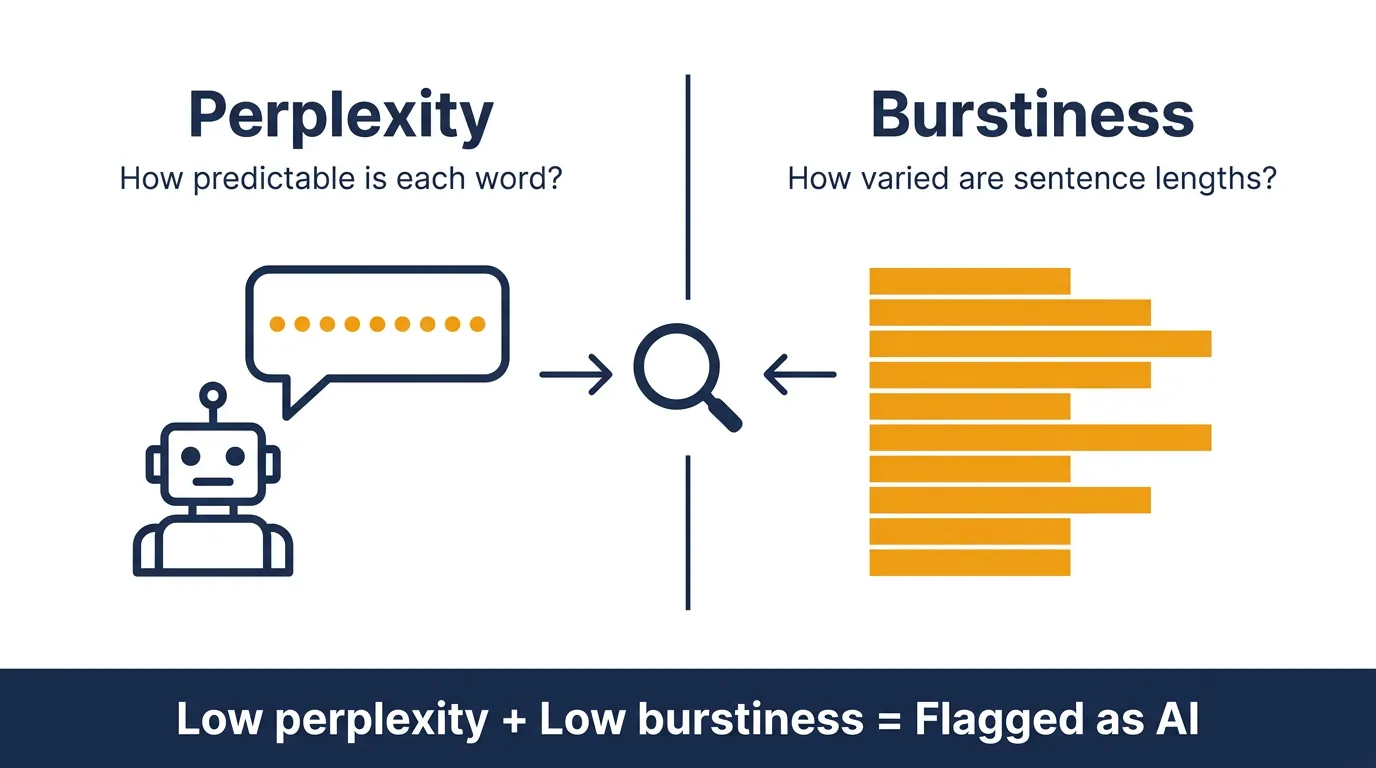
Most people reach for the obvious fix. They run the text through a paraphrasing tool, swap words with synonyms, change a few phrases by hand. None of it moves the score. Those fixes touch the surface of the text, not the statistical layer underneath. GPTZero isn’t reading your vocabulary choices in isolation. It measures two deeper signals: perplexity and burstiness.
That’s the whole problem.
This article teaches a rewrite method that works at the statistical layer, which is the same layer GPTZero’s detection algorithm actually reads. Once you understand what the detector measures, you can engineer your text to pass it. No magic tools required.
You’ll walk away with a four-step method. Apply it to any flagged paragraph and watch the score move.
Why GPTZero Catches What It Catches
The Perplexity Score Is Measuring How Predictable You Sound
GPTZero runs on two core scoring mechanisms. Perplexity comes first, and its weight in the final score is hard to overstate.
Think of it as a predictability meter. When a language model generates text, it consistently selects the most statistically probable next word, every single time. Each word choice follows the highest-probability path, producing text that reads smoothly but falls within a narrow, predictable distribution. GPTZero’s algorithm detects that flatness. A human writer, by contrast, makes unexpected word choices constantly. Not random ones. Just less statistically probable ones. A human might write “the meeting dragged” instead of “the meeting was unproductive.” That small deviation raises perplexity. LLMs almost never make that call, defaulting to the safer, more common phrasing without fail. So GPTZero, reading a passage of AI-generated text, spots a statistical fingerprint: word choices clustered tightly around high-probability tokens, with almost no deviation anywhere.
That flat distribution is the fingerprint.
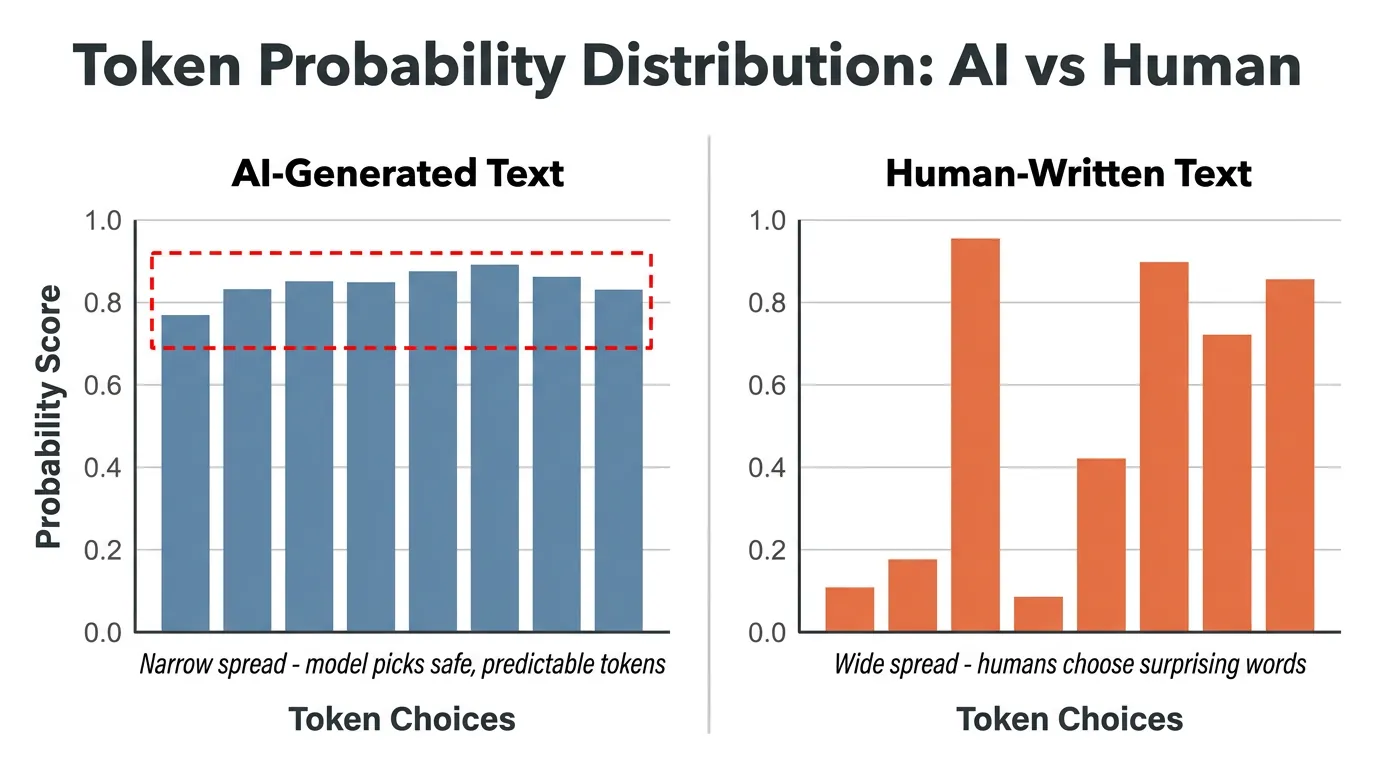
Human writers stray from expected word choices naturally, reaching for unusual constructions without consciously deciding to. The perplexity score captures exactly that deviation. A high perplexity score means the text surprised the model. A low perplexity score means the model could have predicted most of it. AI text scores low. Human text scores higher.
The Burstiness Score Is Measuring Your Sentence Rhythm
Burstiness is GPTZero’s second core signal. It tracks sentence length variation across a passage. AI-generated text tends to produce sentences of similar length and complexity throughout. One sentence runs twelve words. The next runs eleven. Then thirteen. Then twelve again. Steady, uniform, metronomic. Human writers don’t work that way. They swing between short punchy sentences and long complex ones. Short. Then a longer sentence that builds on the previous idea and adds a layer of nuance. Short again. Then another long one. That rhythm reflects natural human cognition, and it’s not something most writers consciously engineer. GPTZero measures the variance in sentence length across a paragraph and flags passages where that variance reads as unusually low.
Low burstiness is one of GPTZero’s strongest AI signals.
Why Synonym Swapping Alone Will Not Save You
Running a draft through a paraphraser changes words. It does not change the underlying statistical distribution. Token probability patterns stay intact. Sentence lengths remain roughly similar. Syntactic structure stays predictable. You’ve altered the surface while leaving the fingerprint completely untouched. GPTZero doesn’t care that you swapped “use” for apply It’s reading the statistical profile of the full passage, not scoring individual word choices in isolation. The fix has to operate at the statistical layer: sentence structure, rhythm, clause ordering, voice markers. That’s what actually shifts the score. Synonym swapping is simply the wrong tool for this problem.
Surface edits fix surface scores.

The Exact Statistical Profile GPTZero Is Looking For
What High Perplexity and High Burstiness Actually Look Like
Two characteristics define the target profile. High perplexity and high burstiness.
High perplexity text catches the prediction model off guard. Word choices fall outside statistical probability. Phrasing feels idiosyncratic. Sentence structures shift. A writer with a genuine voice naturally produces high perplexity because their choices reflect a specific perspective, not a statistical average. High burstiness text alternates visibly in sentence length. Short sentences land hard. Then a longer one follows, building context or layering complexity before the next short sentence cuts through. The rhythm breathes. It speeds up and slows down. That variation is exactly the signal GPTZero is scanning for. Together, high perplexity and high burstiness produce a statistical profile that looks like a person with a voice, not a polished language model.
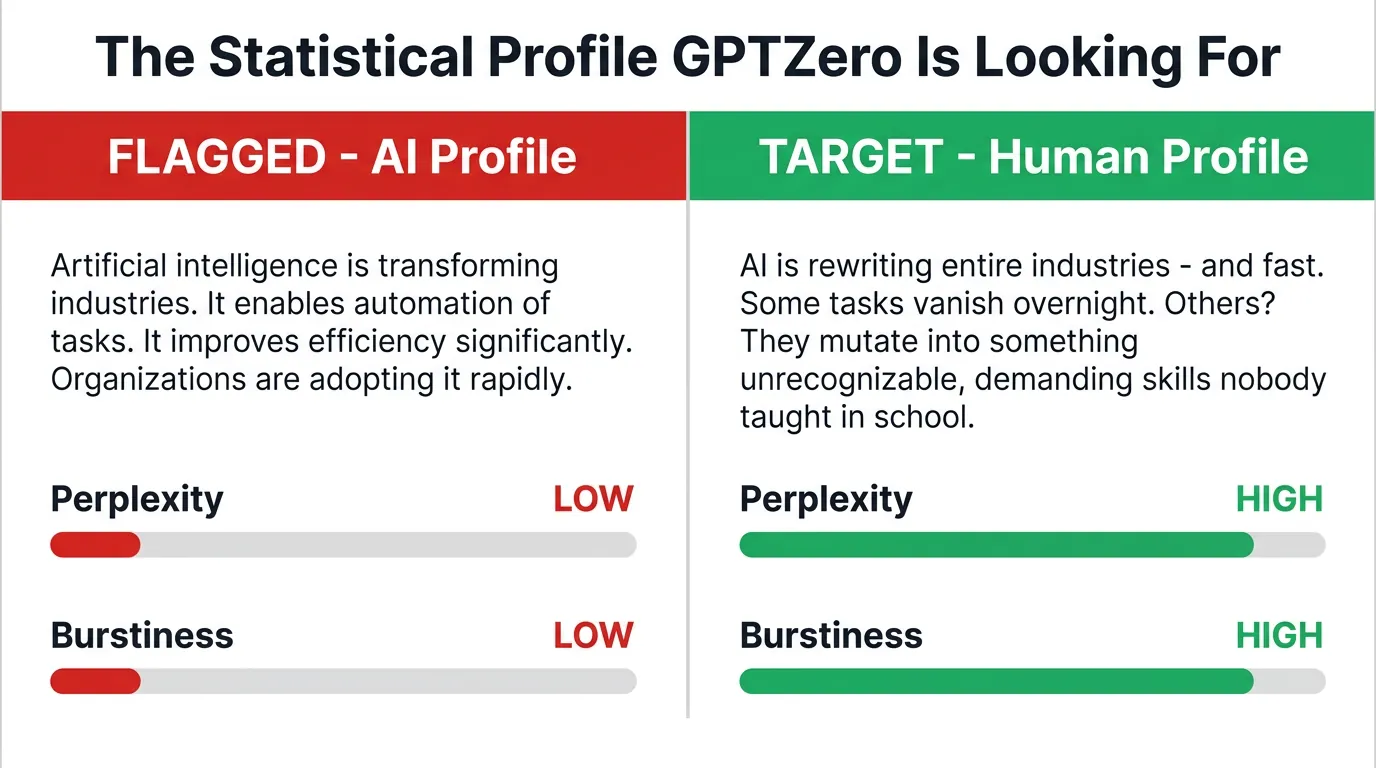
That’s the target.
GPTZero has documented false positive rates. Human-written content gets flagged regularly. Multiple detectors use similar perplexity and burstiness approaches, including ZeroGPT and others. They all share the same core limitation. No humanization method guarantees a 100% pass rate across all detector versions and all content types. Worth knowing before you spend hours rewriting. The method covered here addresses the actual detection mechanism, which makes it more durable than surface-level fixes. But no approach is bulletproof. Go in with realistic expectations.
GPTZero Is Not Infallible and That Matters
GPTZero has documented false positive rates. Human-written content gets flagged regularly. Multiple detectors use similar perplexity and burstiness approaches, including ZeroGPT and others. They all share the same core limitation. No humanization method guarantees a 100% pass rate across all detector versions and all content types. Worth knowing before you spend hours rewriting. The method covered here addresses the actual detection mechanism, which makes it more durable than surface-level fixes. But no approach is bulletproof. Go in with realistic expectations.
A Quick Word on When This Is Legitimate
The Line Between Editing for Voice and Academic Fraud
Using AI as a drafting tool, then rewriting the output to match your voice, is a legitimate professional workflow. Millions of writers do this. The AI produces a rough structure. You bring the voice, the judgment, and the expertise. The final piece is genuinely yours. That’s editing. Submitting AI-generated work as original in an academic or professional context where that’s explicitly prohibited is a different situation. That’s fraud. The detector isn’t the problem in that scenario. The deception is.
This article teaches the rewrite method. That method improves writing quality and shifts the statistical profile. How you use it is your responsibility.
This article teaches the rewrite method. That method improves writing quality and shifts the statistical profile. How you use it is your responsibility.
No lecture. Just clarity on where the line sits.
The Step-by-Step Rewrite Method That Shifts Your Statistical Profile
Step 1 – Engineer Your Burstiness First
Burstiness is the fastest win. Fix it first.
Pull up your AI draft and count the words in each sentence across one paragraph. The pattern shows up immediately. Most sentences land between ten and fifteen words. The variance is narrow. The rhythm is metronomic. Your job is to break that rhythm on purpose. Take three consecutive sentences and shorten two of them hard. Cut to five words. Cut to six. Then let the next sentence run longer and more complex, carrying the full idea across multiple clauses before landing. Then cut again. The pattern becomes: short, short, long, medium, short, long. That alternation is the burstiness signal. You’re not writing worse. You’re writing with more natural rhythm variation. Before treatment, a paragraph might read: “Effective communication requires clarity and precision. Writers should consider their audience carefully. The message must be delivered concisely.” After treatment: “Clarity matters. Precision too. Writers who ignore their audience consistently lose them before the second paragraph even starts. Know who you’re writing for.” Same information. Completely different rhythm profile.
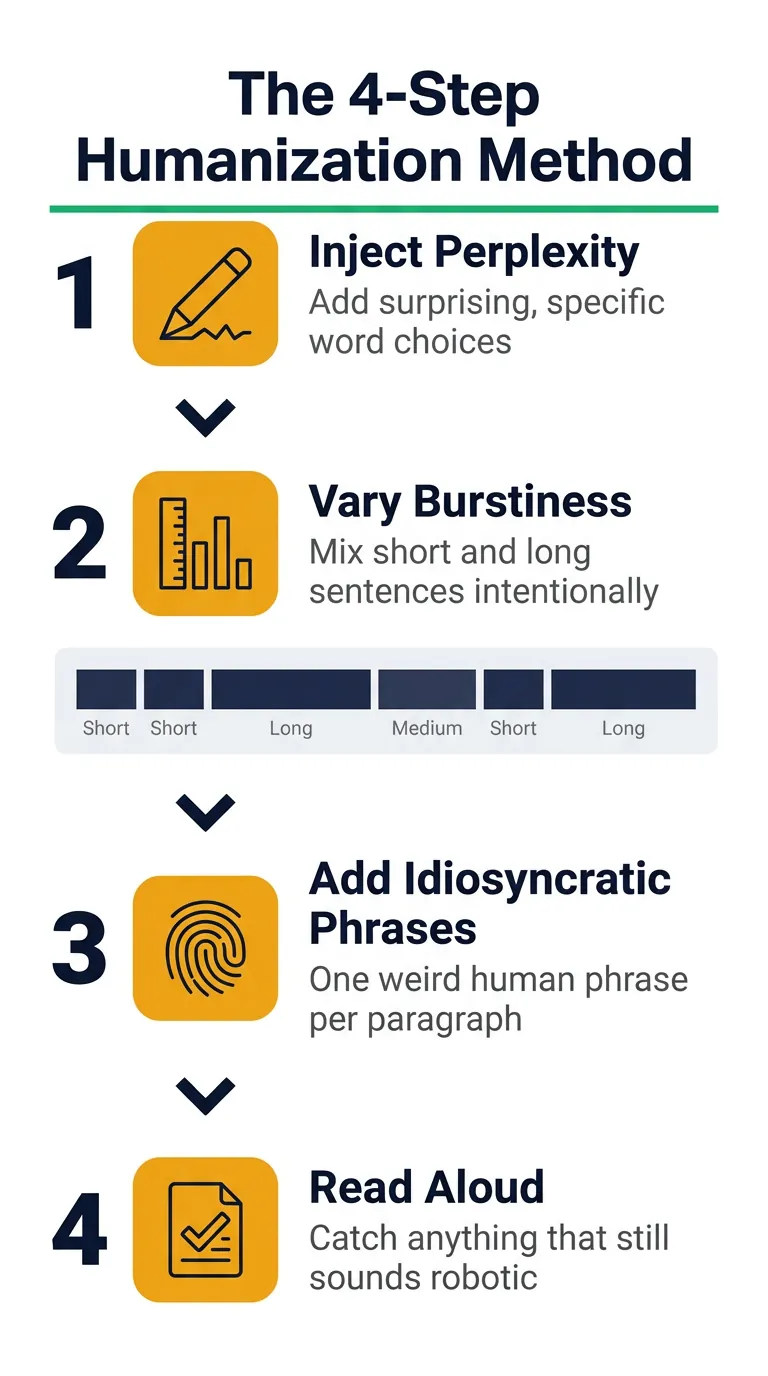
Step 2 – Raise Your Perplexity with Unexpected Word Choices
Perplexity is about surprise at the token level. LLMs have favorite phrases. You know them because you’ve seen them everywhere.
“It is important to note.” “In today’s fast-paced world.” “Using best practices.” “A thorough approach.” These constructions appear constantly in AI output because they’re statistically safe. Every LLM defaults to them. GPTZero has seen enough AI text to recognize these patterns as high-probability tokens clustering together. The fix isn’t synonym swapping. It’s restructuring the clause entirely and pulling in phrasing from your actual voice. Instead of “It is important to note that deadlines affect team morale,” write “Deadlines don’t just affect delivery. They change how a team feels about Monday morning.” The second version is less statistically probable. The word choice is more specific. The structure is different. The perplexity score rises. You’re not writing obscurely. You’re writing with a perspective, which is what a human voice actually sounds like.
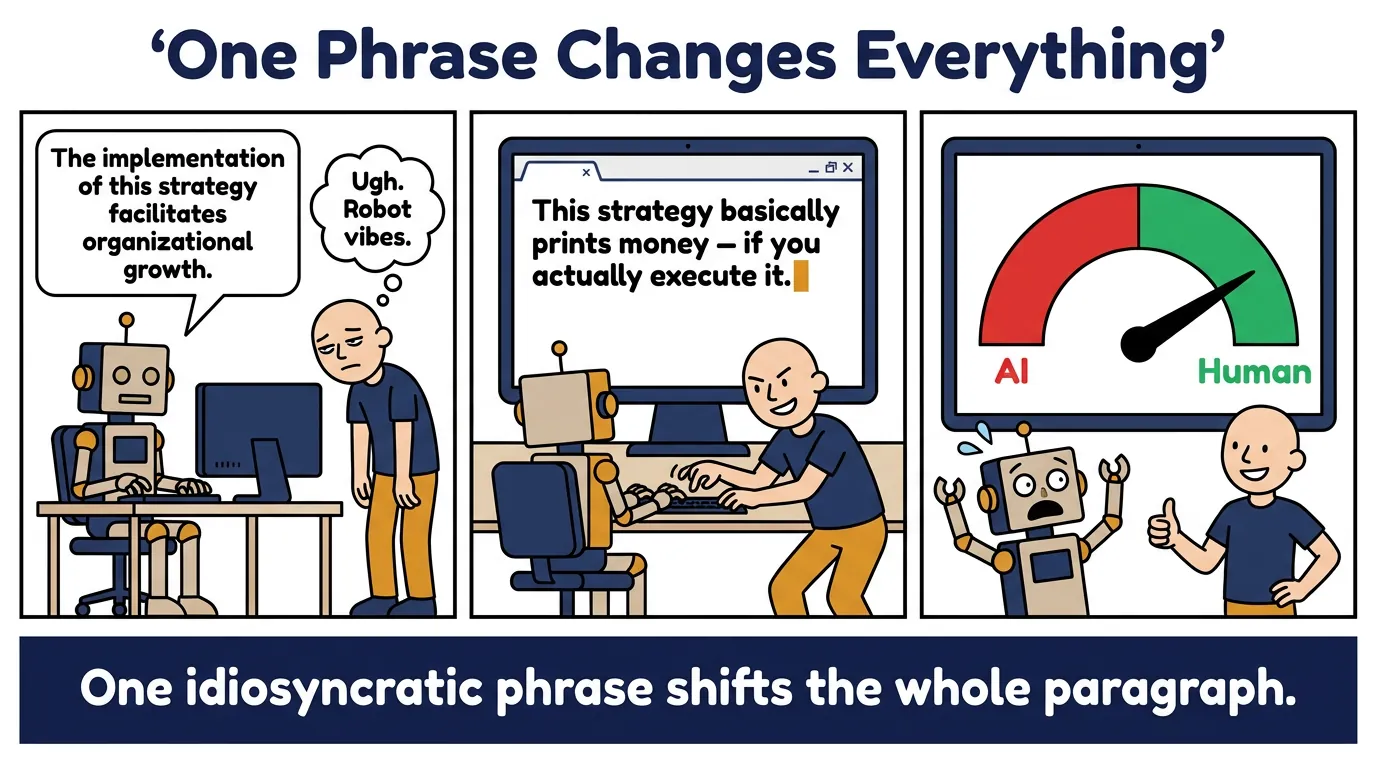
One idiosyncratic phrase can shift a paragraph’s score.
Step 3 – Break the Syntactic Predictability Pattern
AI defaults to subject-verb-object. Every sentence. Consistently. That structural uniformity is detectable.
Start varying the opening element of your sentences. Begin with an adverbial: “By Thursday, the whole plan had collapsed.” Start with a participial phrase: “Running three tools simultaneously, she finished before lunch.” Drop the subject occasionally and open with a direct observation: “Took three weeks. Shouldn’t have taken three days.” Use fragments for emphasis. Deliberately. Each structural variation changes the token probability distribution at the sentence level. GPTZero reads clause ordering as part of the statistical profile, so when every sentence opens the same way, the pattern becomes recognizable and when sentence openings vary across a paragraph, the profile shifts. This step takes practice. Start by identifying the first word of each sentence in a paragraph. If most sentences start with “The,” “This,” “It,” or a proper noun, restructure half of them. The variety doesn’t need to be dramatic. Even small structural changes compound across a paragraph.
Step 4 – Add Voice Markers That LLMs Typically Avoid
LLMs avoid first-person opinions. They avoid hedged uncertainty. They avoid colloquialisms and idiosyncratic asides. These patterns are statistically rare in the training data LLMs optimize for. Adding them deliberately raises both perplexity and the human-likeness signal. Specific voice markers worth injecting: a hedged opinion (“I’m not convinced this works at scale, honestly”), a colloquial aside (“which, for most teams, means starting over”), a direct rhetorical challenge (“Ask yourself if you’d actually read this”), or a first-person observation drawn from your own experience. Even one well-placed idiosyncratic phrase can shift the statistical profile measurably. (Admittedly, it feels unnatural at first to add these deliberately. Do it anyway.) LLMs don’t hedge. They don’t admit uncertainty. They don’t say “honestly.” Those absences are part of the fingerprint. Fill them in.
Before and After – Watching the Score Actually Move
The Original Paragraph and Why GPTZero Flags It
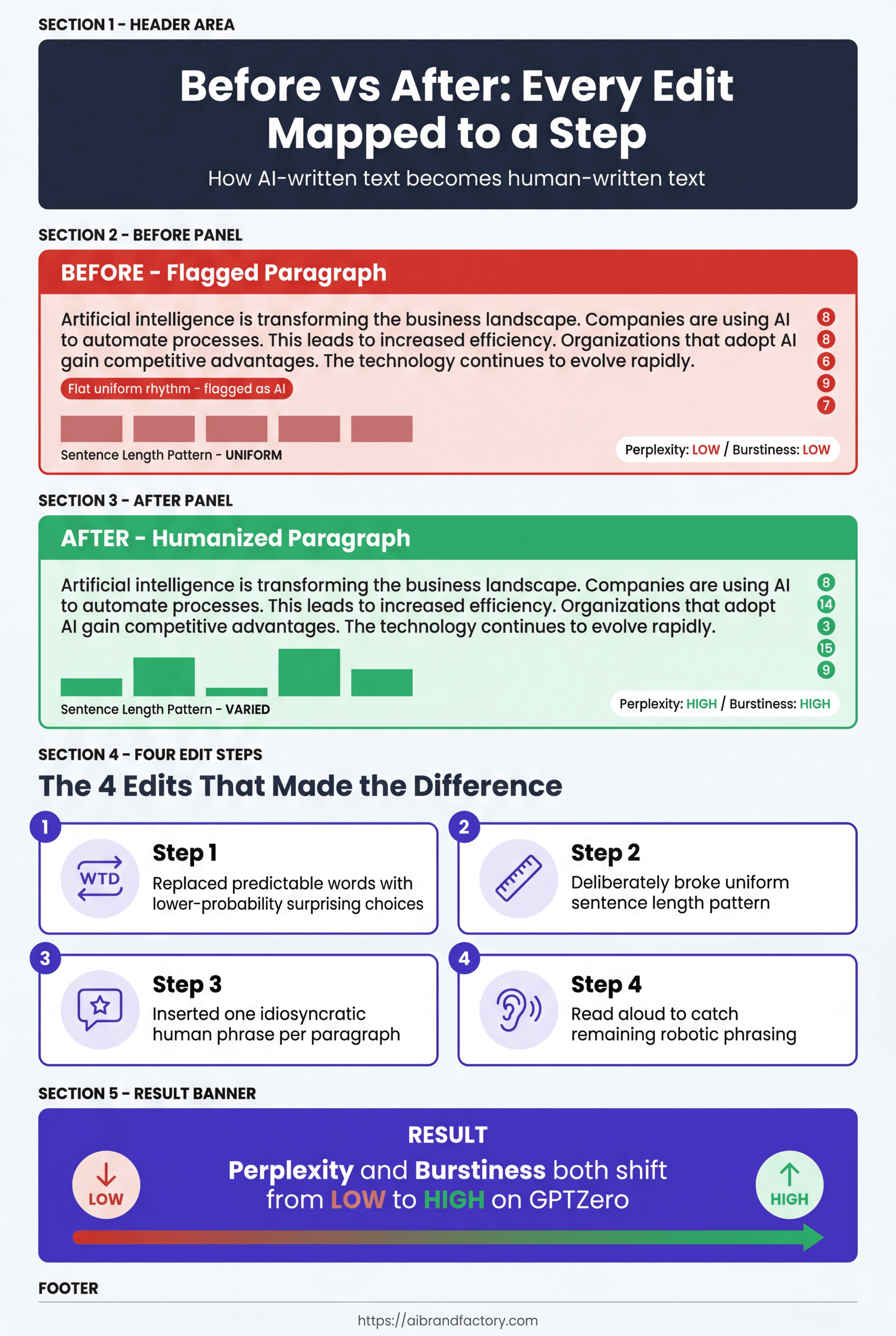
“Effective content marketing requires a strategic approach that aligns with business objectives. Organizations should develop a thorough content calendar to ensure consistent publishing. High-quality content increases audience engagement and supports lead generation efforts. It is important to note that SEO optimization plays a critical role in content visibility. By using data-driven insights, marketers can refine their strategies for maximum impact.”
“Effective content marketing requires a strategic approach that aligns with business objectives. Organizations should develop a thorough content calendar to ensure consistent publishing. High-quality content increases audience engagement and supports lead generation efforts. It is important to note that SEO optimization plays a critical role in content visibility. By using data-driven insights, marketers can refine their strategies for maximum impact.”
Count the sentence lengths: 14, 13, 12, 17, 13 words. Variance is low. Every sentence opens with a subject. The phrasing is safe and predictable throughout. “It is important to note.” “Using data-driven insights.” “Thorough content calendar.” These are high-probability LLM constructions. No voice markers exist. No hedging, no first-person, no idiosyncratic phrasing. The burstiness score is low. The perplexity score is low. GPTZero flags this as AI-generated, and it’s right.
“Content marketing without a strategy is just noise. Most organizations know this. What they miss is the gap between having a content calendar and actually publishing consistently. SEO matters too, though I’d argue audience trust compounds faster than search rankings when you get the voice right. Data helps. But data without editorial judgment produces technically optimized content nobody wants to read.”
The Rewritten Paragraph and What Changed
“Content marketing without a strategy is just noise. Most organizations know this. What they miss is the gap between having a content calendar and actually publishing consistently. SEO matters too, though I’d argue audience trust compounds faster than search rankings when you get the voice right. Data helps. But data without editorial judgment produces technically optimized content nobody wants to read.”
“Content marketing without a strategy is just noise. Most organizations know this. What they miss is the gap between having a content calendar and actually publishing consistently. SEO matters too, though I’d argue audience trust compounds faster than search rankings when you get the voice right. Data helps. But data without editorial judgment produces technically optimized content nobody wants to read.”
Sentence lengths: 8, 4, 17, 15, 3, 15. The burstiness variance is now significant. Sentence openings vary: declarative statement, subject-led, subject-led with clause, adverbial qualifier, fragment, conjunction. The phrase “I’d argue” introduces a first-person hedged opinion, which LLMs avoid. “Just noise” is idiosyncratic phrasing. “Nobody wants to read” is colloquial. Every change maps to one of the four steps.
For writers producing high volumes of content, AI BrandFactory Blog Writer is built to produce this statistical profile at generation, not after manual treatment. The tool is calibrated to produce output GPTZero reads as human by genuinely increasing linguistic variance from the start.
The score moves because the statistical profile changed.
The Sustainable Workflow So You Stop Doing This Every Time
Build a Personal Rewrite Checklist You Actually Use
The four-step method works. It also eats time when you treat it as a full document overhaul.
Don’t rewrite the whole document at once. Work section by section. One pass per section, not a line-by-line edit of every paragraph. The checklist stays simple: check burstiness first, raise perplexity second, vary syntax third, add voice markers fourth. Time-box each pass to ten minutes per section. That constraint forces you to prioritize.
The checklist gets faster as the habits settle in.
The Upstream Fix That Eliminates Most of the Rewriting
The smarter move happens upstream, at the generation stage. When the tool producing your draft is calibrated for linguistically varied output, the rewriting burden drops sharply. Most AI writers produce statistically flat text because they optimize for coherence, not variance. That’s the gap. As AI BrandFactory describes their Blog Writer: “Blog Writer is calibrated to produce output GPTZero reads as human – not by gaming the detector, but by genuinely increasing linguistic variance.” A different design philosophy entirely. AI BrandFactory builds variance in at generation rather than leaving it as a post-production problem.
The smarter move happens upstream, at the generation stage. When the tool producing your draft is calibrated for linguistically varied output, the rewriting burden drops sharply. Most AI writers produce statistically flat text because they optimize for coherence, not variance. That’s the gap. As AI BrandFactory describes their Blog Writer: “Blog Writer is calibrated to produce output GPTZero reads as human – not by gaming the detector, but by genuinely increasing linguistic variance.” A different design philosophy entirely. AI BrandFactory builds variance in at generation rather than leaving it as a post-production problem.
For high-volume writers, that difference compounds fast.
If you’re manually rewriting every draft, that’s a workflow problem. Fix it at the source.
What the Arms Race Means for Your Content Strategy
Why the Only Durable Strategy Is Genuine Linguistic Variance
GPTZero updates its algorithm. So does ZeroGPT. So does every other AI checker.
Specific exploits get patched. A method that games one detector version breaks the moment that algorithm shifts, and that’s exactly the nature of this ongoing arms race between AI writers and detection tools. The only approach with staying power targets what detectors are actually measuring: genuine statistical differences between human and AI writing. Perplexity and burstiness aren’t arbitrary metrics. They reflect real patterns in how humans write versus how LLMs produce text. Methods that exploit specific detector blind spots have short shelf lives. Methods that genuinely increase linguistic variance stay effective because they align with the underlying signal. That’s why the rewrite method taught here actually works.
It improves writing quality. Full stop.
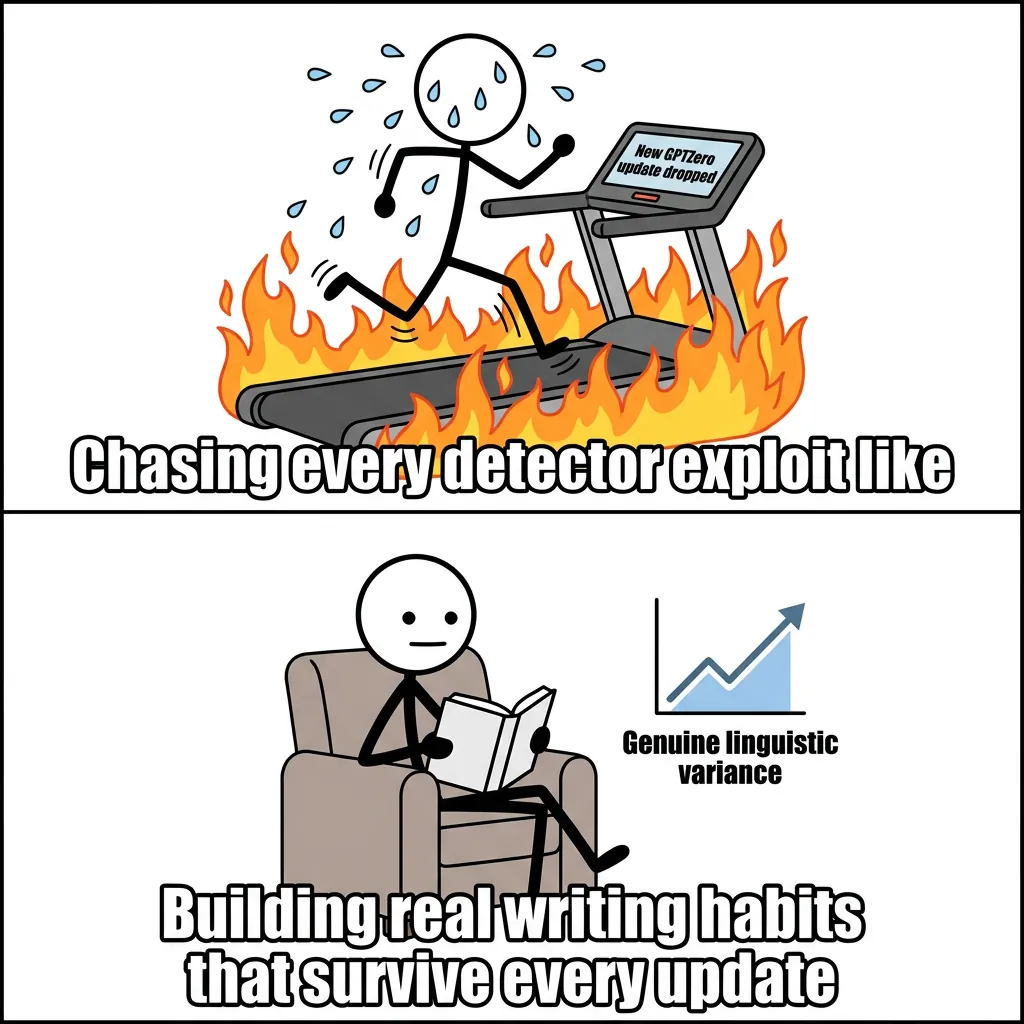
Chasing detector weaknesses is a treadmill. Building linguistic variance is a writing skill that compounds over time.
The Fix Is Statistical, Not Surface-Level
GPTZero catches statistical uniformity. Perplexity and burstiness are the two signals it reads.
The four-step rewrite method works because it targets both signals directly.
Start by varying sentence lengths. Inject perplexity through unexpected word choices and idiosyncratic phrasing. Break syntactic predictability by rotating how sentences open. Add voice markers that LLMs typically avoid. Take one flagged paragraph through all four steps right now, before you close this tab.
No humanization method guarantees a 100% pass rate. But this one addresses the actual detection mechanism, not the surface. That distinction matters more than any specific tool or trick.