AI Writing Tells: The 9 Patterns That Flag Your Content as AI-Generated
AI content detection tools don’t guess – they measure statistical fingerprints left in every unedited AI draft. These fingerprints are consistent, recognizable, and increasingly easy to catch.
Knowing the specific patterns is the only way to fix them.
This article covers all 9 AI writing tells, why detectors flag each one, and exactly what to do about it.
What AI Detectors Actually Look For (And Why It Matters to You)
AI text detectors don’t read for meaning. They analyze math.
Detection tools measure token probability distributions, sentence-length variance, and phrase frequency across your entire document. High predictability in word choice signals machine authorship. Low variance in sentence lengths is another strong flag.
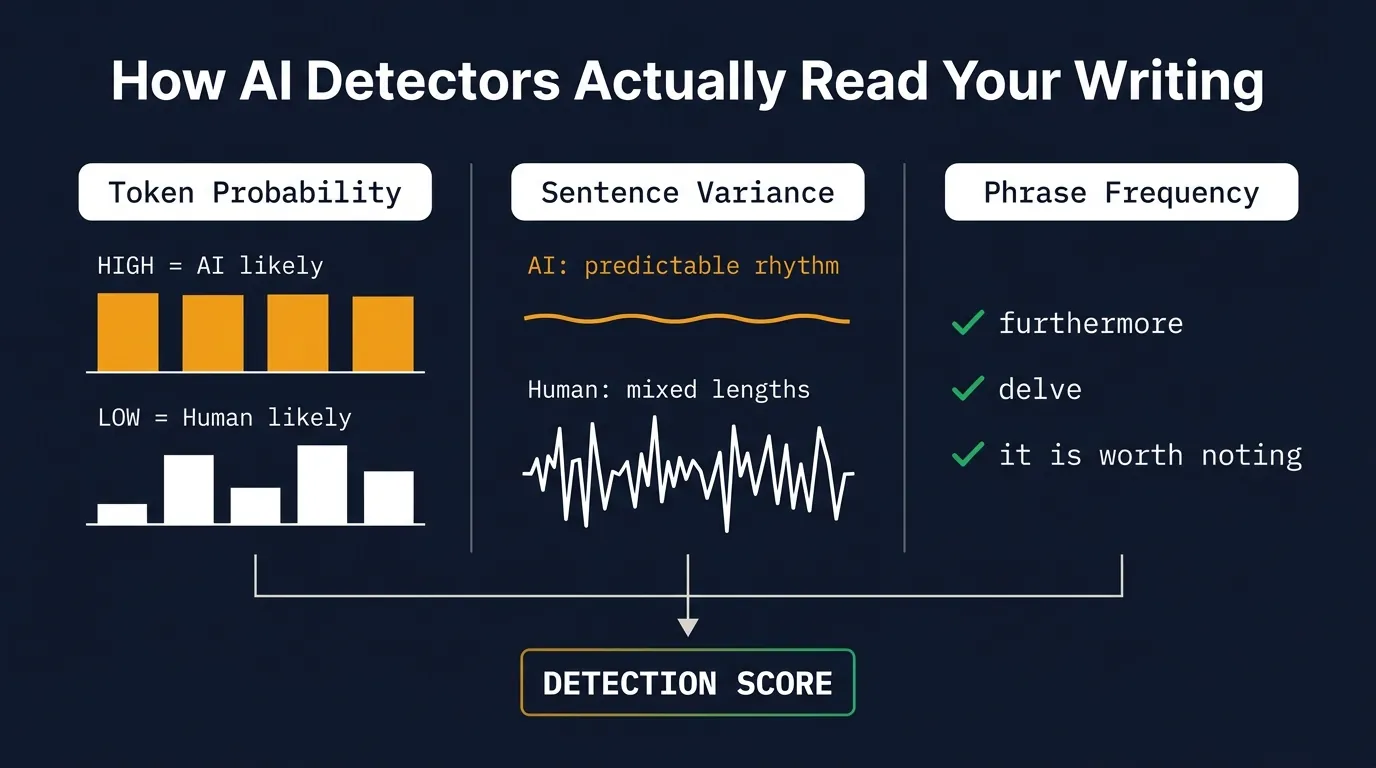
These signals combine into what researchers call a linguistic fingerprint, and AI-generated content leaves the same one, repeatedly.
Your credibility is on the line every time you publish unedited AI output.
The 9 AI Writing Tells That Detectors Catch Every Time
Nine patterns show up in nearly every unedited AI draft.
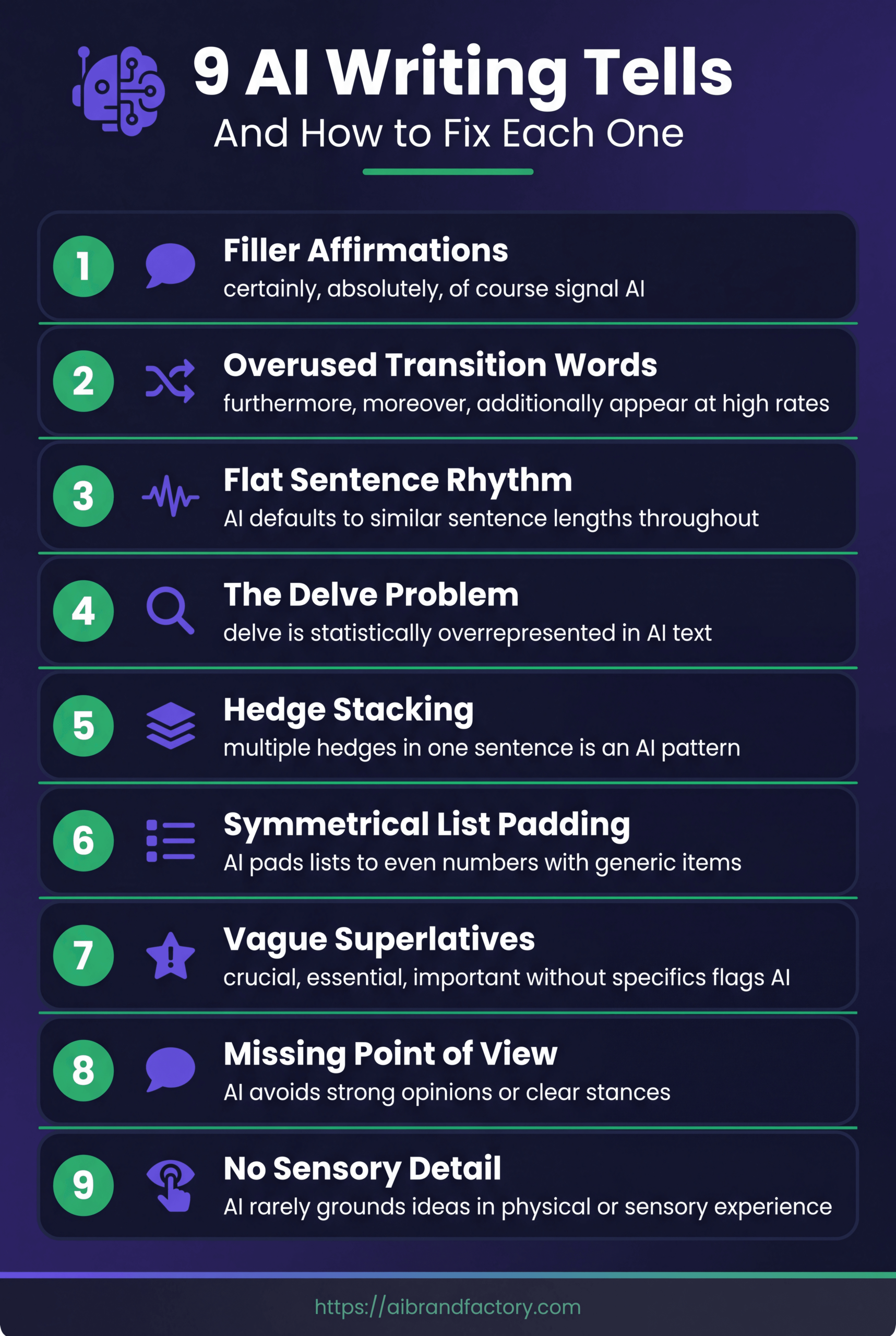
Tell #1: Em Dash Overuse
AI models treat em dashes as a default stylistic tool, connecting clauses at rates no human writer actually reaches. Detectors flag this because the frequency is statistically abnormal.
Before: “The report was thorough – covering every angle – and well-received.” After: “The report was thorough. It covered every angle and landed well.”
Replace most em dashes with periods or commas.
Tell #2: Parallel Structure Overuse
AI builds lists and sentences with machine-like grammatical balance. Every item matches. Every clause mirrors the last. Human writers break symmetry constantly, short items next to long ones, fragments next to full sentences, blunt statements next to detailed ones.
Vary your list item lengths deliberately. Change how sentences open. Break the pattern on purpose.
Symmetry is efficient. Asymmetry reads human.
Tell #3: Rhythmic Cadence Uniformity
This one has a name: burstiness. Human writing clusters short and long sentences naturally, three quick hits, then one longer thought. AI compresses this variance into a flat, even rhythm. Detection algorithms measure burstiness as a quantifiable linguistic metric. Low burstiness scores strongly predict AI authorship in commercial detection tools.
Before: every sentence runs 12-15 words. After: Short sentence. Then a longer one that adds context and depth. Then another short one.
Audit your paragraphs for sentence-length variety.
Tell #4: Transition Word Overuse
“Furthermore,” “Moreover,” “Additionally,” “In conclusion” – these are AI scaffolding, not human writing. AI models drop these transitions at rates far beyond what any human writer uses. They appear because the model learned them as connective tissue. Cut them. Most of the time, the logic between sentences is clear without them.
Tell #5: Hedge Clusters
Hedging language isn’t the problem. Clustering it is. Phrases like “it is worth noting that” and “it is important to consider” show up in AI text in tight groups. Human writers hedge sparingly and spread it out naturally.
Before: “It is worth noting that this approach, while potentially useful, may not be suitable in every context.” After: “This works in most cases. Check your specific situation first.”
Remove the hedge. State the claim directly.
Delete the cluster entirely when you can.
Tell #6: Absent Colloquial Digressions
AI text stays relentlessly on-topic. No tangents. No asides. No informal observations. Human writers wander a little, and that wandering signals authenticity. (I caught myself doing exactly this while writing this section, which felt appropriate.) Detectors flag the absence of natural digression as an AI signal. Add one genuine aside per section, a personal reaction, a brief observation, something off-script.
One digression per section is enough.
Tell #7: Burstiness Collapse
Burstiness collapse goes deeper than rhythmic uniformity. It’s a statistical measurement: the variance in sentence lengths across a paragraph. AI output produces flat distributions, most sentences clustering within a narrow word-count range. Commercial detection tools use this as a primary signal.
Go paragraph by paragraph. Count sentence lengths. If they’re all within two or three words of each other, you have a burstiness collapse problem.
Fix it by deliberately writing one very short sentence and one longer one in each paragraph.
Tell #8: Generic Transitions
Generic transitions differ from transition word overuse. This is about formulaic sameness, AI defaults to the same small set of phrases within and across documents. “With that in mind,” “Building on this,” “This brings us to” – the same handful, repeated. Replace them with context-specific connectors that reflect the actual logical relationship. If you’re contrasting, say “but.” If you’re adding evidence, name what the evidence is. Don’t use a filler phrase as a stand-in for actual logic.
Specific beats generic every time.
Tell #9: Filler Affirmations
“Certainly!” “Great question!” “Absolutely!” “Of course!” These appear disproportionately in AI output as learned politeness patterns. Detection tools flag them immediately. Human readers find them grating. Delete every instance. None of them add meaning. Not one.
Stop Auditing Manually and Start Publishing Clean Content
AI is a legitimate writing tool. Unedited output is the problem, not AI itself. Manually checking for all 9 AI writing tells takes time and demands a different kind of editorial judgment for each one.
That’s the real cost most people underestimate.
Auditing drafts by hand means spending time on pattern-matching that a system can do for you. Each tell needs its own pass: em dashes, then cadence, then transitions, then hedges. Most writers catch two or three and miss the rest. (Admittedly, I did exactly this before building a better workflow.)
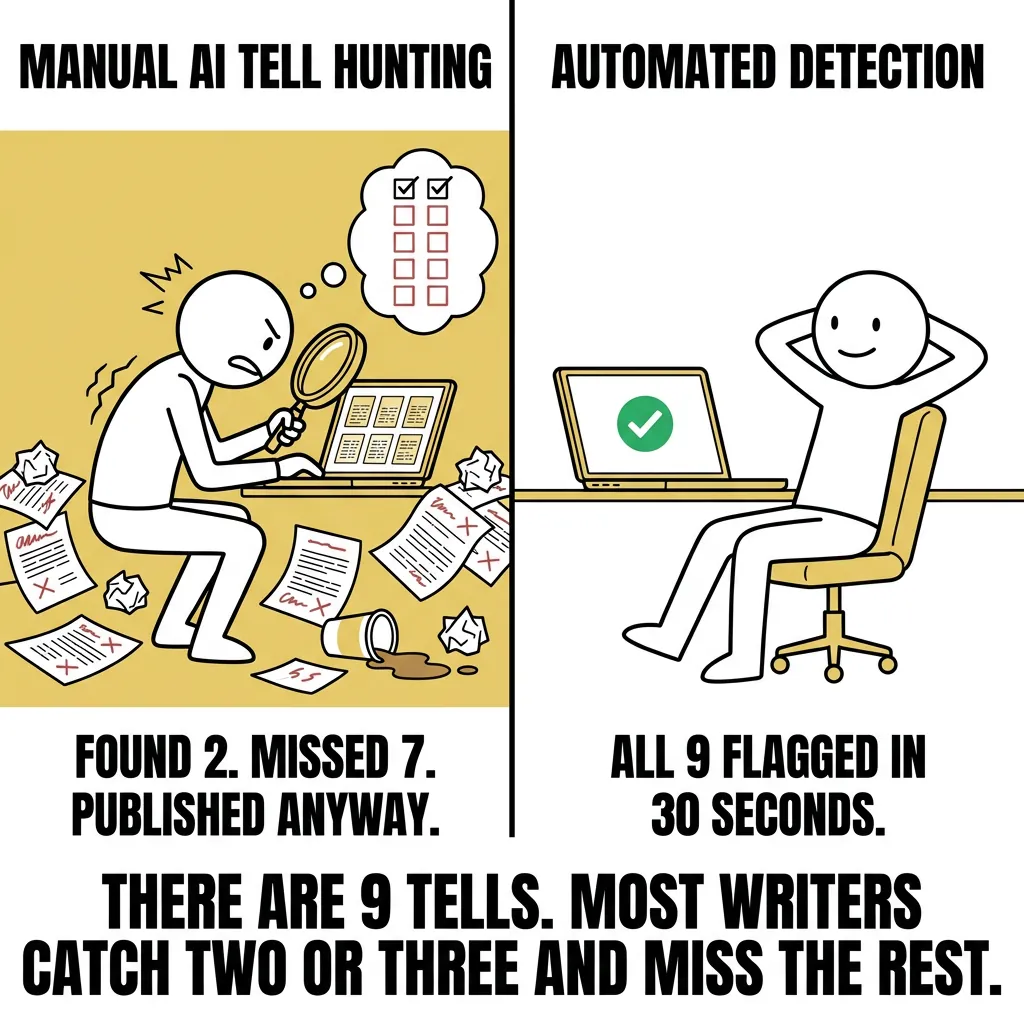
AI Brand Factory‘s Blog Writer runs a 7-layer humanization pipeline that strips all 9 tells automatically, no manual pass required. It’s the alternative to reviewing every draft before you hit publish.
Use it when your editorial time is better spent somewhere else.
Conclusion
AI writing tells aren’t mysterious. They’re measurable, consistent, and fixable. Manual editing discipline works when you’re thorough; an automated humanization pipeline like AI Brand Factory‘s Blog Writer works when time is the real constraint.
Pick one tell from this list and fix it in your next draft.