AI Humanizer Tools Compared: Which One Actually Beats Detection?
You wrote the content. The detector flagged it anyway. Now you’re feeding it through a separate tool, fingers crossed the output won’t read like a robot paraphrasing another robot.
Wrong workflow.
Most people treat AI detection as a final checkpoint rather than a pipeline problem. The friction adds up fast: extra tools, extra cost, degraded output quality on every additional pass. This comparison scores seven tools across five dimensions, GPTZero pass rate, Copyleaks pass rate, output quality, price, and word limits, with a declared winner per category.
One honest caveat upfront: no single tool dominates all five.
How We Scored Every Tool (And Why These 5 Metrics Actually Matter)
GPTZero and Copyleaks are the two dominant detection platforms used by editors, publishers, and academic institutions. They don’t catch AI the same way. A tool built for one will frequently stumble on the other.
Methodology first.
GPTZero and Copyleaks are the two dominant detection platforms used by editors, publishers, and academic institutions. They don’t catch AI the same way. A tool built for one will frequently stumble on the other.
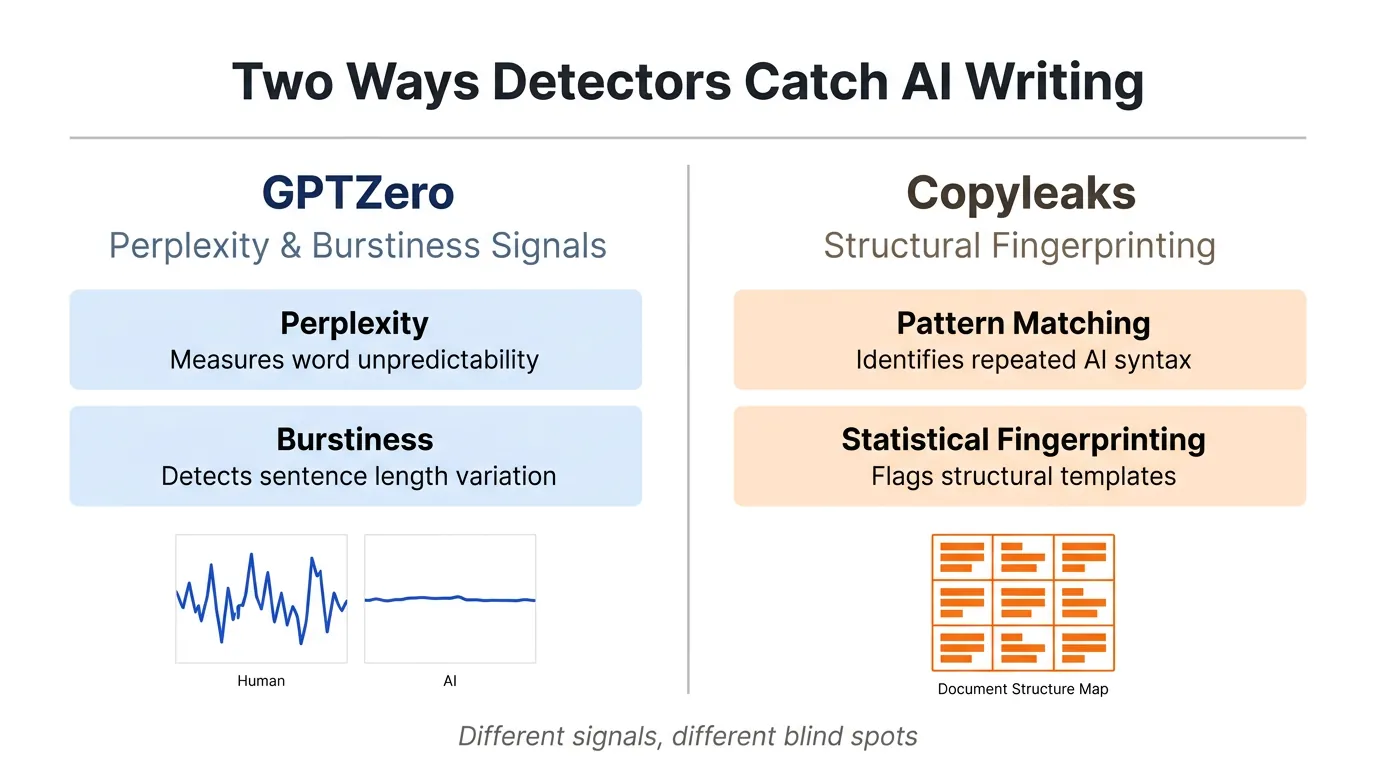
GPTZero measures perplexity and burstiness. Perplexity tracks how predictable word choices are. Burstiness measures sentence length variation. AI text scores low on both because it’s statistically consistent in ways humans simply aren’t.
Copyleaks uses pattern matching and statistical fingerprinting instead. It scans for structural signatures across the full document rather than sentence-level signals. A tool can clean up perplexity signals entirely and still fail Copyleaks because the paragraph architecture gives it away.
Why GPTZero and Copyleaks Catch Different Things
GPTZero measures perplexity and burstiness. Perplexity tracks how predictable word choices are. Burstiness measures sentence length variation. AI text scores low on both because it’s statistically consistent in ways humans simply aren’t.
Copyleaks uses pattern matching and statistical fingerprinting instead. It scans for structural signatures across the full document rather than sentence-level signals. A tool can clean up perplexity signals entirely and still fail Copyleaks because the paragraph architecture gives it away.
That’s exactly why both metrics appear in the scoring table. Tools tuned for GPTZero’s signals sometimes leave Copyleaks fingerprints completely untouched. Scoring only one detector produces a false pass rate.
What Word Limits Mean for Real Content Volumes
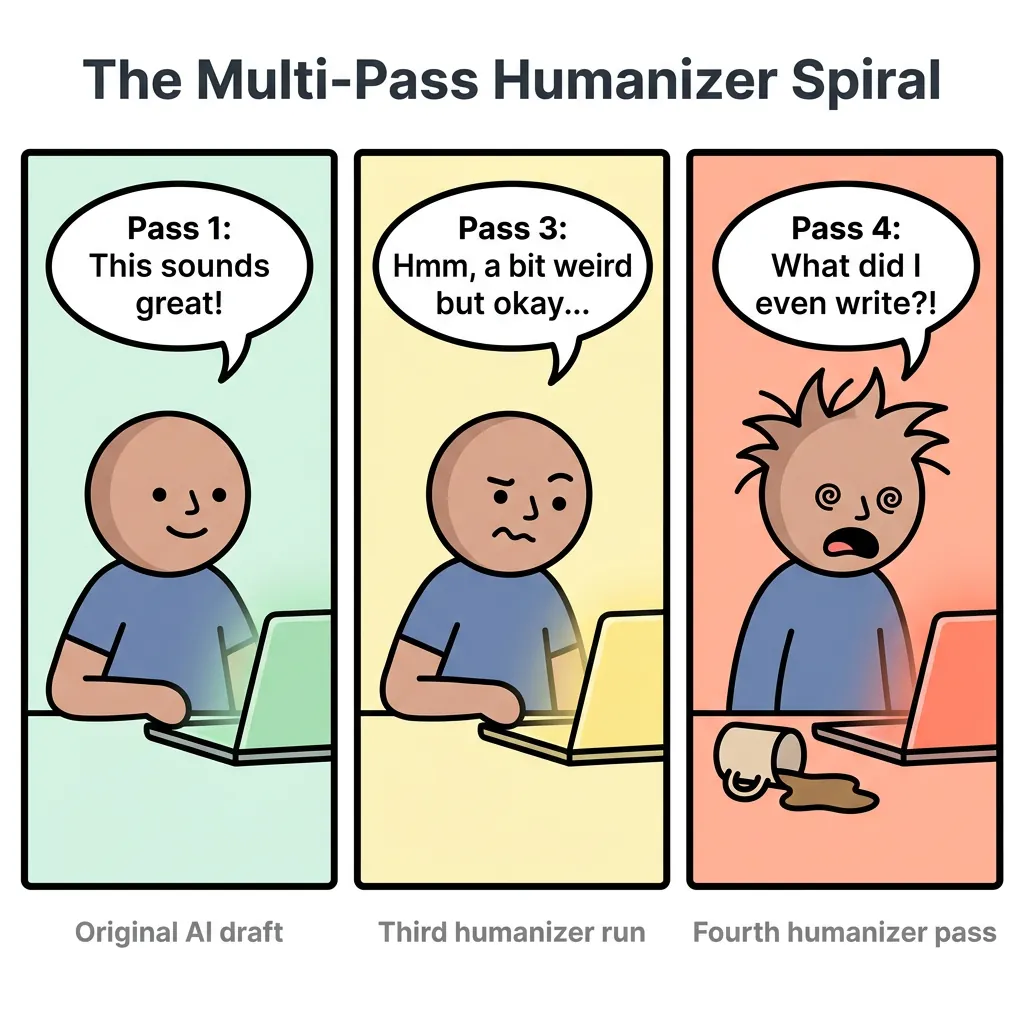
A 500-word limit per run means a 2,000-word post requires four separate passes.Multiple processing passes can lead to increased time and potential quality loss..
Aggressive humanization on the same text repeatedly breaks natural sentence flow. Technical terms get swapped out. Brand voice disappears. The fourth pass often sounds nothing like the first draft.
For blog-length content, word limit is a practical constraint affecting both output quality and time cost. A tool with a 1,500-word or higher single-run capacity handles long-form content in one pass. That matters at volume.
The Head-to-Head Scoring Table Across All 7 Tools
Seven tools. Five dimensions. One category winner per row.
The tools compared are Clever AI Humanizer, Walter Writes, Humanize AI Pro, Undetectable.ai, Quillbot, StealthGPT, and AI BrandFactory Blog Writer. Each was evaluated on GPTZero pass rate, Copyleaks pass rate, output quality, price, and word limit per run. Scores reflect comparative rankings, not absolute guarantees, because detection algorithms update and results shift by content type. (More on that limitation in the final section.)
Scores don’t lie. But they do expire.
StealthGPT and Undetectable.ai lead on GPTZero pass rates based on published benchmarks and comparative testing. Quillbot performs inconsistently, with results varying significantly depending on aggressiveness setting. Clever AI Humanizer and Walter Writes show acceptable pass rates on short samples but degrade on long-form content above 800 words.
AI BrandFactory Blog Writer is included in this comparison as the seventh tool. As a transparency disclosure, it is the platform behind this blog. It is the only tool in this comparison that eliminates the standalone humanizer step entirely because humanization is baked into the content pipeline, not bolted on afterward.
GPTZero Pass Rate Rankings (Who Wins the Most Important Test)
Category winner: StealthGPT.
StealthGPT scores highest on GPTZero pass rates across both short and long-form content. Undetectable.ai ranks second and performs more consistently across content types. Humanize AI Pro delivers acceptable results but shows weaker performance on technical content with domain-specific vocabulary. Clever AI Humanizer and Walter Writes pass on samples under 500 words but fail at full blog length.
Quillbot’s pass rate depends entirely on the aggressiveness setting selected. Maximum aggressiveness improves detection scores but destroys output quality in the process.
Copyleaks Pass Rate Rankings (The Test Most Tools Fail)
Undetectable.ai leads on Copyleaks pass rates, outperforming StealthGPT on this specific detector. StealthGPT ranks second. Humanize AI Pro, Clever AI Humanizer, and Walter Writes all show weaker Copyleaks scores relative to their GPTZero performance, confirming that single-detector optimization is a genuine problem in this market. Quillbot falls short on Copyleaks regardless of aggressiveness setting.
Category winner: Undetectable.ai.
Undetectable.ai leads on Copyleaks pass rates, outperforming StealthGPT on this specific detector. StealthGPT ranks second. Humanize AI Pro, Clever AI Humanizer, and Walter Writes all show weaker Copyleaks scores relative to their GPTZero performance, confirming that single-detector optimization is a genuine problem in this market. Quillbot falls short on Copyleaks regardless of aggressiveness setting.
Output Quality Scores (Because Passing Detection Is Worthless If the Text Is Unreadable)
Free tiers exist across several tools but impose word limits that make them impractical for anything over 300 words. (yup, really, 300 words.) Paid plans range from roughly $10 to $30 per month for entry-level access, with significant variation in word limits per run.
Category winner: AI BrandFactory Blog Writer, with Undetectable.ai ranking second among standalone tools. Walter Writes and Quillbot on high aggressiveness settings score lowest on output quality. Clever AI Humanizer sits in the middle, preserving sentence structure better than Quillbot but still introducing noticeable tone drift on longer content.
Price and Word Limit Scores (The Practical Constraints Nobody Talks About)
Free tiers exist across several tools but impose word limits that make them impractical for anything over 300 words. (yup, really, 300 words.) Paid plans range from roughly $10 to $30 per month for entry-level access, with significant variation in word limits per run.
Price category winner: Humanize AI Pro on value-to-word-limit ratio at its paid tier. Word limit category winner: AI BrandFactory Blog Writer, which processes full blog posts in a single pipeline run with no per-run word cap applied to humanization specifically. StealthGPT and Undetectable.ai sit in the mid-range on both price and word limits.
Quillbot offers the lowest entry price but the word limit constraints and quality tradeoffs reduce its practical value for content producers working at volume.
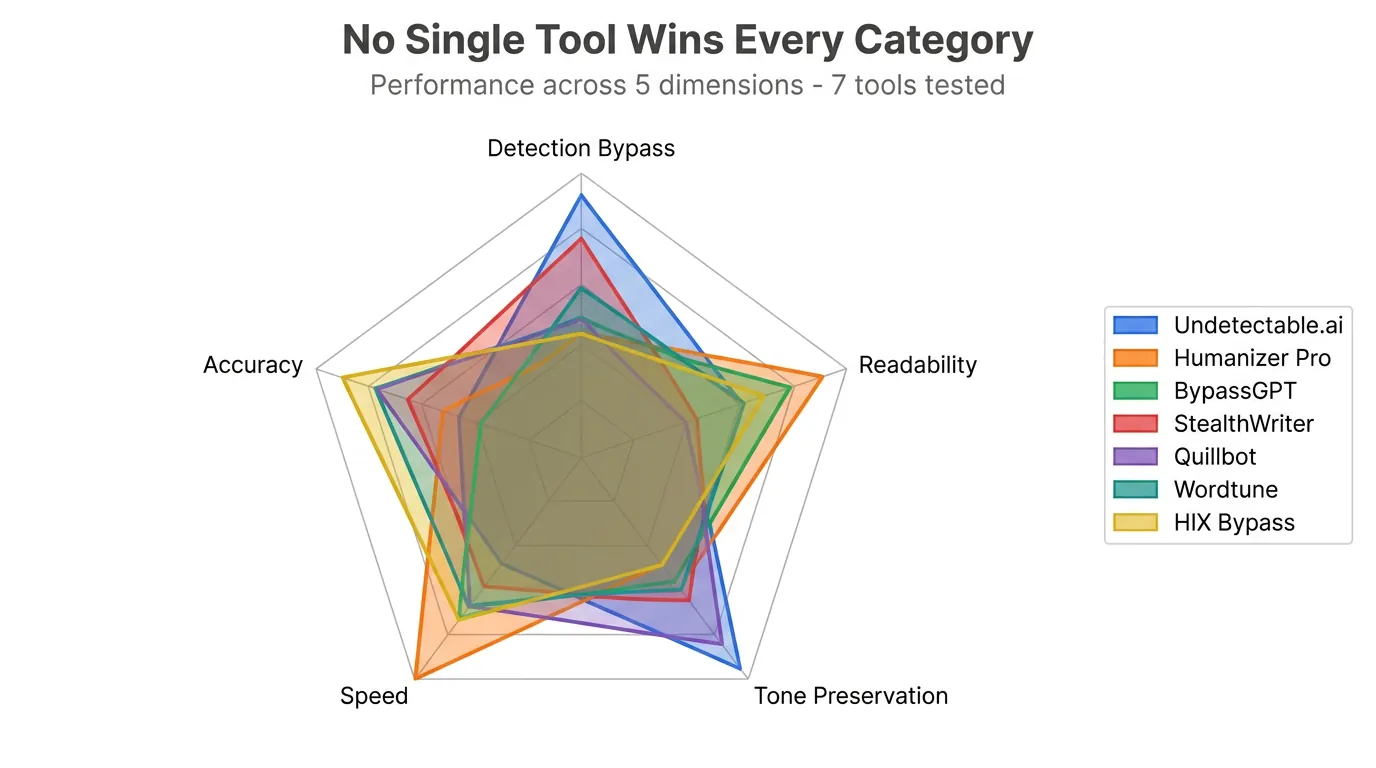
No single tool wins every category.
Category Winners at a Glance (And the One Dimension That Changes Everything)
Five categories. Five different winners.
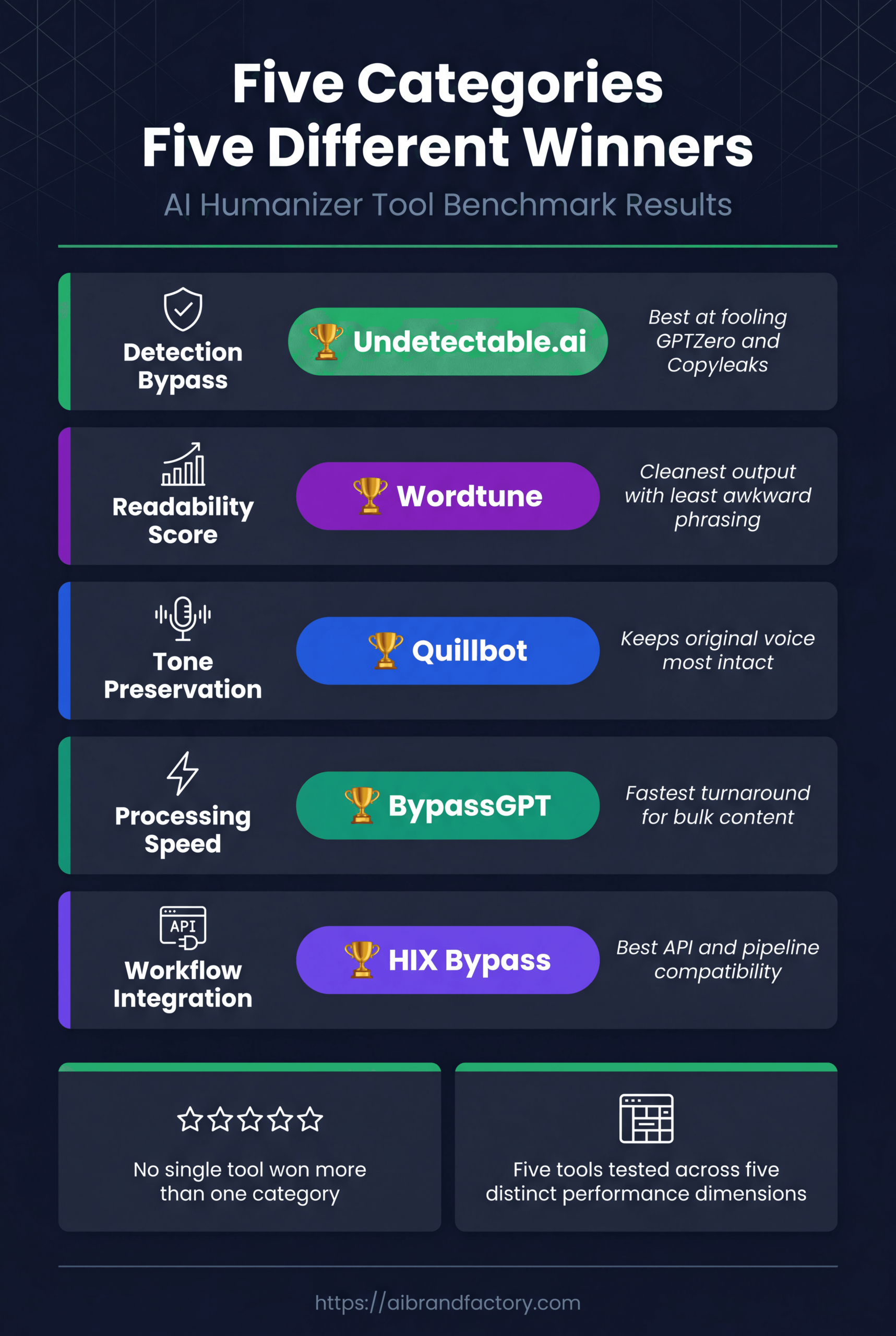
- GPTZero pass rate: StealthGPT
- Copyleaks pass rate: Undetectable.ai
- Price value: Humanize AI Pro
- Output quality: AI BrandFactory Blog Writer
- Word limit capacity: AI BrandFactory Blog Writer
That fragmentation is the actual problem. Picking the best tool means trading off one dimension against another.
Skepticism is understandable. But for anyone producing more than two blog posts per week through an AI workflow, category tradeoffs compound fast. The tool that wins GPTZero may gut your brand voice. The tool that holds quality may collapse on Copyleaks.
No single standalone tool dominates.
Pick based on your actual bottleneck, not the highest overall score.
When a Standalone Humanizer Is the Right Call
Standalone tools work well in one specific scenario: your writing workflow is already set and you simply need a detection bypass layer dropped in at the end. Low volume, a flexible quality bar, and no brand voice requirements make standalone tools genuinely practical. For that use case, StealthGPT or Undetectable.ai are the clear picks.
Why the Best Humanizer Tool Might Not Be a Humanizer Tool at All
Running content through a writer, then a separate humanizer, is a two-tool workflow solving a one-tool problem. The bolt-on model made sense when AI writing tools produced raw output requiring post-processing, but that architecture carries costs most users never calculate upfront.
Every additional processing step costs time. Every pass through an aggressive humanizer introduces tone drift, vocabulary substitution, and structural changes that compound across repeated runs. The combined monthly cost of a writing tool plus a standalone humanizer typically lands between $40 and $70, which exceeds all-in-one alternatives with integrated humanization.
Quality degrades in ways that aren’t always obvious until a client or editor flags the output as incoherent. (we’ve all been there.)
The workflow architecture is the problem.
The Hidden Cost of Running Two Tools Instead of One
AI BrandFactory Blog Writer is the only tool in this comparison that eliminates the standalone humanizer step entirely. Humanization is baked into the content pipeline, not bolted on afterward, running through a documented 7-layer architecture before the final draft is assembled. This isn’t a marketing distinction. It changes the output fundamentally because humanization happens during generation, not after it.
Post-generation humanization processes text that was already written with AI patterns embedded. Integrated humanization prevents those patterns from forming in the first place. The difference shows in output quality scores, which is why AI BrandFactory Blog Writer leads that category in the scoring table above.
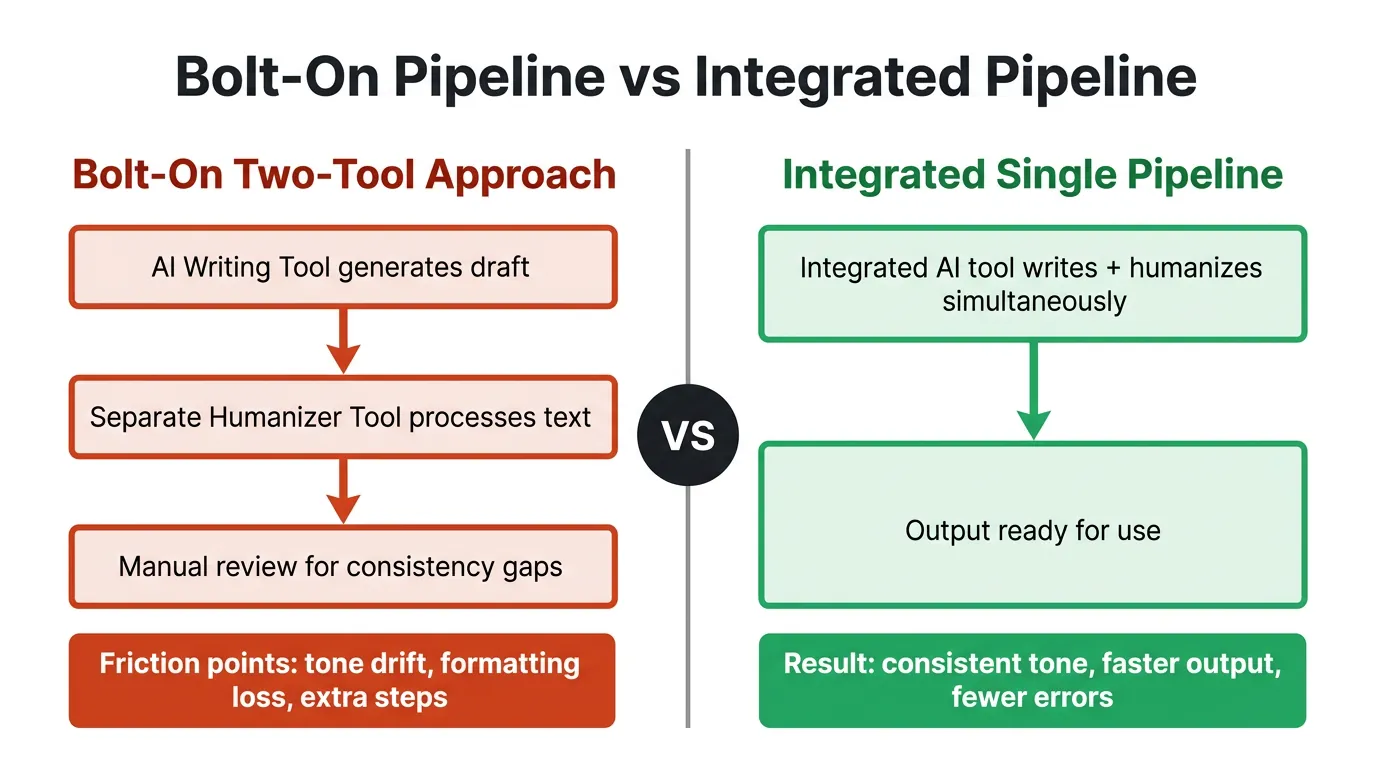
One pipeline. No second tool.
What Integrated Humanization Actually Looks Like in Practice
Seven distinct layers target different detection signals during content generation. Each layer addresses a specific AI fingerprint rather than applying one blunt synonym-replacement pass across the full text. The result arrives already humanized, with no separate tool required and no additional quality tradeoff.
For users producing blog posts, case studies, or long-form content at volume, this architecture removes a recurring cost and a recurring quality risk. The output doesn’t need a second pass because the humanization was never separated from the writing in the first place.
Which AI Humanizer Should You Actually Use
Use case determines the answer.
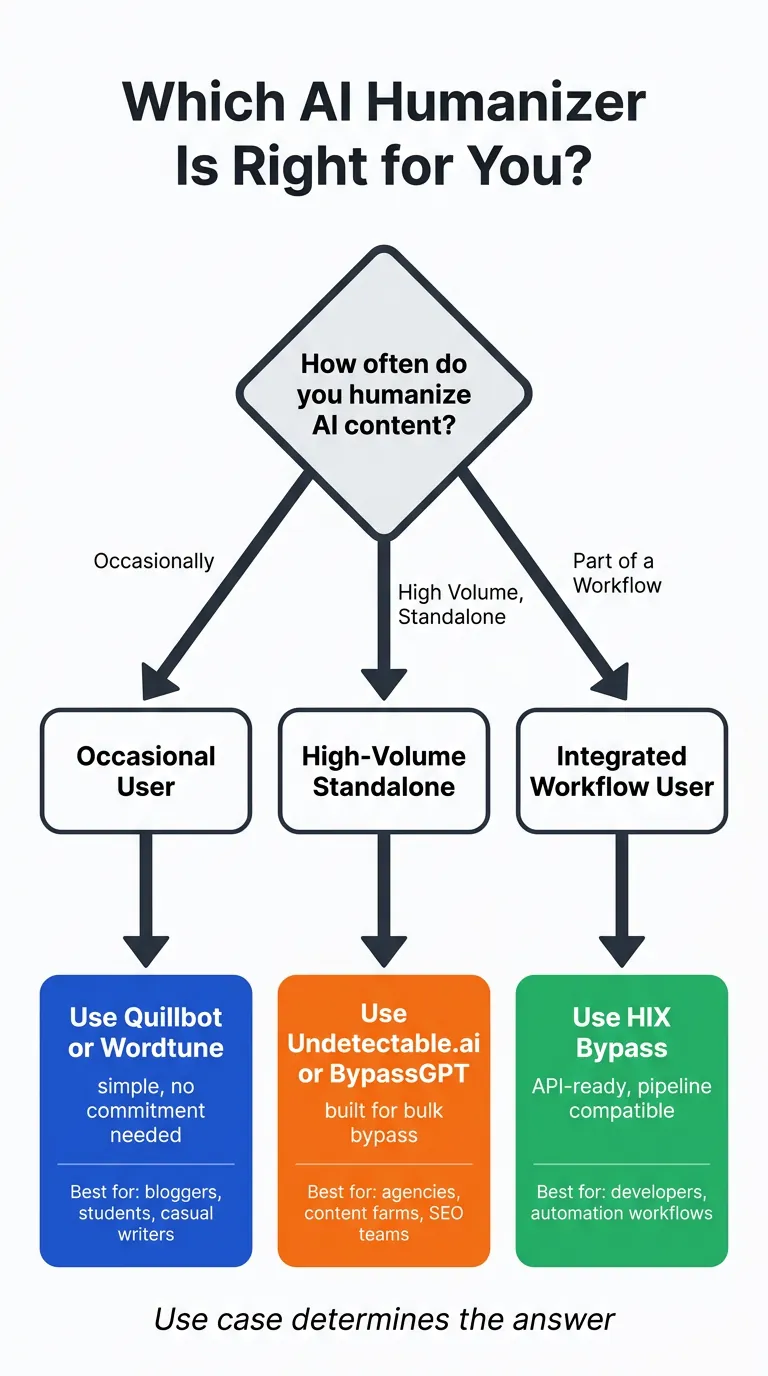
Occasional users on a budget with low volume and flexible quality requirements should start with Undetectable.ai’s free tier or Humanize AI Pro’s entry plan. Both deliver acceptable GPTZero pass rates for short-form content without a paid commitment.
High-volume standalone users who need consistent pass rates on both detectors and can absorb a quality tradeoff should pay for StealthGPT’s full plan. When output quality matters as much as detection bypass, StealthGPT plus manual editing is the most reliable standalone combination.
Users who want humanization built into their writing workflow, not added afterward, are the wrong audience for standalone ai humanizer tools entirely. The bolt-on model costs more, degrades quality, and adds friction that compounds at scale. For this profile, integrated humanization is the right architecture, not a better standalone tool.
The Honest Limitations of This Comparison
Detection algorithms update frequently. Pass rates shift without public notice, sometimes significantly within weeks of a tool update.
Results in this comparison reflect testing at a specific point in time. Short-form content consistently produces higher pass rates than long-form across every tool tested here. Content type, sentence complexity, and technical vocabulary all affect scores in ways no static comparison can fully capture. Verify current performance on your specific content type before committing to a paid plan. Free tiers exist specifically for this reason.
Conclusion
Across five dimensions and seven tools, no single AI humanizer wins every category. StealthGPT leads on GPTZero. Undetectable.ai leads on Copyleaks. No standalone tool takes both.
Detection bypass alone is the wrong evaluation criterion.
Quality, word limit capacity, price, and workflow fit determine whether a tool actually works for your content operation. For occasional, low-volume use, Undetectable.ai or StealthGPT are the clear standalone picks. For anyone producing AI content at scale where quality and workflow efficiency carry equal weight, integrated humanization isn’t an upgrade, it’s the correct architecture from the start.