
AI Copywriting: Tools, Frameworks, and Real Examples That Convert
Most AI copy reads fine but converts nothing. Generic benefits, vague language, CTAs nobody touches.
Better prompting alone won’t fix it. Applying proven copywriting frameworks at the prompt level changes the outcome entirely. This guide covers AIDA, PAS, FAB, and Before-After-Bridge with concrete examples, plus a direct comparison of Copy.ai, Jasper, and AI BrandFactory.
AI copywriting tools aren’t the problem. Framework ignorance is.
Start here.
The Three Reasons AI Copy Fails to Convert
AI-generated copy breaks down in three consistent ways.
Generic Benefits That Say Nothing to Nobody
“Saves you time” is not a benefit. It’s filler. AI defaults to statements nobody disputes and nobody remembers.
Generic benefits fail because they don’t differentiate. They don’t connect to your reader’s actual situation.
No Specificity Means No Credibility
Vague language kills trust fast. “Boost your results” means nothing to a buyer scanning your landing page. Specificity – numbers, timeframes, named outcomes – is what actually converts.
AI produces vague copy by default. It needs explicit prompting to generate specific claims. Without that instruction, you get “grow your business” every time. (admittedly, we’ve all shipped that copy once)
Weak CTAs That Ask for Nothing
A CTA should state what happens next and why it matters right now.
AI-generated CTAs default to “Learn More” or “Get Started.” Neither carries urgency. Neither frames the outcome. The reader clicks nothing because nothing gives them a reason to move.
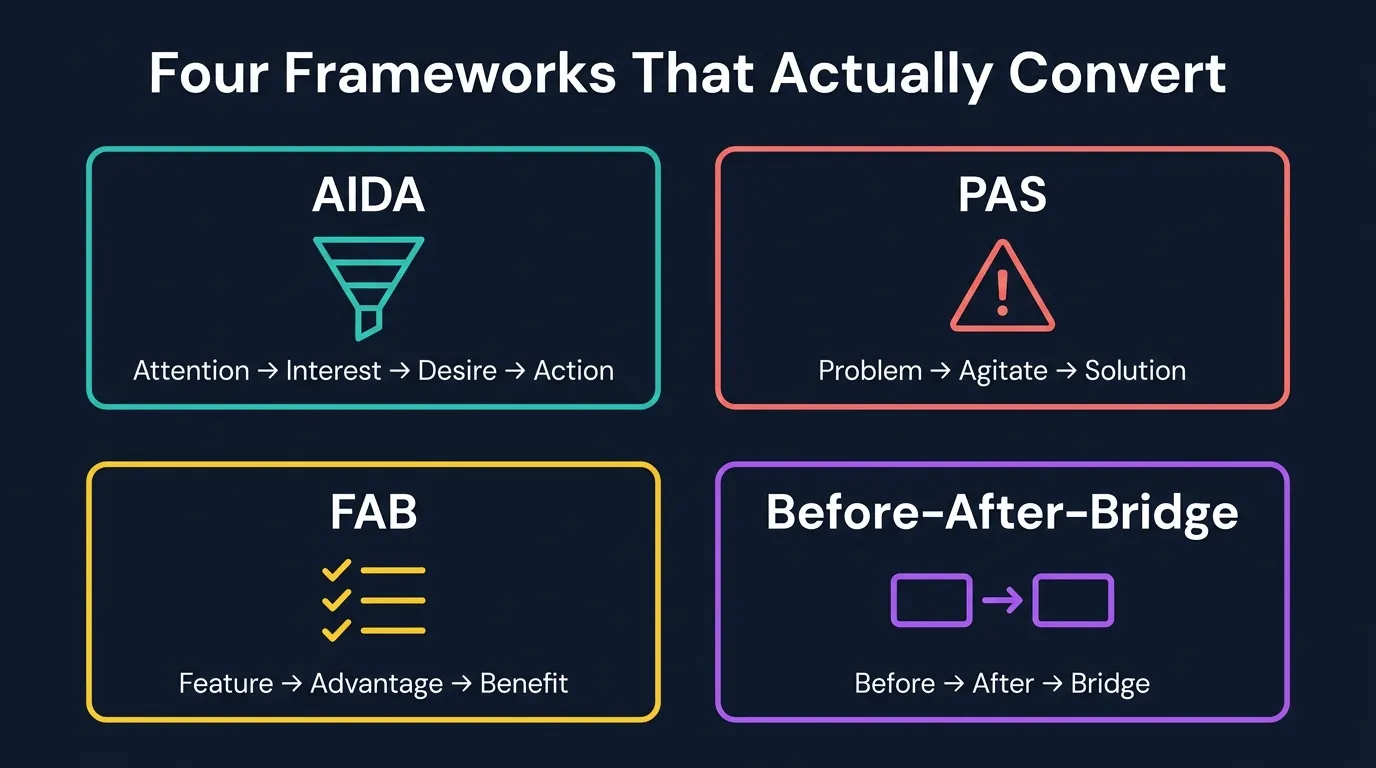
Four Copywriting Frameworks Every AI Prompt Should Know
Generic prompts produce generic copy. Framework-specific prompts produce conversion copywriting.
AIDA Gets Attention Before It Earns Action
AIDA stands for Attention, Interest, Desire, Action. The most widely used conversion structure for good reason.
Without explicit prompting, AI opens with flat statements that drop readers immediately. The Attention step must be disruptive and specific. Interest builds on a concrete claim. Desire fires when the reader sees an outcome they actually want. Action names the exact next move with a reason to take it now.
Prompt template: “Write a [format] using the AIDA framework for [product] targeting [audience].”
PAS Turns Pain Into the Most Persuasive Copy You Can Write
PAS stands for Problem, Agitate, Solution. This framework works because it finds readers inside their frustration. The Agitate step is where AI stumbles without explicit instruction. Left to its own devices, AI softens the pain. You have to force it to amplify instead.
Prompt: “Write using PAS. Problem: [specific pain]. Agitate: make it visceral. Solution: [product/offer].”
PAS performs best for email subject lines, landing page intros, and ad copy.
FAB Forces AI to Connect Features to Real User Value
FAB stands for Features, Advantages, Benefits. Feature: what it does. Advantage: why that matters. Benefit: what the user gains. Without FAB, AI catalogs capabilities with zero connection to buyer outcomes.
Prompt: “Apply the FAB framework. Feature: [X]. Advantage: [Y]. Benefit: [Z]. Write the copy.”
FAB is the strongest framework for product pages and comparison content.
No other framework closes the feature-to-value gap as cleanly.
Before-After-Bridge Shows the Transformation That Closes Sales
Before–After–Bridge is a narrative framework. Before: the painful current reality. After: the desired future state. Bridge: your product is the path connecting them.
AI needs both states explicitly defined in the prompt to generate specific copy. Without that input, it produces abstract transformation language that converts nobody.
Before-After-Bridge works especially well for testimonials, case study intros, and homepage hero sections.
Before and After: 3 Real Examples That Show the Gap
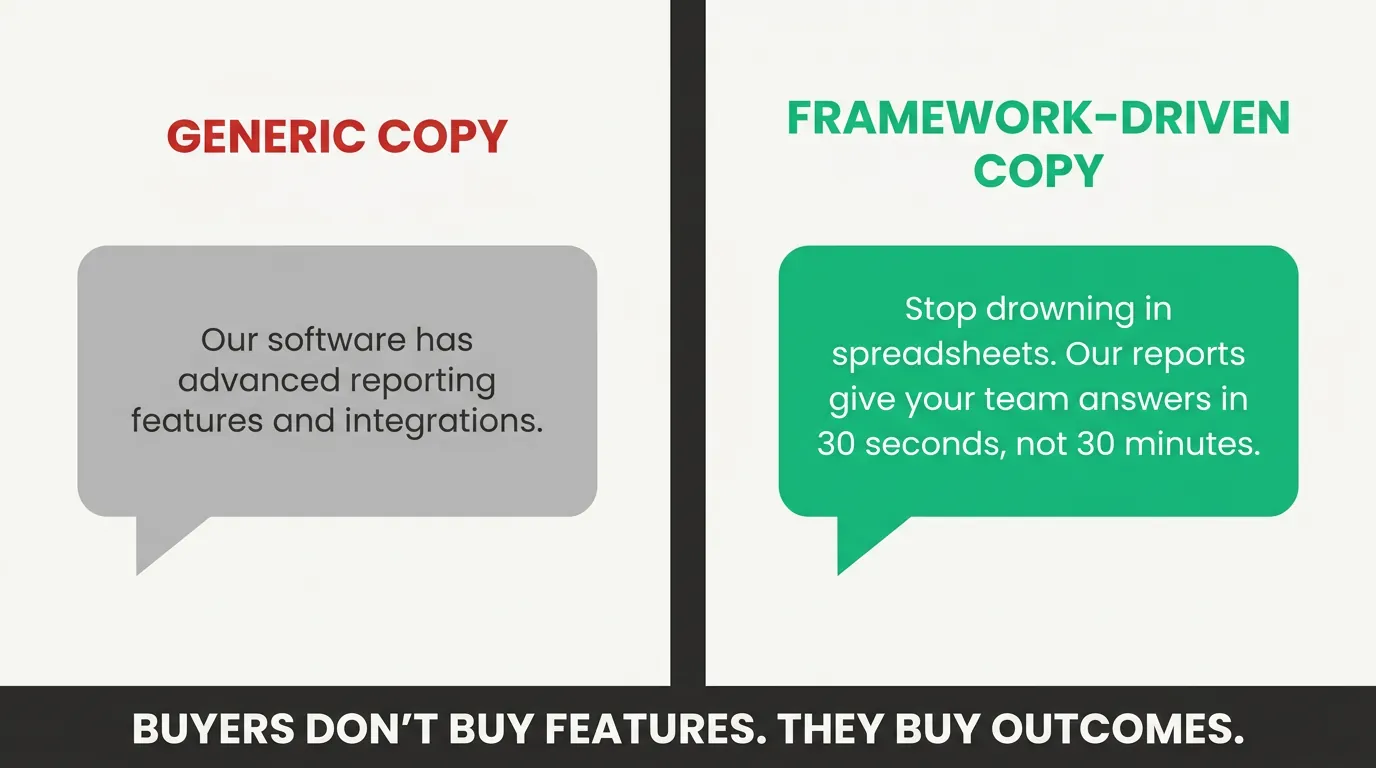
Frameworks don’t just sound better. They perform differently.
Generic AI Output vs PAS-Prompted Email Copy
Generic output: “Our tool helps you save time on content creation.” No problem named. No frustration amplified. No urgency created.
PAS version: “You’re spending four hours writing one blog post. That’s four hours you’re not pitching, closing, or building. [Product] cuts that to 25 minutes so you ship more and chase less.“
The gap lives entirely in the Agitate step. Without explicit instruction, AI skips it completely. The generic version describes a feature. The PAS version earns a click.
Generic AI Output vs AIDA-Prompted Landing Page Headline
Generic headline: “Powerful AI writing for your business.“
AIDA version: “Your competitors are publishing daily. You’re still editing your last draft. [Product] produces a publish-ready post in 25 minutes – SEO-optimized, humanized, cited.“
The AIDA headline jolts attention with a specific competitive reality. It builds interest through a concrete claim, then triggers desire with an outcome. Generic prompting produces placeholders. Framework prompting produces headlines that stop scroll.
Generic AI Output vs FAB-Prompted Product Description
Generic output lists three features with no connection to user value. (we’ve all read this copy and felt nothing)
FAB version: “Feature: 10-agent content pipeline. Advantage: every step – research, SEO, humanization – runs sequentially without manual handoffs. Benefit: you get a publish-ready post without managing six tools or three freelancers.“
Buyers don’t purchase features. FAB forces AI to write for the buyer’s outcome, not the product’s spec sheet.
Copy.ai vs Jasper vs AI BrandFactory for Framework-Driven Copy
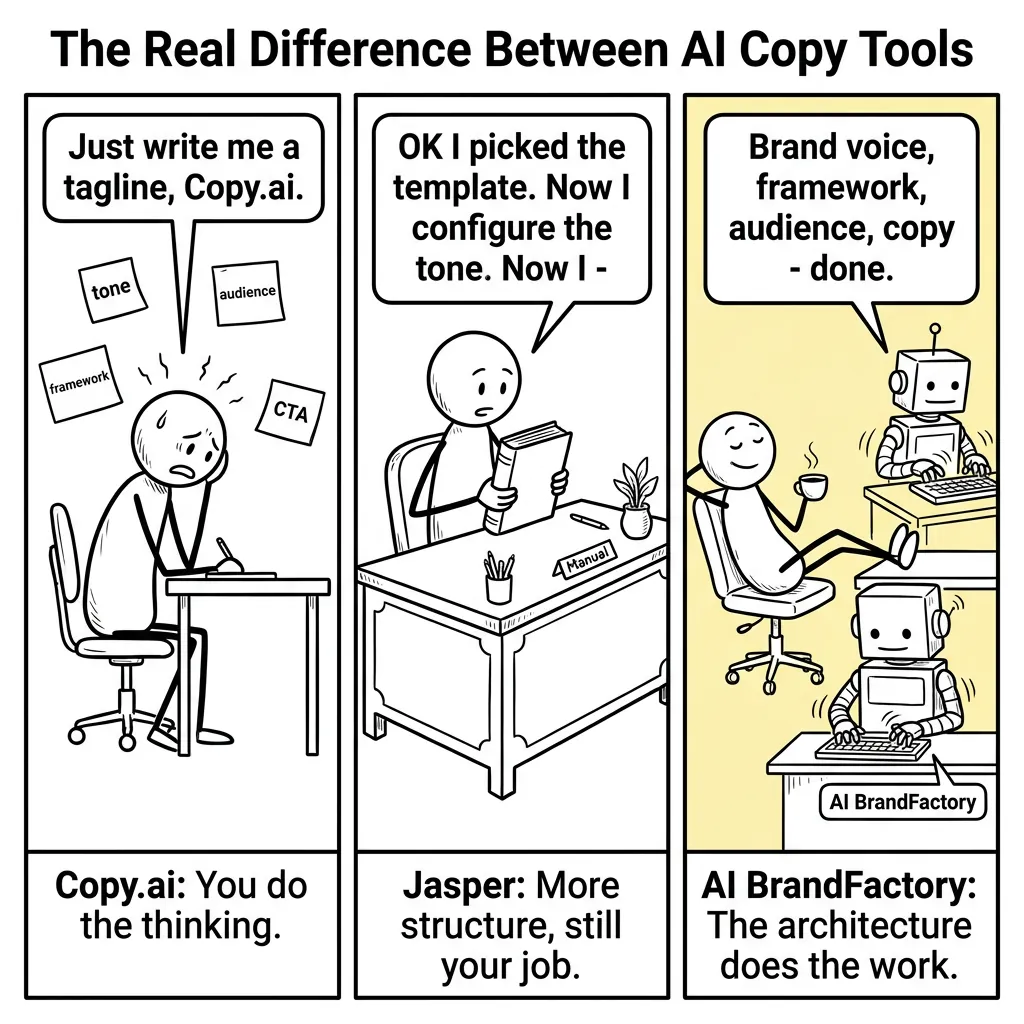
All three tools generate AI copy. Where they split apart is how much heavy lifting they leave on your plate.
What Copy.ai Gets Right and Where It Leaves You Doing the Work
Copy.ai carries a solid template library and punches out short-form content fast. Workflow templates loosely mirror copywriting structures.
Framework application stays entirely user-dependent – the tool neither enforces nor guides framework selection. Best for marketers who already know their frameworks and just want speed. Knowing what to prompt and how to structure it remains your problem entirely.
Copy.ai is a capable tool. Not a framework system.
What Jasper Gets Right and Where It Hits Its Ceiling
Jasper handles long-form better than most AI writing tools. Boss Mode and the document editor support longer framework-driven pieces.
Framework templates exist – but you have to select and configure them correctly. Best for teams with a defined content workflow who can brief the tool with precision.
Jasper gives you more structure than Copy.ai. The prompting burden still lands on the user.
How AI BrandFactory Removes the Prompting Burden Entirely
Skepticism is fair – most tools claim to simplify framework application but just relabel their templates. What separates AI BrandFactory is where framework selection actually happens. Not at the prompt level. At the architecture level.
The Blog Writer applies copywriting frameworks automatically once you specify the content type. Framework selection is baked into the 10-agent pipeline – nothing you configure or write yourself. The 18-field brand knowledge base carries your voice, your compliance rules, and your positioning into every generation automatically.
Best for marketers who want framework-driven copy without becoming expert prompt engineers.
This is the only tool in the comparison that produces framework-driven output without requiring you to know the framework.
AI BrandFactory isn’t a writing assistant. It’s a production system where expertise lives inside the architecture, not inside your prompts.
Conclusion
Framework-driven AI copy beats generic output. Every time. AIDA, PAS, FAB, and Before-After-Bridge are the four structures worth your attention.
Specificity and sharp CTAs are what separate copy that converts from content nobody finishes reading.
Want the frameworks applied for you instead of by you? AI BrandFactory is the only option in this comparison built that way. One pipeline handles framework selection, brand voice, SEO, and humanization. Start there.