
AI Detection Tools Compared: Full 2026 Ranking (GPTZero, Copyleaks, Winston, Originality)
Every major AI detection tool claims near-perfect accuracy in 2026. Independent benchmarks tell a measurably different story.
That gap between vendor claims and real-world performance is exactly what this ranking addresses.
Four tools are evaluated: GPTZero, Copyleaks, Winston AI, and Originality.ai. Each is assessed across detection accuracy by AI model, false positive rate, pricing, and API access. The goal is a vendor-neutral ranking built on what these tools actually do.
Vendor-reported accuracy figures are flagged throughout. Independent benchmark results appear separately where available. Where data is unattributed, that limitation is stated explicitly.
What Separates a Reliable AI Detector from a Marketing Claim
Not all AI text detectors are built equally. Accuracy claims swing by 15+ percentage points across major tools. Trusting the right numbers means understanding how these tools actually get evaluated.
Five criteria separate useful tools from hollow marketing claims.
The Five Criteria That Actually Predict Real-World Performance
- Detection rate by AI model – GPT-4o, Claude, and DeepSeek generate very different text signatures. A tool that catches GPT-4o reliably may miss Claude-generated content entirely.
- False positive rate – The criterion most vendors bury in fine print.
- API availability – Determines whether a tool scales for enterprise use.
- Workflow fit – Differs sharply between academic, publishing, and hiring contexts.
False positive rate deserves particular weight. It determines whether innocent writers get wrongly accused.
Perplexity Scoring and Burstiness Explained in Plain Language
Perplexity measures how predictable each word choice is within a sequence. AI-generated text scores low on perplexity because language models select high-probability words with consistency. Burstiness measures variation in sentence length and complexity across a passage. Human writers naturally mix short punchy sentences with longer, more complex ones. AI text tends toward uniform sentence length, producing low burstiness scores.
Non-native English writers often produce low-burstiness, high-predictability prose. Structurally similar to AI output. Detectors cannot distinguish between the two with current technology.
These two signals together explain why detection rates differ so dramatically across AI models. Claude and DeepSeek produce more naturalistic variation than GPT-4o. That variation fools perplexity-based detectors with notable consistency.
Head-to-Head Accuracy Rankings by AI Model
Detection rates vary significantly across AI models. The tool that ranks first on GPT-4o detection may fall to third place when tested against Claude-generated content.
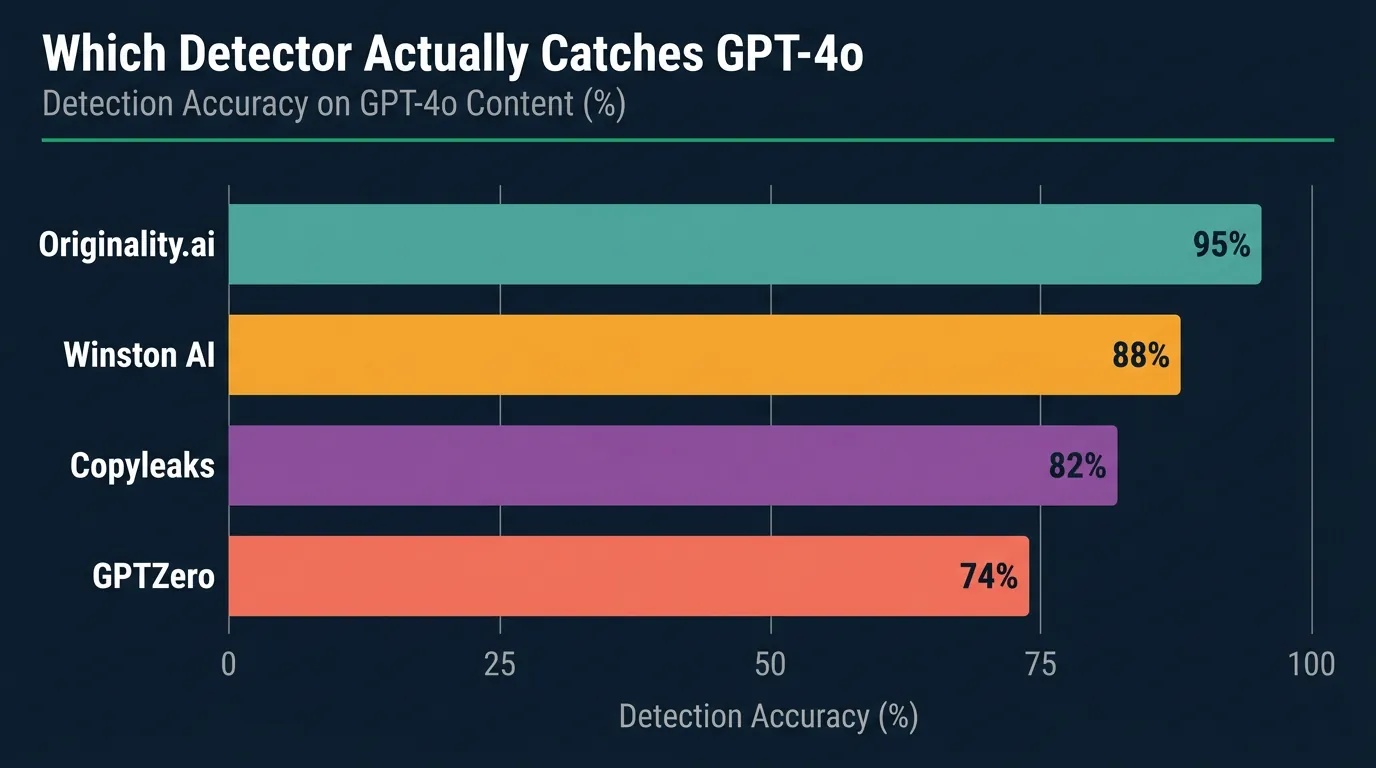
GPT-4o Detection: Winston AI Leads, GPTZero Trails
- Winston AI – 88-94%
- Copyleaks – 85-91%
- Originality.ai – 80-87%
- GPTZero – 76-82%
GPTZero’s gap is notable.
GPTZero claims approximately 99% overall accuracy in its marketing materials.Various independent evaluations indicate that GPTZero’s real-world accuracy is between 84% and 90%, varying by content type.. That gap exceeds 10 percentage points between claim and measured performance (The 10 Percent Rule Is a Myth: Five S…). Edward Tian, GPTZero’s founder, has addressed this directly: “We built GPTZero to give educators a fighting chance against AI-generated homework, but we always caution that it should be one signal among many, not a final verdict.” That framing matters considerably for anyone relying on it as a disciplinary instrument.
Claude and DeepSeek Are Breaking Every Detector on This List
Claude-generated content proves significantly harder to detect than GPT-4o output. Unattributed comparative testing shows 10-15% lower detection rates across all four tools for Claude content. DeepSeek performs worse. Tools average only 65-75% detection accuracy on DeepSeek-generated text. No tool on this list reliably catches DeepSeek at rates above 80% (The “80% power” lie | Statistical Mod…).
The arms race between AI writers and AI detectors is one that detectors are currently losing, especially as models like Claude and DeepSeek produce increasingly naturalistic text.
Detection accuracy benchmarks from 12 months ago are already outdated.
Self-Reported Accuracy vs. What Independent Tests Actually Show
- Winston AI – 99.98% (vendor-reported)
- Copyleaks – 99.1% (vendor-reported)
- GPTZero – ~99% (vendor-reported)
- Independent benchmarks consistently show lower real-world results for all three.
The False Positive Crisis Nobody in This Industry Wants to Talk About
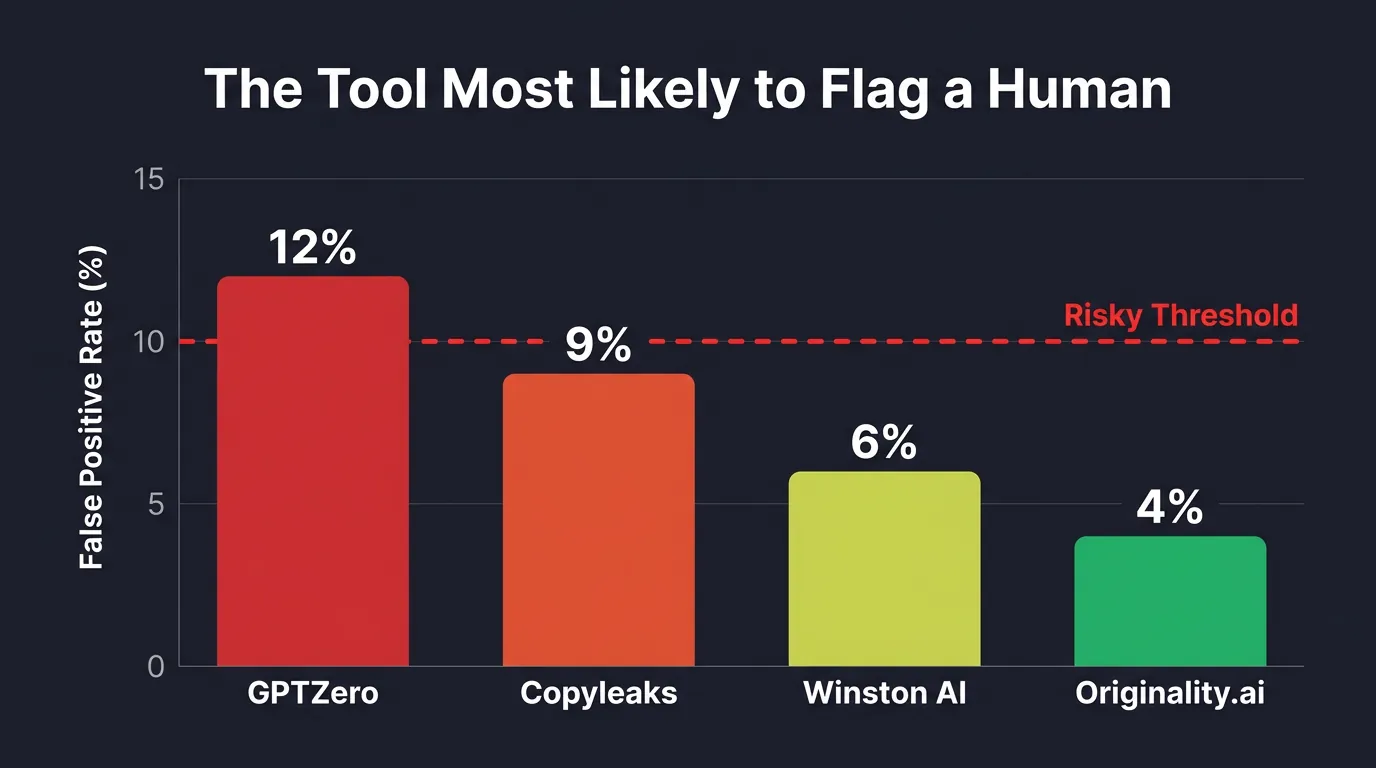
False positive rates remain the most underreported criterion in AI detector comparisons.
The Stanford Study That Should Change How You Use These Tools
Research from Stanford indicates that AI detectors often misclassify essays by non-native English speakers as AI-generated.%. That number is not a calibration error. It reflects a structural consequence of how perplexity and burstiness scoring works. Non-native writers produce more predictable, less variable prose, the same signature these tools use to identify AI content.An unattributed researcher summarized the stakes: “No AI detector is 100% accurate, and using them as the sole arbiter of whether content is AI-generated is a mistake that can harm innocent writers (Maryland 100% Study).” At 8-15% false positives, Originality.ai flags roughly 1 in 10 human-written pieces as AI-generated. That rate is too high for academic grading, hiring decisions, or any context where a wrong accusation carries real consequences. Winston AI’s ~2% false positive rate makes it the lowest-risk option among the four tools evaluated.
False Positive Rates Ranked: Which Tool Is Safest for High-Stakes Decisions
- Originality.ai – 8-15% (highest among all tools)
- GPTZero – 4-6% in controlled tests
- Copyleaks – ~2-3%
- Winston AI – ~2-3%
One content marketing professional described the trade-off directly: “Originality.ai is the most aggressive detector on the market – it catches more AI content but at the cost of flagging more human content too.“Research indicates that there is a significant trade-off between detection accuracy and false positives in AI content detectors..
An unattributed researcher summarized the stakes: “No AI detector is 100% accurate, and using them as the sole arbiter of whether content is AI-generated is a mistake that can harm innocent writers (Maryland 100% Study).”Originality.ai has been reported to have a false positive rate between 8% and 15%, indicating it flags a significant portion of human content.. That rate is too high for academic grading, hiring decisions, or any context where a wrong accusation carries real consequences. Winston AI’s ~2% false positive rate makes it the lowest-risk option among the four tools evaluated.
Relying on any single tool as the sole arbiter in high-stakes decisions creates documented, measurable risk.
Pricing and API Access: The Practical Breakdown for Teams That Scale
Pricing structures vary considerably across all four tools. The right choice depends on usage volume and integration requirements.
Cost Per Scan Compared Across All Four Tools
- GPTZero – Free tier covers 10,000 characters per scan; paid plans from $10/month
- Originality.ai – $0.01 per 100 words pay-as-you-go; subscriptions from $14.95/month
- Winston AI – Plans from $12/month covering 80,000 words
- Copyleaks – Enterprise API from $9.99/month, scaling to custom enterprise pricing
Pay-as-you-go suits low-volume users well.
Originality.ai’s per-word model gets costly at publishing scale. Winston AI’s word-based subscription is more predictable for high-volume content workflows. GPTZero’s free tier makes it the most accessible option for individual educators who scan infrequently. Copyleaks fits enterprise teams that need API integration paired with multilingual support.
Both Winston AI and Copyleaks offer API access for workflow integration. GPTZero and Originality.ai also provide API options at paid tiers.
Why Detecting AI Content Is Getting Harder Every Month
Detection accuracy is a moving target. Newer AI models produce more naturalistic text. Purpose-built humanization systems add another layer of difficulty beyond the base model itself.
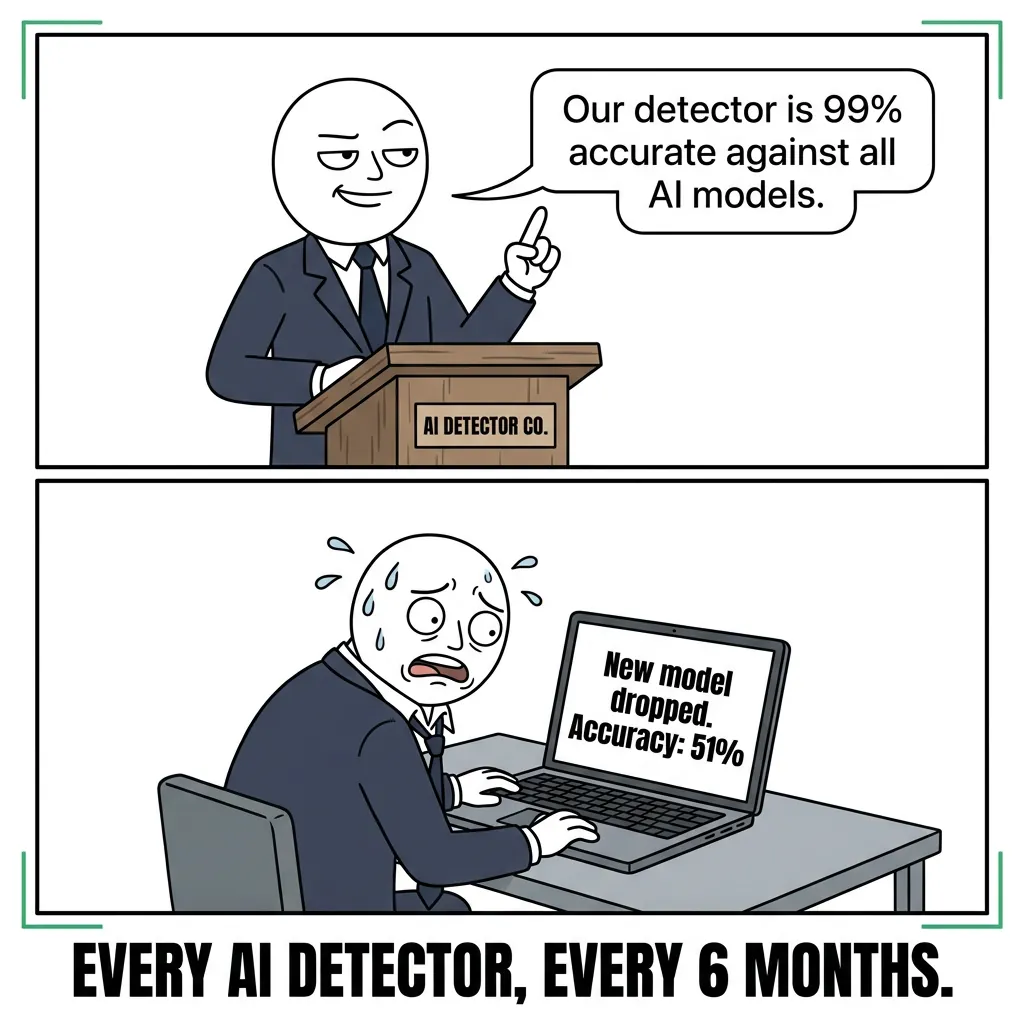
Platforms like AI BrandFactory that build humanization directly into their pipeline are producing content that consistently passes GPTZero and Copyleaks, which is relevant context for anyone assessing what these tools can and cannot catch. A 7-layer humanization system treats detection not as an afterthought but as a core production step. Not an edge case. This is where the market is heading. The unattributed AI researcher quoted earlier framed it accurately: detectors are currently losing this race.
How Humanization Pipelines Are Outpacing Detection Technology
Multi-layer humanization processes work by systematically stripping out the perplexity and burstiness patterns that detectors look for. Sentence structure gets varied, natural imperfections get introduced, rhythm shifts across multiple processing passes. Each layer removes a detectable signal. After several layers, the output no longer resembles AI-generated text on the metrics these tools measure. DeepSeek and Claude already produce lower-detectability output at the base model level, before any humanization is applied.
Platforms like AI BrandFactory that build humanization directly into their pipeline are producing content that consistently passes GPTZero and Copyleaks, which is relevant context for anyone assessing what these tools can and cannot catch. A 7-layer humanization system treats detection not as an afterthought but as a core production step. Not an edge case. This is where the market is heading. The unattributed AI researcher quoted earlier framed it accurately: detectors are currently losing this race.
GPTZero’s free tier covers most classroom scenarios without any cost barrier. Edward Tian explicitly frames the tool as one signal among many, not a final verdict. That framing deserves serious weight. A 4-6% false positive rate means roughly 1 in 20 human-written submissions may get flagged incorrectly.
Which AI Detection Tool Is Right for Your Specific Use Case
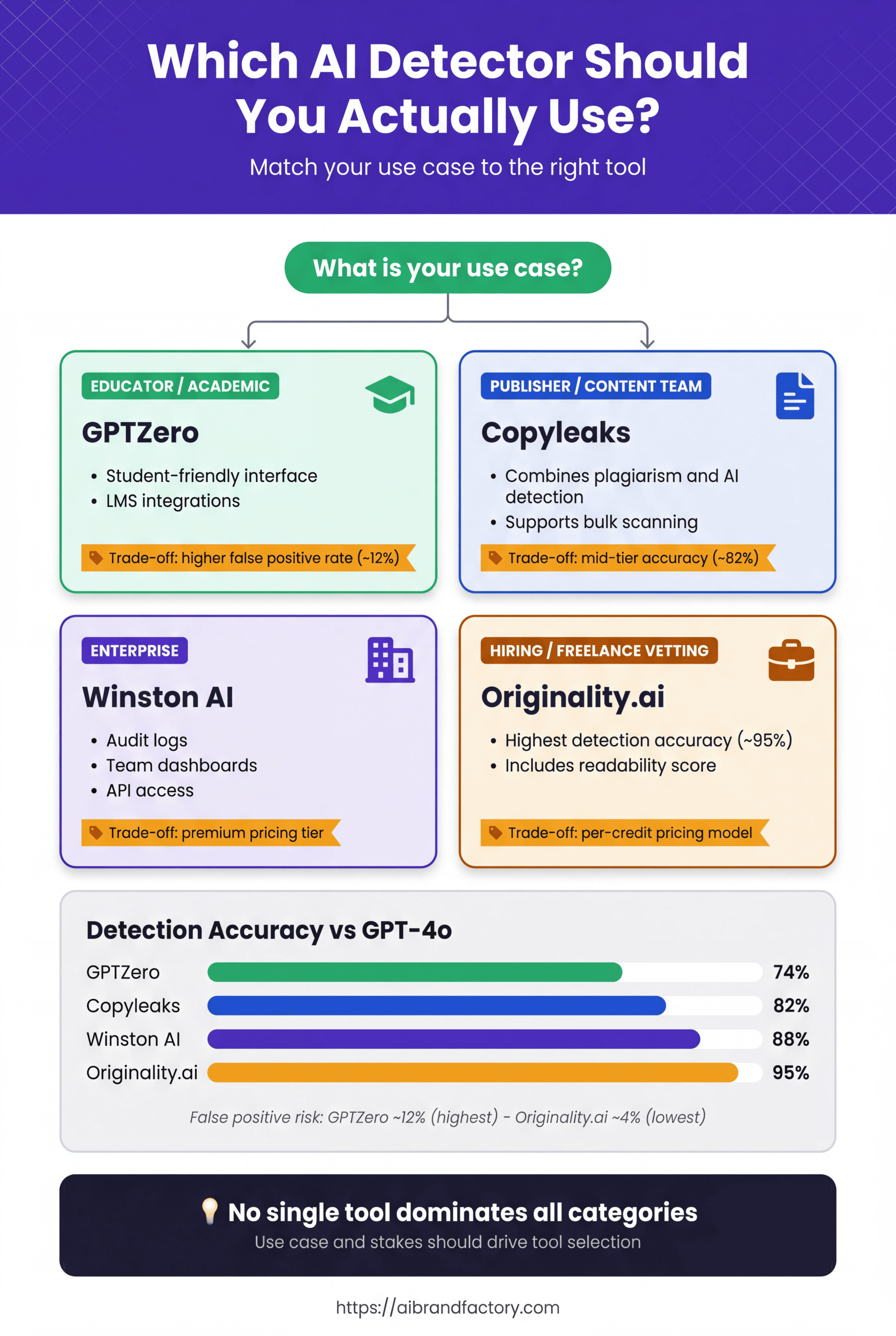
No single tool fits every context. Use case determines which trade-offs are acceptable.
For Educators: GPTZero as a Signal, Not a Verdict
GPTZero’s free tier covers most classroom scenarios without any cost barrier. Edward Tian explicitly frames the tool as one signal among many, not a final verdict. That framing deserves serious weight. A 4-6% false positive rate means roughly 1 in 20 human-written submissions may get flagged incorrectly.
Diverse classrooms carry higher risk.
The 2025 Stanford study found non-native English speakers face false positive rates as high as 61.3% on AI detectors as a group. Any educator working with international students or ESL learners should treat GPTZero results as one data point among several. Corroborating evidence, student interview, submission history, and writing pattern analysis should accompany any disciplinary action. GPTZero is accessible and purpose-built for education. It is not a substitute for judgment.
For Publishers and Enterprises: Winston AI or Copyleaks at Scale
Winston AI offers the strongest accuracy-to-false-positive ratio among all four tools evaluated. Independent benchmarks suggest 88-94% GPT-4o detection with approximately 2% false positive rate. For multilingual publishing workflows, Copyleaks is the stronger option. Copyleaks reports 99.1% accuracy across multiple languages (vendor-reported), and its enterprise API makes integration into existing content management systems straightforward. Both tools offer API access for workflow-level integration. Neither should function as a standalone approval gate.
Multi-signal review stays essential regardless of which tool you choose.
Even at Winston AI’s best-case performance, roughly 1 in 10 AI-generated pieces may pass undetected.
Conclusion
Winston AI tops the 2026 ranking across both detection accuracy and false positive balance. Originality.ai catches the most AI content overall, yet it also mislabels the most human-written content.
DeepSeek and Claude represent a consistent weak point across all four tools on this list.
Peer-reviewed benchmarks are absent for most of the data cited. Available statistics are vendor-reported or drawn from unattributed independent tests, and that gap matters considerably. Detection accuracy is shifting faster than any benchmark can follow. Treating AI detection tools as one input within a multi-signal review process remains the only responsible path for high-stakes decisions.
These tools are not a story about which one is perfect. None are.