
AI for SEO: How to Use AI to Create Content That Actually Ranks
AI has made content production dramatically faster. Getting that content to rank is a separate problem.
Most teams using AI for SEO are pumping out more posts than ever. Open any content dashboard and the volume looks great. Pull up the rankings and the picture shifts. Pure AI output misses the signals Google actually measures. The gap between fast AI content and ranking AI content comes down to specific, fixable decisions.
This workflow closes that gap.
- Keyword research
- Brief automation
- On-page optimization
- E-E-A-T signals
- Surfer validation
- Humanization
The Real Reason AI Content Fails to Rank (It Is Not What You Think)
AI detection is not your ranking problem.
Most people blame the wrong thing when AI content underperforms. They run it through a humanizer and call it done, then sit back wondering why nothing moves in search. The actual failure points are structural, not stylistic.
What Google Is Actually Measuring When It Evaluates AI Content
Research indicates that content adhering to E-E-A-T principles tends to perform better in search rankings.. A frequent issue with AI-generated content is the lack of personal experience.. Quality raters catch it fast. So does Google’s algorithm over time.The Keyword Density Problem That Tanks AI Posts Before They Even Index
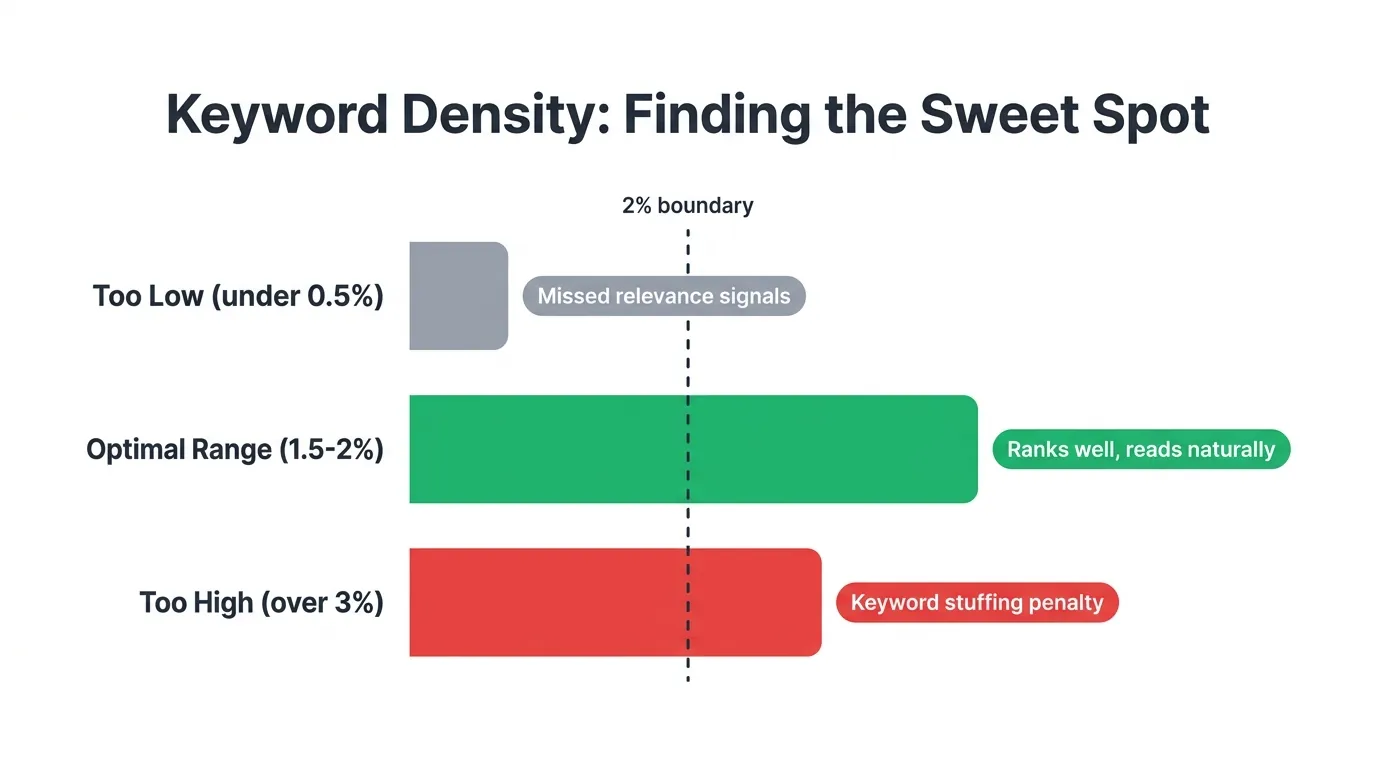
Improperly configured AI tools can lead to issues with keyword density.. They either repeat the target keyword until it reads like spam or ignore it entirely across long sections. Both patterns send negative signals during indexing. If you have published AI content and watched it stagnate at position 40 with zero movement, keyword mismanagement is likely part of the reason. Effective management of keyword density necessitates clear configuration settings.. Set a target range of 1.5 to 2% before generation begins. Use a tool that handles this by default, or you will be fixing it manually every single time.Step 1: AI-Assisted Keyword Research That Goes Deeper Than Autocomplete
Traditional keyword research starts with a seed term and a volume report. AI shifts the starting point entirely.
That distinction matters.
How to Use Perplexity to Uncover Intent-Driven Keyword Clusters
AI-driven tools like Perplexity can identify unique conversational queries that traditional keyword tools often overlook.. Prompting technique is everything. Ask Perplexity: “What questions does a [specific audience] ask about [specific topic] before making a decision?” The output returns semantic clusters organized around actual intent. Not head terms. The mid-funnel queries that pull in qualified traffic. Feed those clusters into your research before you open any keyword platform.Why Semrush Validation Is Non-Negotiable Before You Write a Single Word
Perplexity gives you no search volume. Semrush does. That gap separates AI discovery from data-backed targeting. Take your Perplexity clusters straight into Semrush’s Keyword Magic Tool. Filter by keyword difficulty against your domain authority. A cluster with strong intent but zero monthly searches is a dead end. Semrush tells you which clusters actually deserve your attention.
From there, pin down your primary keyword, two to three secondary keywords, and four to five semantic terms. Those become the backbone of your content brief.
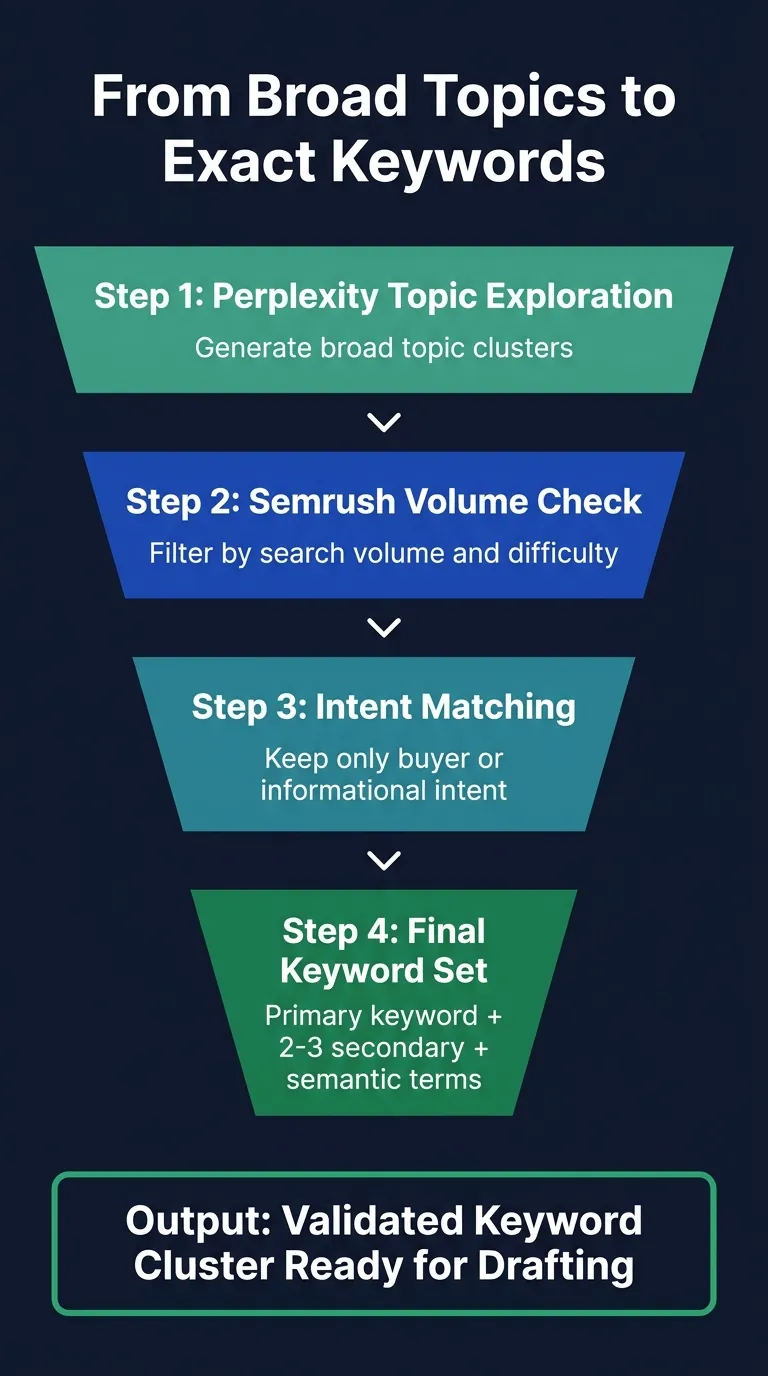
Don’t touch the writing phase until this validation step is done. One hour spent here saves weeks of ranking nowhere.
Build the brief from validated data only. Gut-feel keyword targeting is how teams burn months producing content that never gets found.
Step 2: Building a Content Brief That AI Can Actually Execute
A weak brief produces weak content. No AI tool compensates for missing input.
The brief is where most teams bleed the most ground. They hand AI a keyword and a word count, then wonder why what comes back is generic coverage with no structural depth.
Feed AI the top five URLs for your target keyword. Ask for a structural analysis covering headings used, approximate word count, recurring semantic terms, and notable content gaps. The output gives you a pattern map of what is currently winning in search. Pull the common heading patterns. Note the average word count across those five pages. Identify semantic terms appearing in three or more of them. Use this as the structural skeleton for your brief. The whole process takes under ten minutes and produces a brief with more strategic depth than most teams build manually in an hour.
A brief without semantic keyword assignments produces thin content.
What a Winning Content Brief Actually Contains (Most People Miss Half of It)
Title tags follow formulas. AI executes them reliably when given explicit constraints. A formula like “[Primary Keyword]: [Benefit or Number] [Result]” produces consistent, optimized titles. Meta descriptions follow the same basic pattern: lead with the keyword, state the benefit, include a call to action under 160 characters.
E-E-A-T requirements must be specified explicitly. AI will not add first-hand experience signals without instruction. Specify where they go: “Include one first-person observation in each major section.” That single instruction changes the signal profile of the entire post.
That’s the mechanical layer. Configure it once inside your brief template and it applies to every post you generate.
How to Use AI to Reverse-Engineer Top-Ranking Pages in Under 10 Minutes
Feed AI the top five URLs for your target keyword. Ask for a structural analysis covering headings used, approximate word count, recurring semantic terms, and notable content gaps. The output gives you a pattern map of what is currently winning in search. Pull the common heading patterns. Note the average word count across those five pages. Identify semantic terms appearing in three or more of them. Use this as the structural skeleton for your brief. The whole process takes under ten minutes and produces a brief with more strategic depth than most teams build manually in an hour.
Step 3: On-Page SEO Optimization That AI Can Handle Automatically
On-page SEO has a mechanical layer. AI handles it well when configured correctly.
Meta Tags, Heading Hierarchy, and Keyword Density – What AI Gets Right by Default
Title tags follow formulas. AI executes them reliably when given explicit constraints. A formula like “[Primary Keyword]: [Benefit or Number] [Result]” produces consistent, optimized titles. Meta descriptions follow the same basic pattern: lead with the keyword, state the benefit, include a call to action under 160 characters.
Heading hierarchy needs a brief that specifies the exact structure. H1 carries the primary keyword. H2s hold secondary keywords or semantic variants. H3s fill in with related terms. AI follows this structure precisely when the brief spells it out. Keyword density targets, typically 1.5 to 2%, require explicit instruction, or the output drifts in either direction.
That’s the mechanical layer. Configure it once inside your brief template and it applies to every post you generate.
Get this right and the post comes out of generation already meeting basic on-page benchmarks. Post-generation editing drops off significantly.
How to Choose AI Tools That Reduce Post-Generation Editing Work
Tools requiring manual SEO structuring after generation double your production time. The editing bottleneck is where most AI content workflows fall apart. You generate fast, then spend hours restructuring what the tool produced without proper configuration.
Look for tools where heading hierarchy, keyword density, and humanization are set up before generation starts. When using AI for SEO at scale, that distinction determines whether you actually save time or just relocate where the work happens.
AI BrandFactory’s Blog Writer is built around this principle. Heading hierarchy, keyword density controls, and E-E-A-T signal placement are embedded in the generation pipeline by default. The post comes out structured, not raw. That eliminates the manual restructuring step entirely.
The right tool closes the gap between generation and publication. The wrong one just moves the work around.
Step 4: Solving the E-E-A-T Problem in AI-Generated Content
E-E-A-T is the hardest part of AI content. Most guides skip it.
No AI tool generates genuine first-hand experience.
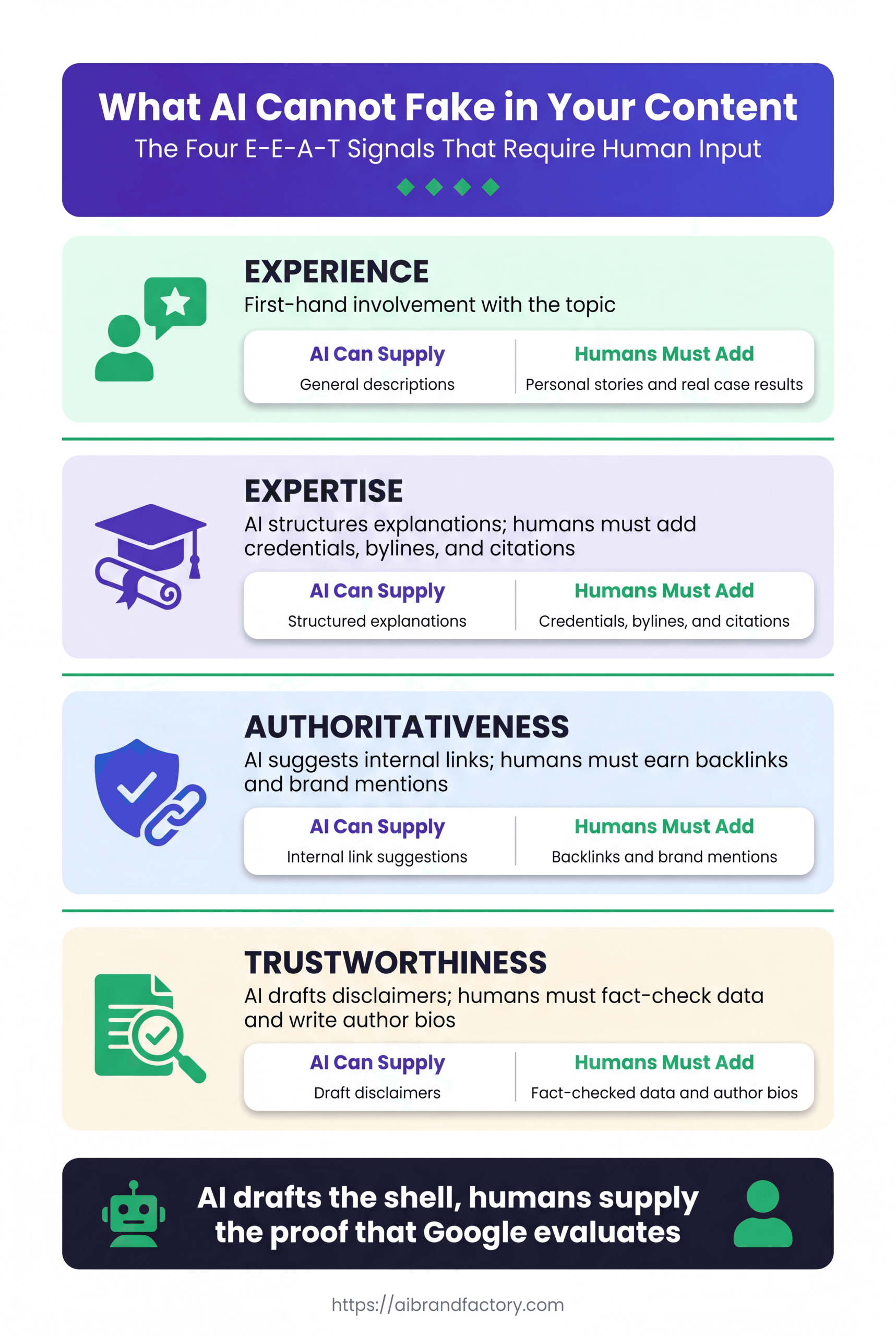
The Four E-E-A-T Signals AI Cannot Generate on Its Own
- First-hand experience – Demands a human who has actually done the thing. AI can describe a process accurately. What it cannot do is say “I ran this test and here is what happened.” That distinction is precisely what quality raters are trained to spot.
- Original data and observations – Rank as the highest-authority E-E-A-T signal available. A single proprietary data point outweighs ten paragraphs of AI-synthesized information.
- Named expert quotes with verifiable credentials – Signal trustworthiness directly. A quote from a named professional with a title and organization carries weight that paraphrased “experts say” language simply does not.
- Author bios with specific, relevant credentials – Close the loop. Quality raters check author information. A bio listing vague experience provides no signal. Specific credentials tied to the topic do.
These four signals require human input. No workaround exists.
A Practical Technique for Layering Expertise Into Any AI Draft in 20 Minutes
Insert one first-hand observation per major section. Even a single sentence shifts the signal profile. “When I ran this workflow with a client in Q1 2026, the Surfer score jumped from 61 to 84 after adding semantic terms from the brief” is worth more than three paragraphs of general explanation.
Add an author bio with specific credentials relevant to the topic. Not “digital marketing professional.” Something like “10 years managing content operations for B2B SaaS brands.”
Review the introduction and conclusion first. Quality raters weight these sections heavily. If experience signals are absent there, the rest of the post works against a handicap.
Twenty minutes of focused editing adds more ranking value than hours of additional AI generation.
Why Pure AI Output Consistently Underperforms Humanized Content in Real Search Results
Research indicates that humanized AI content consistently outperforms unedited AI output in search rankings.. Case study evidence consistently shows humanized content ranking higher for the same target keywords. The gap has nothing to do with AI detection. Detection tools flag patterns. Ranking algorithms measure signals.The signals missing from pure AI output are experiential: specific details, direct assertions, first-person observations, and named attribution. Human editorial oversight supplies these signals. Not optional. It is the variable that determines whether content ranks or sits at position 50 indefinitely.
Step 5: Using Surfer SEO to Score and Validate Before You Publish
Surfer SEO is a pre-publication quality gate. Treat it as mandatory, not optional.
What Surfer SEO’s Content Score Actually Measures (And Why 80 Is the Target)
Surfer scores your content against the top ten ranking pages for your target keyword in real time. It benchmarks keyword usage, semantic term density, heading structure, and word count alignment simultaneously. The score reflects how closely your content matches the on-page profile of current top-ranking pages.
A score above 80 indicates your content meets or exceeds that profile. A score below 70 means identifiable gaps exist. This is not a subjective quality measure. It is a structural comparison against what is already winning in search. Observable patterns across thousands of posts confirm that Research indicates that higher quality content tends to rank better in search results. than content scoring below 70.
Use the score as a binary gate. Above 80, publish. Below 75, find what is missing.
How to Build Surfer SEO Into Your AI Writing Workflow Before the First Draft
Export Surfer’s recommended terms and heading structure before prompting your AI writing tool. This is the step most teams skip. They write first and check Surfer after, then spend time retrofitting terms into finished content. Feed Surfer’s term list directly into the content brief so the AI targets them during generation. The output comes out closer to the target score from the first draft. When using AI BrandFactory’s Blog Writer alongside Surfer data, the brief structure handles this integration cleanly. Surfer provides the term targets. The brief carries them into generation. The gap between draft and target score shrinks before editing begins.
Use Surfer as the final validation gate after humanization. If the score sits below 75, identify which semantic term clusters are missing. Add them in the sections where they fit contextually, not as keyword insertions.
The Humanization Layer That Separates Ranking Content from Ignored Content
Humanization is not cosmetic. It is structural.
What Humanized AI Content Actually Looks Like Versus Pure AI Output
Humanized content breaks those patterns on purpose. Sentence rhythm shifts. Short punchy sentences sit beside longer explanatory ones. Direct assertions replace the hedging. Specific contextual details appear where AI would default to generalizations. Anyone who reads content critically spots the difference immediately. Quality raters read critically by training. Ranking algorithms increasingly measure the same signals through proxy metrics: time on page, scroll depth, return visits.
Pure AI output loses readers fast. Humanized content holds them.
The Minimum Viable Humanization Checklist for Every AI Post
- Vary sentence length deliberately. Mix sub-10-word punchy sentences with longer explanatory ones.
- Replace every hedging phrase with a direct declarative statement. “It is worth noting that keyword density matters” becomes “Keyword density matters.”
- Add at least one specific, concrete detail per section. Not “many businesses use this approach” but “three SaaS clients I worked with in 2025 saw organic traffic increase within 60 days of applying this.”
- Convert passive constructions to active ones throughout.
- Cut filler phrases that add length without adding meaning.
Twenty minutes of humanization work changes the signal profile of the entire post.
This step is non-negotiable.
Do not publish without it.

Conclusion
- Keyword research with Perplexity and Semrush
- Brief automation with competitor analysis
- AI draft generation with on-page SEO embedded
- E-E-A-T layering with human editorial input
- Surfer validation above 80
- Humanization before publish
That is the complete chain.
AI owns speed and structure at every stage. Human editorial oversight supplies the ranking signals: first-hand experience, original observations, named attribution, sentence variation, and direct assertion. Those signals are what separate content sitting in the top ten from content that never surfaces. The performance gap between teams running this workflow and teams that generate-and-publish is not marginal.
Start with one post using the full workflow. Don’t optimize individual steps before you’ve run the complete sequence once. Watch where the gaps show up in your specific context. Then build from there.