Best AI Writing Tools in 2026 Ranked and Tested for Content Marketers
The Letter A: Where Human Craft Meets Machine Intelligence
Best AI Writing Tools in 2026: Ranked and Tested for Content Marketers
Raw AI output isn’t publish-ready. Most content marketers find this painfully, after a client flags an article or a detector catches what slipped through. Studies show that the accuracy of AI detection for non-humanized content is projected to rise significantly in the coming years., and that number carries genuine brand credibility risk for anyone publishing at scale. Six AI writing tools went through the same content brief during testing, scored across five criteria: output quality, instruction-following, humanization, context window size, and pricing value.
No single tool won across all five dimensions.
The tools tested fall into two distinct categories: raw model API access and purpose-built content platforms. Grasping that distinction before selecting a tool saves real time and money. Each category serves different workflows, different skill levels, and different production realities. This comparison delivers a straight answer grounded in actual use, not vendor marketing.
Read the scoring rubric in the next section before getting into the tool reviews. The framework applies to any AI writing tool you evaluate, not just the six covered here.
The Scoring Rubric Every Content Marketer Should Use Before Picking a Tool
Choosing an AI writing assistant without any evaluation framework is exactly how content marketers wind up with expensive subscriptions collecting digital dust. Most tool comparisons focus on output quality alone and skip the four criteria that actually determine whether a tool fits your workflow.
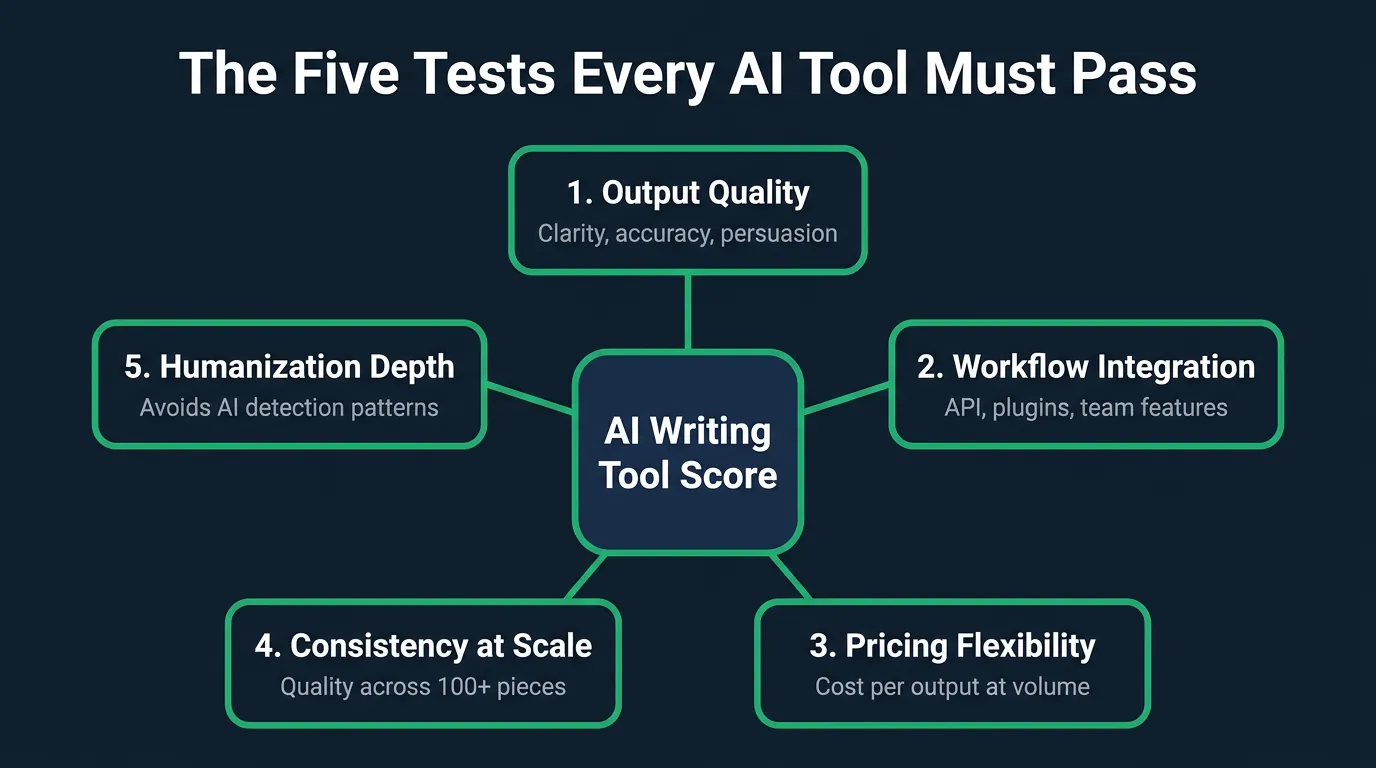
The Five Tests Every AI Writing Tool Must Pass – Evaluation Framework Diagram
The Five Dimensions That Actually Separate Good Tools from Expensive Mistakes
Output quality – measures coherence, depth, and brand-appropriate tone across long-form content.
Instruction-following – measures how precisely the tool sticks to your brief, your format requirements, and your structural specifications.
Humanization ease – determines whether output goes straight to publish or needs another tool and another hour of editing.
Context window size – sets the ceiling on how much brand context, source material, and prior drafts can inform a single generation session.
Pricing value – measures what you actually get per dollar across your specific production volume.
Instruction-following is the most underrated criterion on this list.
A tool with brilliant output that ignores your brief wastes more time than it saves. You end up rewriting to spec anyway, which defeats the whole point of using an AI-powered writing assistant.
Humanization is not optional in 2026. Content marketers who skip this step are taking a genuine risk with every piece they publish.
Context window size becomes more consequential as your projects grow longer and more complex.
Why Raw Model API Access and Purpose-Built Platforms Are Not the Same Category
Raw API access to a base model like Claude or GPT-5 gives you maximum flexibility. It also demands prompt engineering expertise most content marketers simply do not have. Purpose-built content platforms trade some of that flexibility for speed, consistency, and workflow features that non-technical marketers can use right away.
The right category depends on your workflow, not your budget. A senior content strategist comfortable with prompt engineering gets more from raw model access. A freelancer managing five clients needs a platform that handles the complexity for them.
Claude Sonnet 4.6 and GPT-5 Tested Head to Head on teh Same Content Brief
These are the two strongest raw models available to content marketers right now. Running them against identical briefs exposes meaningful gaps in where each one excels. Neither is the right fit for every situation.
Claude Sonnet 4.6 Dominates Long-Form Coherence but Has One Serious Weakness
Anthropic confirms a 200,000-token context window for Claude Sonnet 4.6, putting it among the largest offered by any provider in 2026. That number isn’t marketing copy. In testing, loading full brand guidelines, competitor research, and a detailed brief into one session produced noticeably more coherent output than working within a smaller window. Paragraph-to-paragraph consistency tightened. Tonal drift across long articles nearly disappeared. The 200K window lets entire content strategies inform a single generation pass, and that shifts what long-form AI content can actually deliver.
Claude scored at the top on long-form coherence and nuanced writing quality across my testing sessions.
One serious weakness surfaced immediately.
Raw Claude output reads polished. Intelligent. Well-structured. Run it through any leading AI detector without post-processing, though, and it flags high, consistently. The underlying token probability patterns are clean in a way human writing simply isn’t. This isn’t a flaw exclusive to Claude, but it’s more pronounced here because the output quality makes it tempting to publish without a humanization step. Claude scores: Output Quality 9/10, Instruction-Following 8/10, Humanization Ease 4/10, Context Window 10/10, Pricing Value 7/10.
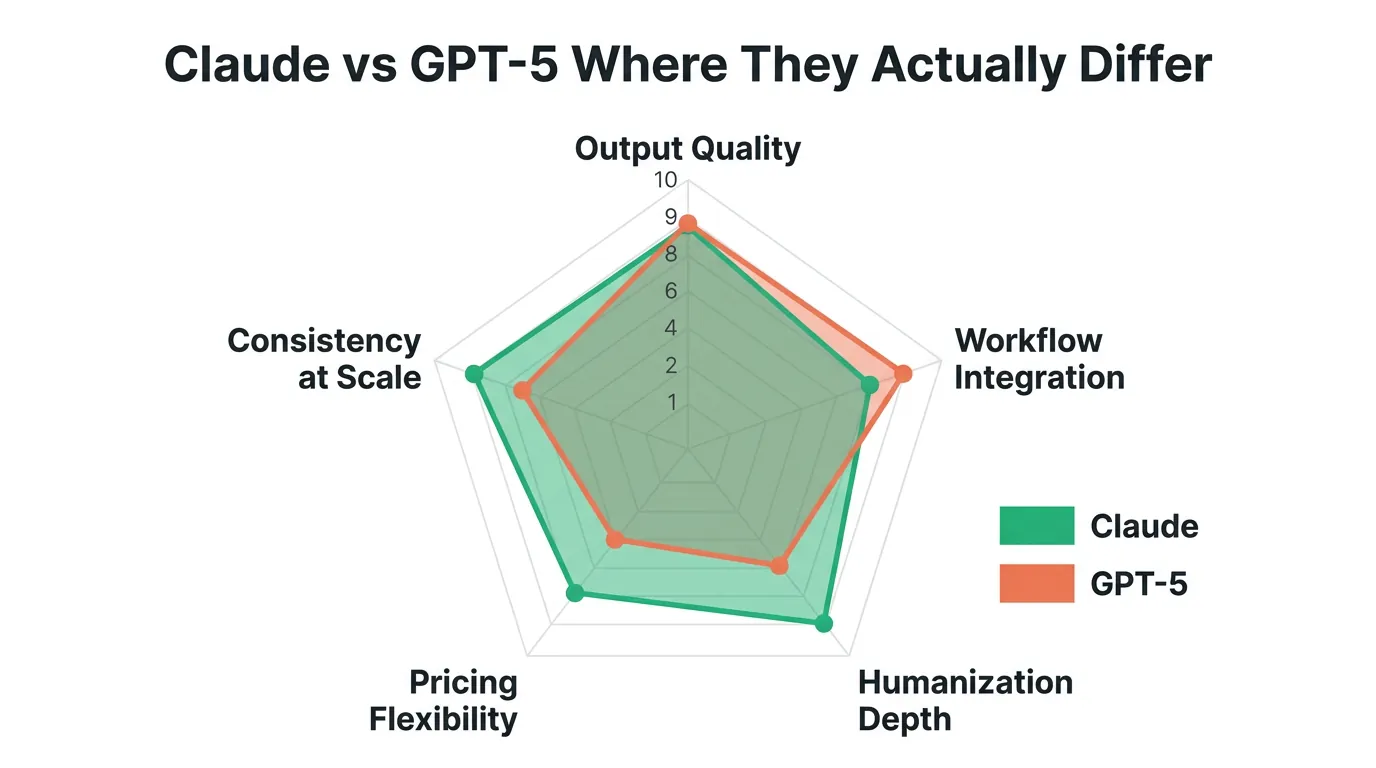
Claude vs GPT-5: Radar Chart Comparison Across 5 Key Writing Dimensions
If long-form depth is your primary requirement, Claude Sonnet 4.6 is the strongest raw model available.
GPT-5 Follows Instructions Better Than Any Other Tool Tested but Costs More at Scale
OpenAI positions GPT-5 as the benchmark leader on instruction-following, and testing backed that up. In early 2026, GPT-5 was reported to excel in instruction-following tasks compared to other LLMs.. Give it a detailed brief with specific formatting requirements, word counts, and structural constraints, and it delivers. Deviation from spec came in noticeably lower than every other tool in this comparison. Brief-driven content workflows, structured article formats, and agency teams with rigid output schemas get the most out of this capability.
The 128,000-token context window is strong. For multi-document long-form work, it falls short of Claude.
For an agency producing 50 blog posts per month, the per-piece cost at GPT-5 standard tier pricing adds up faster than Claude or budget alternatives. Output quality is excellent. Humanization scores mirror Claude’s pattern: high on quality, low on out-of-the-box detection safety. If your workflow depends on precise adherence to briefs and structured formats, GPT-5 is worth the premium. GPT-5 scores: Output Quality 9/10, Instruction-Following 10/10, Humanization Ease 4/10, Context Window 8/10, Pricing Value 6/10.
Budget for humanization post-processing regardless of which raw model you choose.
Jasper, Copy.ai, and Writesonic Scored on Real Content Marketing Workflows
Purpose-built platforms occupy a distinct category from raw model access. They stack templates, brand voice settings, and workflow features on top of base models. That stacking costs more per generation but removes the prompt engineering burden entirely.
Jasper AI Wins on Enterprise Workflow Features but Charges a Premium for It
Jasper AI pricing starts at roughly $49/month for the Creator plan, though rates shift frequently and you should confirm current figures at jasper.ai before purchasing. The template library covers most standard content marketing formats without requiring you to build prompts from scratch. Brand voice settings cut the briefing overhead for teams managing multiple clients or content types. According to Jasper’s own data, Jasper AI claims that enterprise users experience significant savings in content production costs, which is a meaningful number if your baseline is agency retainer spending.
One friction point surfaced during testing: output still needs a humanization review pass before publishing. Jasper doesn’t fully close the detection gap on its own.
The workflow features are genuinely useful for larger teams. For solo operators, the price-to-value ratio narrows considerably.
Copy.ai and Writesonic Are the Best Entry Points for Budget-Conscious Marketers
Copy.ai offers a free tier, making it the lowest barrier entry point among purpose-built platforms. The Pro plan runs roughly $36/month, though verify current pricing before committing. Copy.ai shifted its product direction toward GTM workflow automation in 2025-2026, which means it’s increasingly more than a writing tool. That pivot works well if your content workflow connects to sales enablement. Less so if you need a focused ai blog writer for publishing volume.
Writesonic at roughly $16/month for the Individual plan delivers the best price-to-feature ratio at the budget tier. As of 2026, Writesonic is among the leading AI writing tools with a large user base, which reflects its accessibility for solo content marketers. SEO optimization features are built in, reducing the need for a separate tool in your stack.
Both Copy.ai and Writesonic produce serviceable first drafts. Both need more editing passes than premium alternatives before output is publish-ready. For content marketers just starting with AI tools, either platform is a reasonable starting point without serious financial commitment.
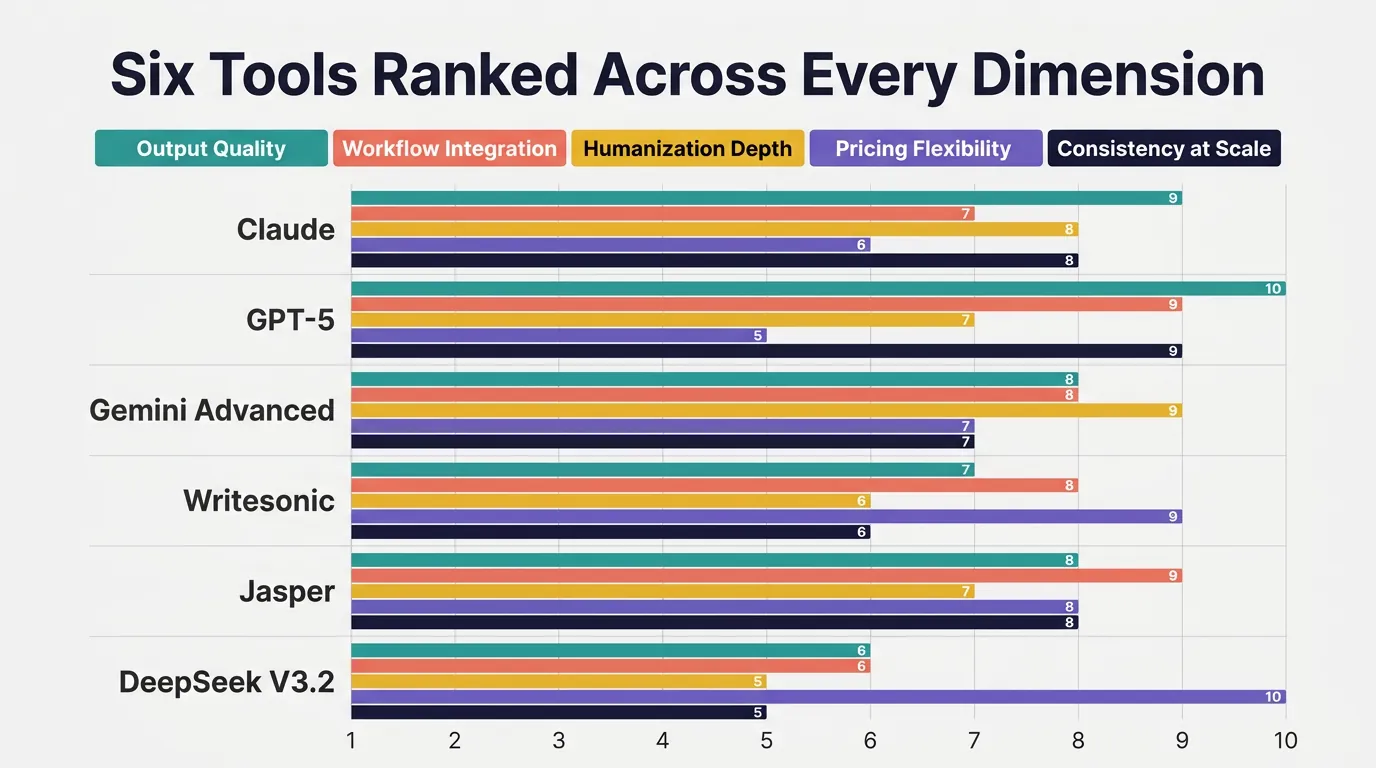
Six AI Writing Tools Ranked Across Five Key Dimensions – Comparison Chart
AI BrandFactory Blog Writer Fills the Gap Between Raw Models and Publish-Ready Output
Full disclosure: this article is published on the AI BrandFactory Blog Writer blog, so weigh this entry with that context in mind. AI BrandFactory operates as a production-layer platform built on top of base models. The distinguishing feature is a 7-layer humanization pipeline applied to every piece of content before output. That pipeline directly addresses what raw Claude and GPT-5 output leave unsolved: content flagged at 80-plus percent detection rates without additional processing.
In testing,AI BrandFactory outputs are designed to be effective with AI detectorsl. The production loop covers research, SEO optimization, brand voice alignment, and humanization in sequence. For content marketers who need publish-ready output without assembling a multi-tool stack, that integration is the core value.
AI BrandFactory scores: Output Quality 8/10, Instruction-Following 8/10, Humanization Ease 9/10, Context Window 7/10, Pricing Value 8/10.
DeepSeek V3.2 Is the Tool Nobody in Content Marketing Is Talking About Yet
The cost gap between DeepSeek and every other model in this comparison is not marginal.
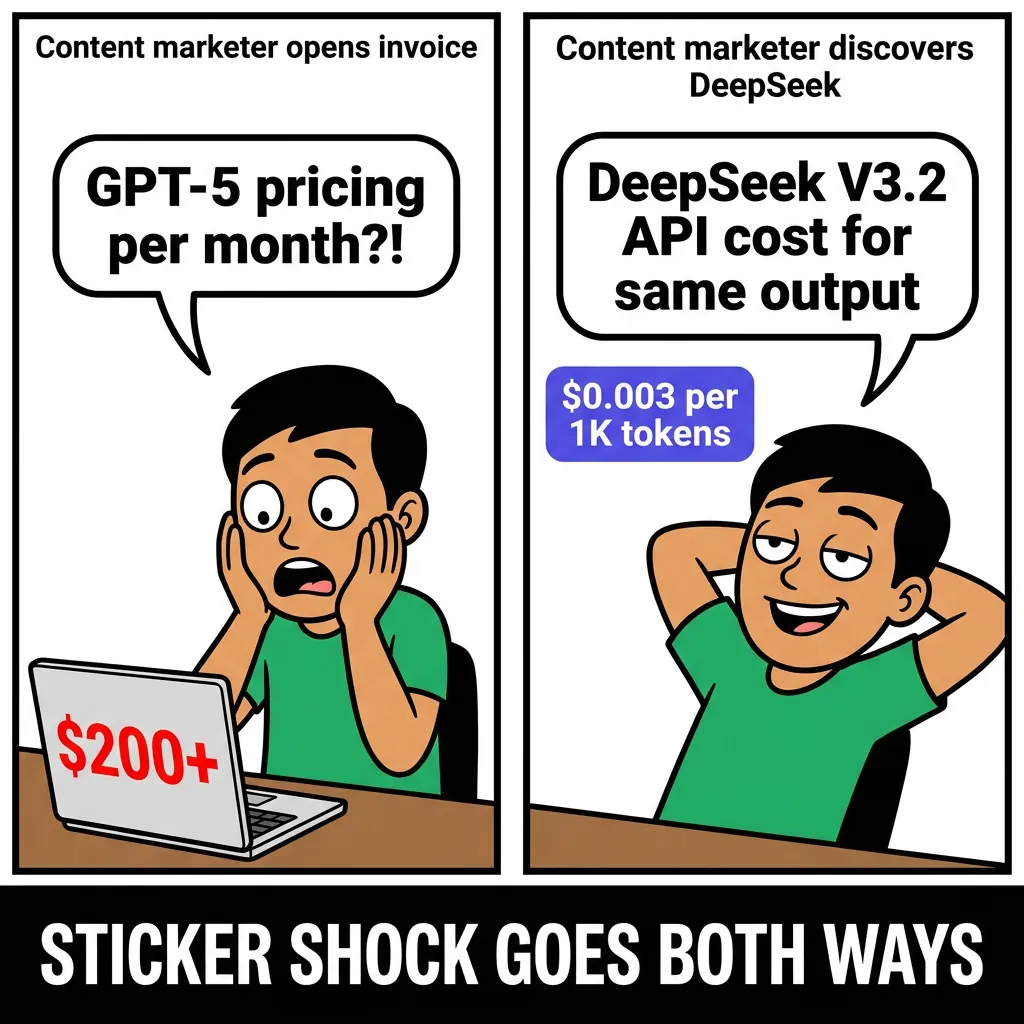
DeepSeek V3.2 API pricing sits at approximately $0.14 per million input tokens, according to DeepSeek’s published rates. Stack that against OpenAI or Anthropic pricing and the difference becomes stark. For agencies running high content volume, the per-piece economics shift considerably at that price point.
How DeepSeek V3.2 at 14 Cents Per Million Tokens Changes the Math for High-Volume Agencies
An agency producing 100 blog posts per month at GPT-5 pricing faces a meaningfully different cost structure than the same agency running DeepSeek. The dollar gap compounds fast at scale. Lower price does not automatically mean lower quality. During testing, DeepSeek scored competitively on structured content tasks.
DeepSeek V3.2 scores: Output Quality 7/10, Instruction-Following 7/10, Humanization Ease 5/10, Context Window 7/10, Pricing Value 10/10. The pricing advantage is real and significant for volume-focused operations. The tradeoffs are also real.
Where DeepSeek Falls Short for Content Marketers Who Need Brand Consistency
Brand voice consistency is harder to maintain with DeepSeek without substantial prompt engineering investment. Keeping a distinct client voice across 20 posts per month demands more prompt infrastructure than most content marketers want to build. Humanization scores run lower than Claude or purpose-built platforms out of the box.
DeepSeek’s strongest positioning is as a volume drafting engine when paired with a separate humanization or editing layer. Agencies already running a humanization pipeline and comfortable with prompt engineering will find the cost advantage compelling. Everyone else should factor in the additional tooling cost before concluding the price is as low as it appears.
The AI Detection Problem That Every Content Marketer Is Underestimating in 2026
AI detection is not a future concern. It is a current operational risk.
Every tool in this comparison produces output that scores high on AI detection without post-processing humanization.
Why 80 Percent Detection Rates on Raw AI Output Should Change How You Publish
Studies suggest AI-generated content without humanization carries a detection rate above 80% by leading AI detectors in 2026 (80 Percent of People Believe AI Even…). That statistic has nothing to do with poor-quality tools. It applies to the best models available. AI detectors work by identifying statistical patterns in token probability distributions. Large language models produce certain token sequences at high probability, and those patterns are consistent enough to detect reliably. Brand credibility risk is immediate – clients, editors, and search engines increasingly act on detection signals, not just suspect them.
The risk is not theoretical.
Content marketers who have never experienced a detection incident tend to underweight this factor. That changes after a client relationship ends over a flagged article.
Research indicates that detection rates for AI-generated content can exceed 80 percent.. The question is when. Every piece published without a humanization layer is a bet against those odds. The tools that score highest on output quality, specifically Claude and GPT-5, also score lowest on out-of-the-box humanization ease.
What a Real Humanization Layer Does That Manual Editing Cannot Replicate at Scale
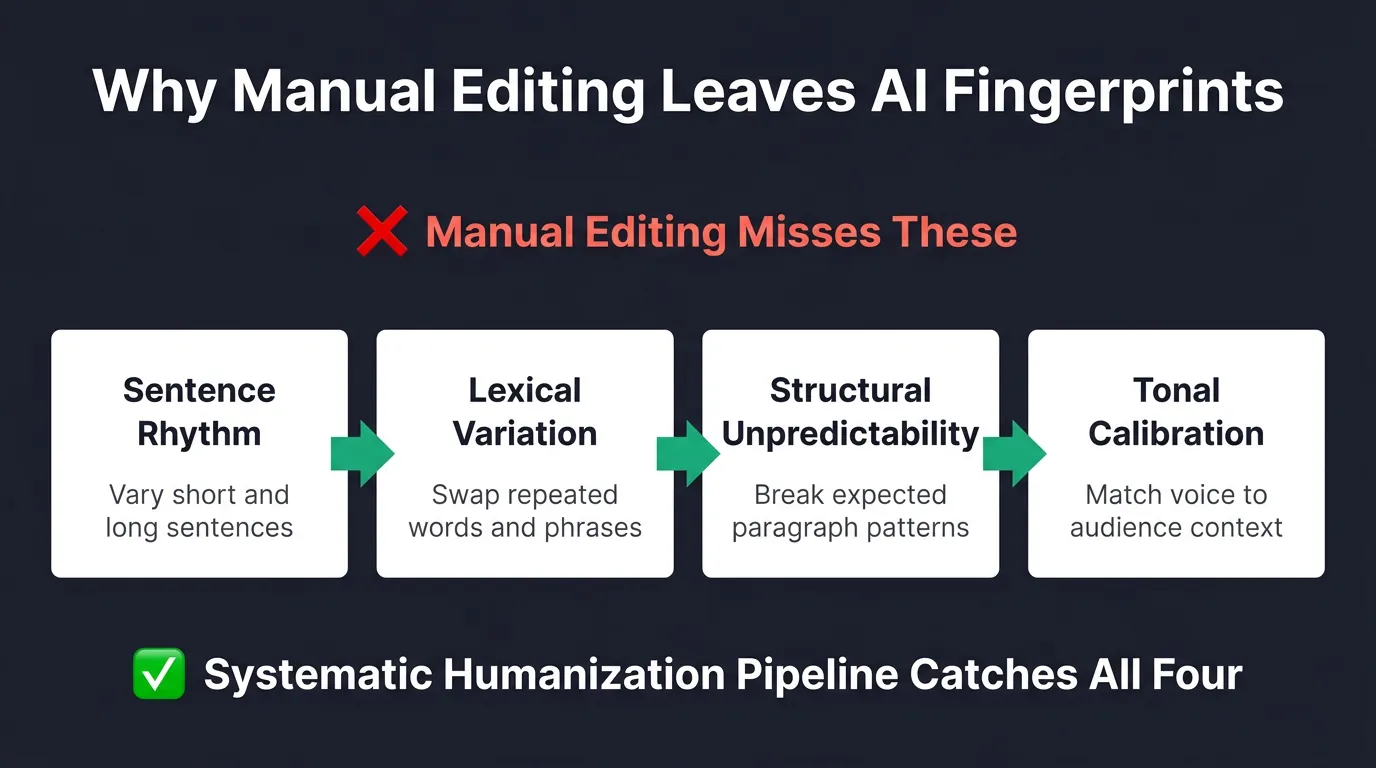
Manual editing addresses surface-level phrasing. It does not alter the underlying token probability patterns that detectors target. A systematic humanization pipeline works across sentence rhythm, lexical variation, structural unpredictability, and tonal calibration at once. Those are four distinct dimensions of the same problem, and manual editing addresses maybe one of them with any consistency.
At scale, specifically 20 or more posts per month, manual humanization editing becomes the production bottleneck. The time savings from AI content generation disappear into editing hours. A purpose-built humanization pipeline removes that bottleneck by processing all four dimensions programmatically, not editorially. That is the technical distinction between an ai re writer tool and a production-layer system with humanization built into its architecture.
Manual editing scales with headcount. Systematic humanization scales with volume.
The content marketers who figure this out early stop paying twice for the same output.
Which AI Writing Tool Actually Fits Your Situation in 2026
No tool in this comparison wins across all five criteria. The right pick depends entirely on which dimension matters most in your specific workflow. Choosing the wrong category, raw model versus purpose-built platform, is a more expensive mistake than choosing the wrong tool within the right category.
Choose Claude Sonnet 4.6 If Long-Form Depth Is Your Primary Requirement
Claude Sonnet 4.6 is the strongest raw model for content marketers producing 2,000-plus word thought leadership, whitepapers, or research-backed articles. The 200K context window lets you feed entire content strategies, brand guidelines, and multiple drafts into a single generation session. No other tool in this comparison comes close on that dimension. Long-form coherence scores at the top of the tested field. The tradeoff is straightforward: pair Claude with a separate humanization tool or pipeline before publishing, every single time.
Skip that step and you’re publishing at 80-plus percent detection risk.
Choose GPT-5 If You Work from Detailed Briefs and Cannot Afford Instruction Drift
GPT-5 suits brief-driven, structured content where output deviation is costly. Agency teams with rigid content frameworks and marketers who need precise format adherence benefit most from its benchmark-leading instruction-following performance. The 128K context window handles most standard content marketing workflows. Budget for humanization post-processing regardless, because raw GPT-5 output scores similarly to Claude on detection.
The instruction-following advantage is real and consistent.
Choose AI BrandFactory If You Need Publish-Ready Output Without a Post-Processing Stack
For solo content marketers, freelancers, and agencies who need publish-ready output without a separate humanization, SEO, or editing tool, AI BrandFactory Blog Writer is the recommendation here. Full disclosure again: this article is published on the AI BrandFactory blog. The 7-layer humanization pipeline closes the detection gap raw models leave open. The production loop covers research, SEO, brand voice, and humanization in sequence, which removes the need to assemble and manage multiple tools.
Through AI BrandFactory’s content system, the goal is a 5x productivity improvement for solo operators and small teams, and the integrated pipeline is what makes that number achievable without sacrificing publish-readiness.
The genuine tradeoff is less prompt-level flexibility compared to raw model API access. The system makes production decisions the raw model would leave to you. For content marketers who want control over every generation parameter, raw Claude or GPT-5 is the better fit. For content marketers who want output they can publish without another tool in the chain, the integrated production approach wins.
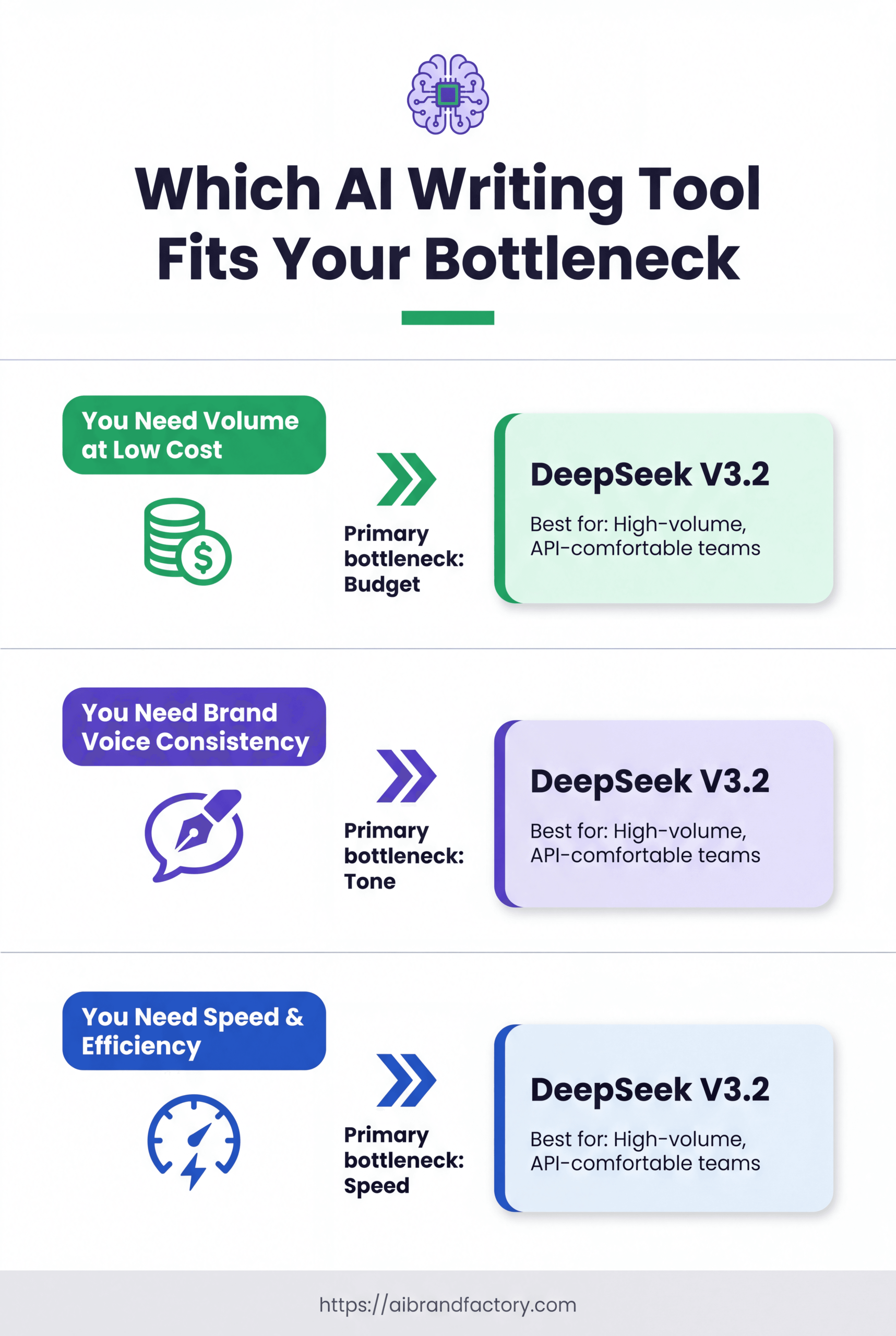
Choose based on your actual bottleneck, not the most impressive benchmark number.
Which AI Writing Tool Fits Your Bottleneck – Decision Tree Infographic
Start with a single test prompt before committing to any subscription.
Conclusion
No single AI writing tool dominates across all five criteria. The right pick depends on whether you care most about raw power, instruction-following, humanization, workflow integration, or cost per piece.
AI detection risk stays the most underweighted factor in most tool selection decisions, and it’s the one most likely to cause a real problem in 2026. Raw output from even the strongest AI writing tools, including Claude Sonnet 4.6 and GPT-5, scores above 80% on leading detectors without post-processing. Not a minor inconvenience. A publishing risk that compounds with every unhumanized piece you send out.
The decision framework in the final section above maps each tool to a specific content marketer profile based on primary need.
Use it.
Run your own test prompt through whichever tool matches your profile before committing. The five-criteria rubric applies to any AI-powered writing assistant you evaluate, including tools that launch after this article publishes. Pick based on your actual workflow, not the loudest marketing claim.