How to Get 10x Output From Any AI Writing Assistant in 2026
Vintage Typewriter Key with AI Circuit Traces — AI Writing Assistant Guide
AI Writing Assistant Guide: How to Get 10x Output From Any AI Tool
Most people treat an AI writing assistant like a search engine. Vague request, generic response, blame the tool. Wrong approach entirely.
Structured prompting changes everything.
This guide covers the Role + Context + Constraint + Format framework and three distinct AI modes. Use both together and output quality jumps fast. Start here, build from there.
The Default Prompt Problem That Kills Your AI Output
What a Default Prompt Actually Produces
Type “write a blog post about content marketing” into any AI writing assistant. Watch what comes back – a five-paragraph essay, generic subheadings, no specific audience, and advice you’ve read a hundred times before.
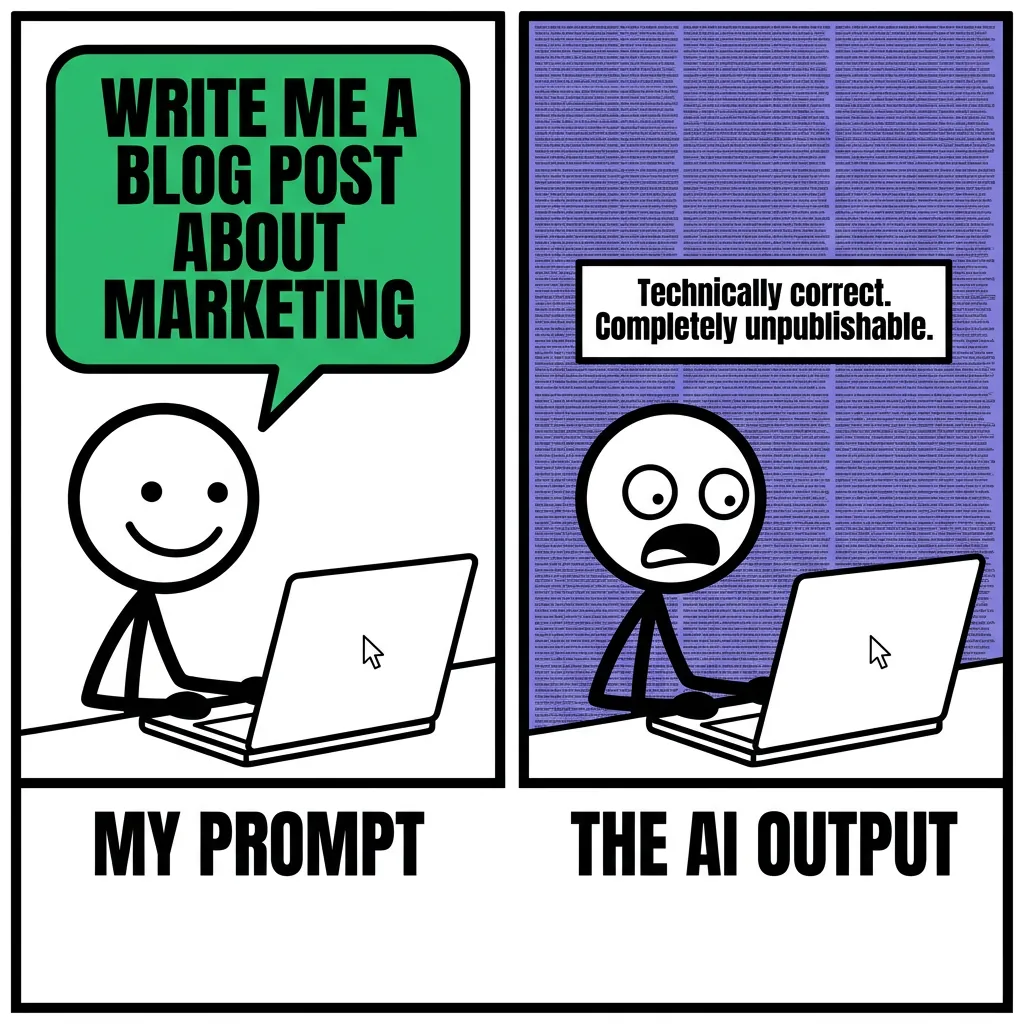
Default prompts give the AI nothing to work with. No persona, no audience, no constraints, no format guidance. The model fills every gap with the most average interpretation possible. Technically correct output.Completely unpublishable. You spend more time rewriting than you saved by using AI in the first place.
The AI Blog Post Problem: What You Ask For vs. What You Get
That gap between expected and actual output is a prompting problem.
Why Structured Prompts Consistently Outperform
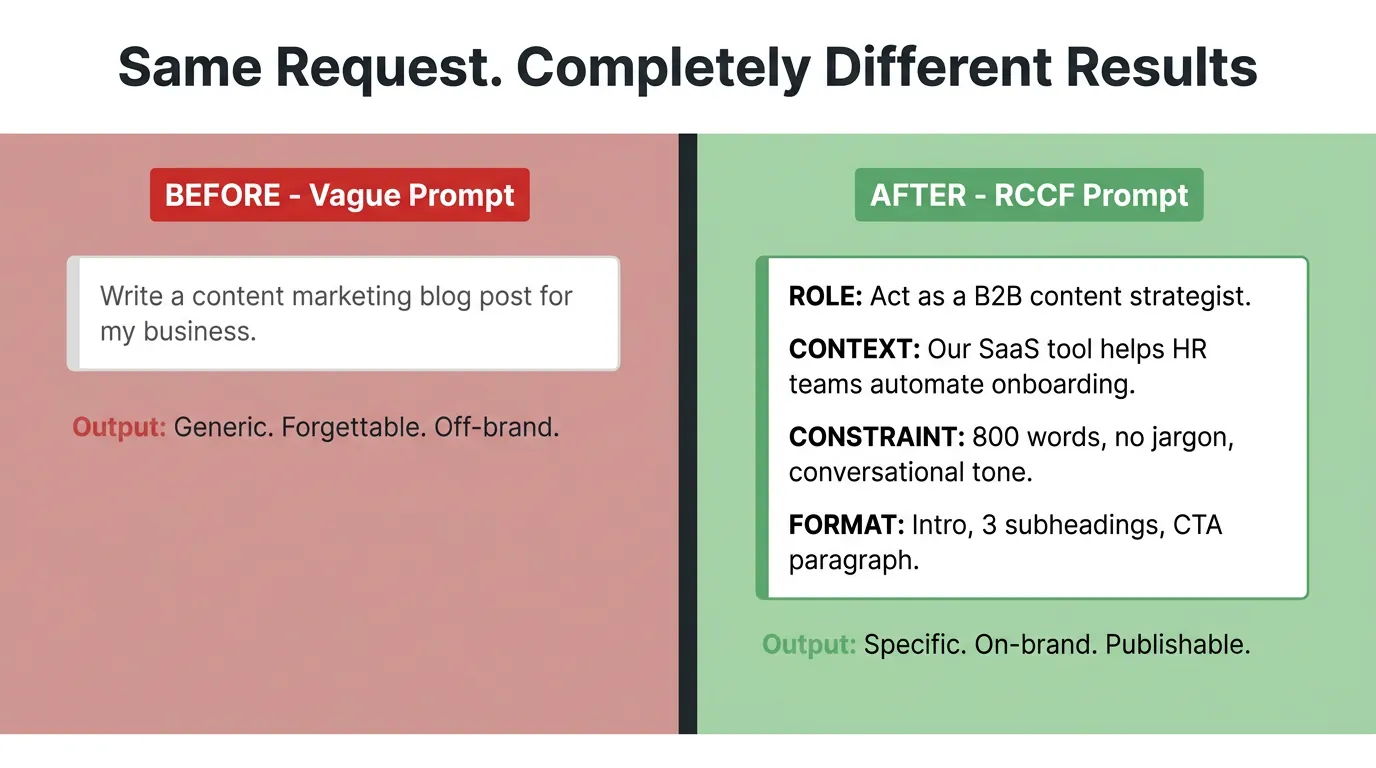
AI models respond to specificity – more signal means less noise. When you give a vague request, the model guesses at your intent. When you give structured input, it executes against a clear brief. Take the same content marketing request and rewrite it with role, audience, constraints, and format. The output shifts from generic filler to something close to publishable. That’s not a different tool – it’s the same model with better instructions.
Vague Prompt vs. RCCF Prompt: Before and After Comparison Card
Prompt engineering isn’t a technical skill reserved for developers.
Anyone can learn it in an afternoon.
The Four-Part Framework That Changes Everything
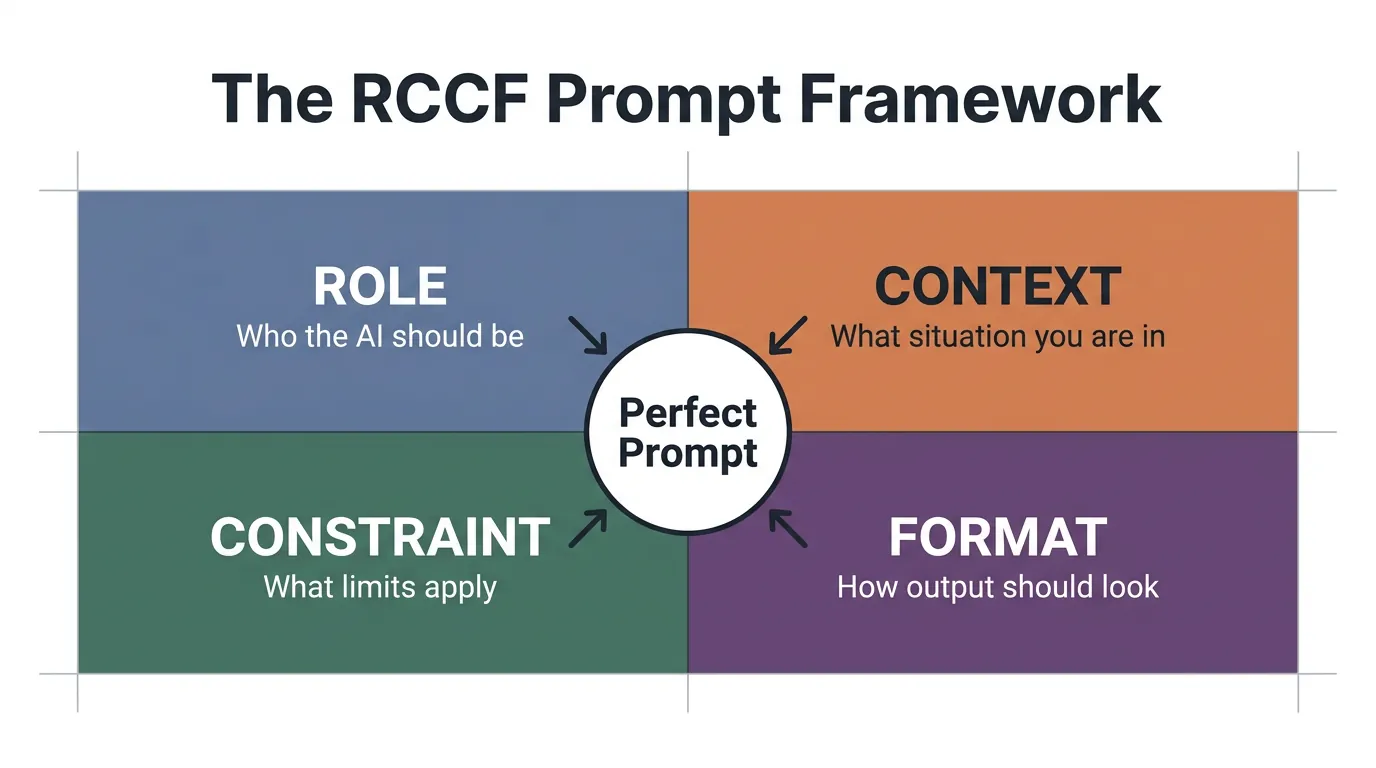
Role, Context, Constraint, Format – four components that turn a vague request into a precise brief.
The RCCF Prompt Framework – Four-Quadrant Diagram
Role Gives Your AI a Job to Do
Role assigns the AI a specific expert identity before any task begins. Try this: “You are a B2B SaaS content strategist with 10 years of experience writing for enterprise buyers.” That single line shifts output tone, vocabulary, and depth. The AI stops writing like a generalist and starts writing like a specialist. Role is the fastest single improvement most writers make to their prompts.
Context Tells It What Actually Matters
Context is the background information your AI writing assistant needs to produce relevant output. It covers your audience, the purpose of the piece, existing content the new piece connects to, and your brand’s competitive positioning. Without context, the model defaults to the most average interpretation of your request. A blog post for a CFO audience reads completely differently from one aimed at a marketing intern. More relevant context means fewer revision rounds, every time.
Specificity in context is not optional.
Constraints and Format Lock In the Output You Need
Constraints define what to avoid. Word count limits, banned phrases, tone restrictions, reading level requirements – these are your guardrails. Format specifies the delivery structure: number of H2 headers, bullet point usage, paragraph length, whether you want a summary section.
Together, constraint and format eliminate the two most common sources of unusable AI output. Without them, you get an essay when you needed a listicle, or 1,500 words when you needed 600. With them, the output arrives in the right shape on the first pass.
Structured prompting is cause and effect, not theory.
The Three AI Modes and How to Switch Between Them
Most writers use one prompt style for everything. Research, drafting, editing – crammed into a single request, expecting clean results from the chaos. That conflation degrades all three outputs at once.
Researcher Mode Pulls Signal From Noise
Research prompts need three things: a source scope, an output format, and a relevance filter. Copy this template and adapt it: “You are a research analyst. Summarize the three strongest arguments for [topic] from a B2B perspective. Format as bullet points with one supporting fact each. Exclude consumer-focused angles.” That structure gives the model a clear job with clear boundaries. The output becomes a usable brief, not a wall of text you have to sort through. Don’t ask a research prompt to also draft – conflation degrades both outputs.
Separate modes produce separate wins.
Drafter Mode Builds the First Version Fast
Drafter prompts need full RCCF structure applied from the start. For long-form content, add one more element: chain-of-thought instruction. Tell the AI to reason through the section structure before writing. “Before drafting, outline the logical flow of each section, then write.“ That single instruction improves coherence across multi-section documents. Without it, long-form AI drafts drift – strong opening, weak middle, abrupt close.
Chain-of-thought is the connective tissue.
Editor Mode Fixes What the Drafter Missed
Editor prompts need a specific improvement target. Not “make this better” – that’s a default prompt. Try: “Remove all passive voice constructions. Reduce total word count by 15%. Do not change any factual claims or restructure existing paragraphs.” That specificity tells the model exactly what to fix and what to leave alone. Keep editing prompts separate from drafting prompts, or the AI rewrites content you wanted preserved. Line-level editing and structural editing are different tasks, and they require different prompts.
Five Prompt Templates That Outperform Default AI Every Time
Templates for Blog Posts, Outlines, and Social Copy
Five templates cover the writing scenarios eating up most of your production time. Each one follows the RCCF framework, and you can verify the logic piece by piece, then adapt everything to your niche.
Blog Draft Template: “You are a [industry] content strategist writing for [audience]. Write a 1,200-word blog post on [topic]. Use H2 and H3 headers. Avoid passive voice. Open with a specific problem the reader faces, not a definition.”
Outline Template: “Before creating the outline, reason through the logical progression a reader needs to understand [topic]. Then produce a six-section outline with one sentence explaining the purpose of each section.”
Social Copy Template: “You are a LinkedIn ghostwriter. Adapt this blog excerpt for a LinkedIn post. Max 150 words. No hashtags. Open with a counterintuitive claim. End with a question.” Every annotation explains the reasoning behind each component, not just what to type.
Starting points. Not finished systems.
Editing Template: “Edit the following for clarity and concision. Remove filler phrases, reduce word count by 20%, and flag any claims that need a source. Do not change the structure or reorder paragraphs.”
Research Brief Template: “You are a research analyst. Identify the five most cited arguments for [topic] in B2B contexts. Format as a numbered list with one supporting data point per item. Exclude opinion pieces as sources.” Both templates assign the model a precise job with precise boundaries. Human judgment on output quality still applies, because structured prompts sharpen the starting point, not the final decision. No AI writing assistant replaces the call on whether the output is actually good.
AI BrandFactory‘s Blog Writer has this RCCF logic built directly into the system architecture. You don’t engineer prompts by hand, the 10-agent pipeline handles it. That’s what fully-engineered AI writing infrastructure looks like in practice.
The templates work. The platform removes the manual work entirely.
How to Build This Into a Repeatable Writing Workflow
The Sequence That Produces Publish-Ready Content
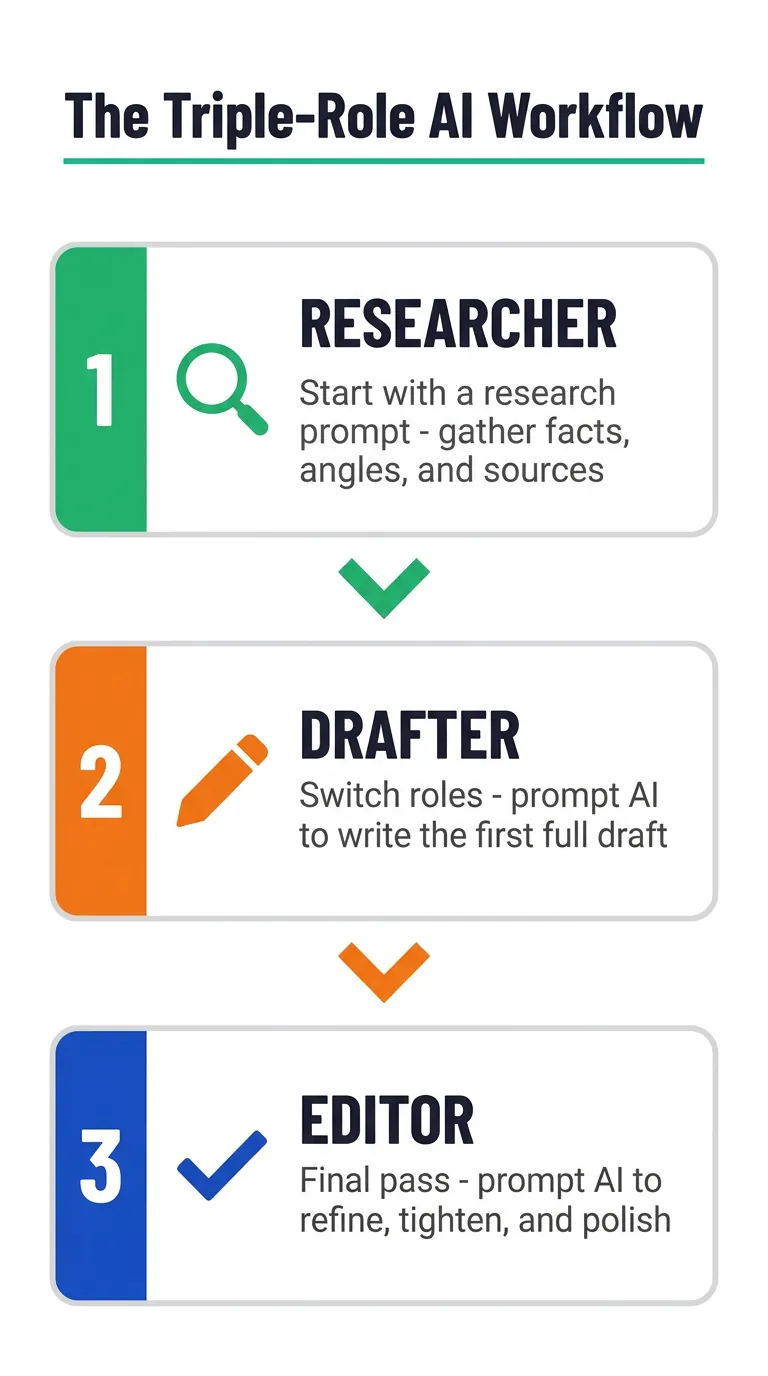
Researcher first – Start with a research prompt to pull angles and supporting data before a single word gets written.
Drafter second – Run a drafter prompt next, full RCCF structure with chain-of-thought instruction for anything over 800 words.
Editor last – Finish with targeted editing prompts, one improvement task per prompt, not an open-ended rewrite request.
That sequence is the workflow.
The Triple-Role AI Workflow: Researcher, Drafter, Editor Step-by-Step
Research takes roughly 10 minutes with a structured prompt.Studies show that a clear outline can expedite the writing process for lengthy articles..Editing takes another 10 minutes when the prompt specifies exactly what to fix. Total time for a publish-ready piece using an ai powered writing assistant: under 40 minutes. Writers hitting 10x output aren’t using better tools – they run this sequence consistently rather than prompting at random. Chain-of-thought instruction at the drafting stage keeps long-form content coherent from section to section, which is precisely where most AI drafts break down.
For readers who want this output without building the prompts manually, AI BrandFactory‘s Blog Writer is the direct path, with the research, drafting, and editing logic running automatically through a 10-agent pipeline.
Conclusion
Structured prompting is a skill. One that compounds with consistent use.
Pick one mode, researcher, drafter, or editor, and run one structured prompt today.
The RCCF framework is the single highest-use change any AI writing assistant user can make. It doesn’t replace human judgment about what gets published. What it does is hand you a dramatically better starting point, every time.