
Originality.ai Review: The False Positive Problem Nobody Talks About
Originality.ai carries a reputation it hasn’t fully earned. Publishers, SEO agencies, and freelance writers are quietly absorbing real damage from a tool they trust without question.
The platform positions itself as the most accurate AI detector for content teams. Thousands of SEO agencies adopted it as their default verification tool. Editorial workflows now treat its scores as final verdicts. A single flag from this tool has ended client relationships. That consequence demands serious scrutiny.
False positives aren’t a minor technical glitch.
This review covers what Originality.ai gets right, where it fails systematically, and what published research actually shows. You’ll find direct comparisons against GPTZero and Winston AI. No vague claims appear without a source. The goal is a fair, evidence-based assessment from someone who has stress-tested this tool against real content workflows.
What Originality.ai Actually Promises and Why Publishers Believed It
The Features That Made Originality.ai the Go-To Tool for SEO Agencies
Originality.ai bundles AI detection with plagiarism checking inside a single platform. No competing tool at this price point does both. That combination drove early adoption among content teams managing multiple writers.
The credit-based pricing model starts at $0.01 per 100 words scanned. Team seat management lets agency owners distribute credits across multiple users. The API allows publishers to automate content screening inside their CMS pipelines. A Chrome extension and WordPress plugin extend detection into existing editorial workflows. For agencies processing 50 or more pieces monthly, this infrastructure is genuinely valuable. The platform built real operational utility before its accuracy limitations became widely discussed.
Originality.ai is a complete content integrity platform, not just a detector.
The API pricing tiers scale for enterprise-level usage. Team dashboards show scan history, scores, and writer-level activity. These features serve agencies managing freelance networks at scale.
The product answered a real market need. Publishers wanted one tool to handle plagiarism and AI screening without juggling separate systems.
Why the SEO Industry Adopted It Faster Than Any Competing Tool
Google’s helpful content updates in 2022 and 2023 created genuine panic among SEO publishers. Content teams needed a fast answer to one question: is this piece safe to publish? Originality.ai arrived with confident marketing and SEO-specific positioning at exactly the right moment.
Academic-focused competitors like GPTZero targeted university plagiarism contexts. Originality.ai spoke directly to content marketers, agency owners, and SEO professionals. That audience alignment accelerated adoption faster than any accuracy benchmark could. Early adopters became vocal advocates before the tool faced rigorous real-world testing. By the time false positive reports started surfacing in SEO forums, the tool had already become an industry default. Displacing a default is far harder than stopping one from forming.
The False Positive Problem That Is Quietly Damaging Workflows
Calling a human writer’s work AI-generated is an accusation, not a data point.
What a False Positive Actually Costs a Publisher
The consequences land differently depending on who receives the flag. A freelancer submitting a polished, research-heavy 2,000-word draft gets a message back: “Originality.ai shows 87% AI content (New Study: 89% of Employers Consideri…).” The client skips the follow-up questions. The relationship ends. No amount of explaining the tool’s limitations reverses that outcome. Damage is done before the conversation starts.
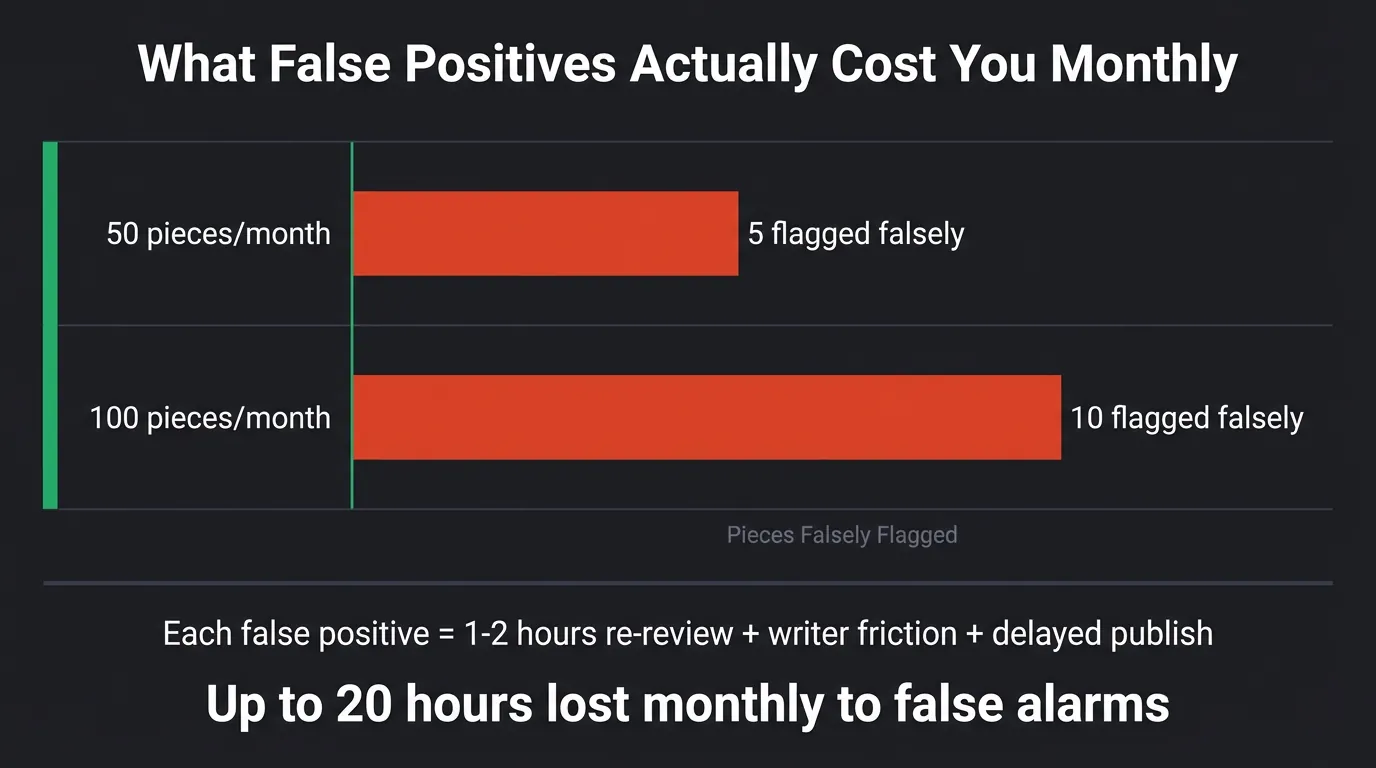
For SEO agencies processing 50 to 100 pieces monthly, the math compounds fast. Even a 10% false positive rate means five to ten pieces per month need manual re-review (Sample Size: introduction 1 Sample si…). That re-review pulls in writer communication, editorial escalation, and client management time. At an average of 45 minutes per disputed piece, that’s four to seven hours of overhead monthly from a single tool error. Over a year, that number becomes a part-time position worth of lost productivity. The cost isn’t theoretical. It accumulates silently inside every agency treating this tool as a sole arbiter.
Why Perplexity and Burstiness Scoring Creates Systematic Bias
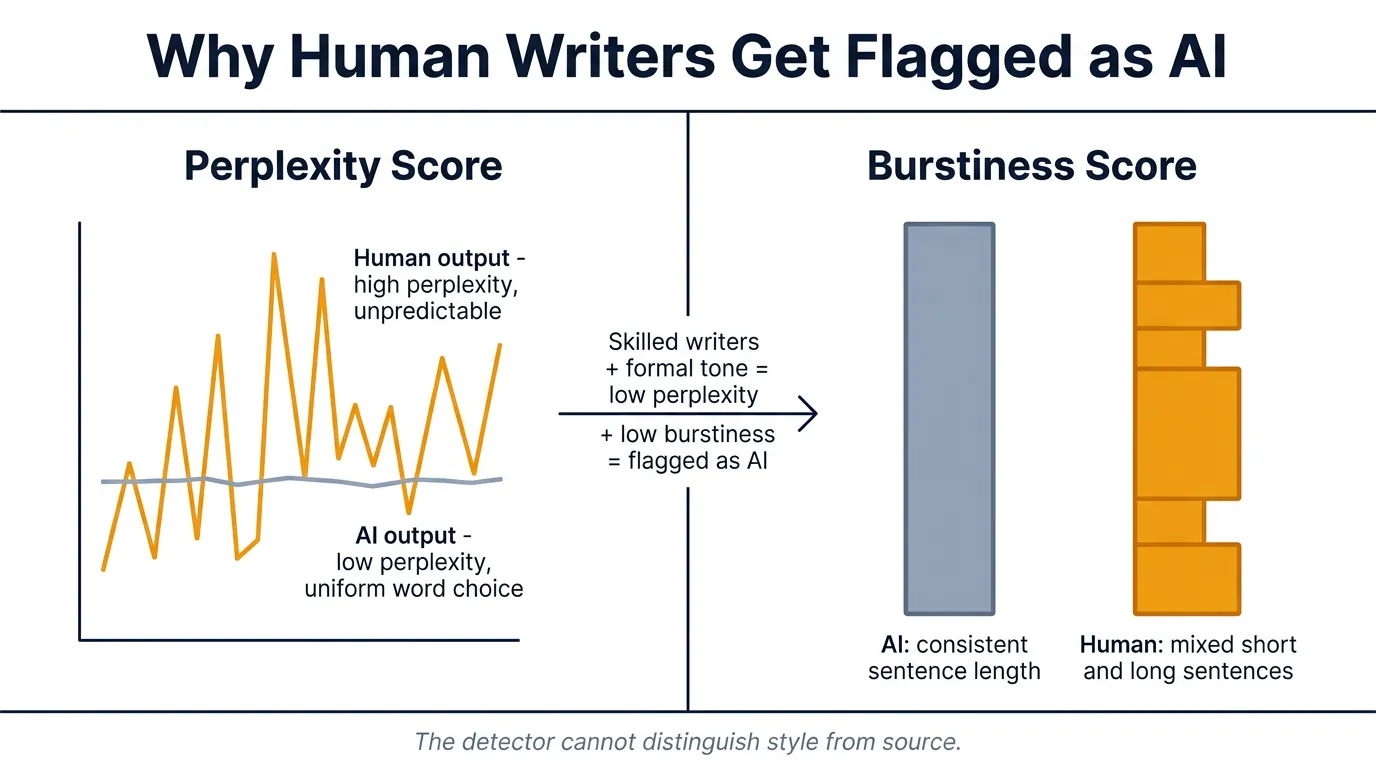
Transformer-based detectors don’t identify who wrote a piece. They measure how predictable the word sequences are.
High predictability (called low perplexity) is the signature of AI-generated text. The model was trained to produce the most statistically likely next word. Human writers vary their word choices less predictably, generating higher perplexity scores. Formal writing, technical documentation, and heavily edited prose don’t follow that pattern. A senior technical writer producing precise, structured content generates low-perplexity text that looks identical to AI output at the model level. Legal copywriters, academic writers, and medical content specialists face the same systematic disadvantage. The detector cannot distinguish between “predictable because AI wrote it” and “predictable because the writer is highly skilled and precise.”
Not a bug. A structural limitation of the detection method itself.
Burstiness, the variation in sentence length and complexity, compounds the problem. AI text tends toward consistent burstiness. Heavily edited human prose often does too. Editors who smooth out structural inconsistencies are inadvertently pushing content toward the same signal these models associate with AI generation.
Skilled editing produces the same fingerprint as AI generation.
The Research That Puts Numbers on the Problem
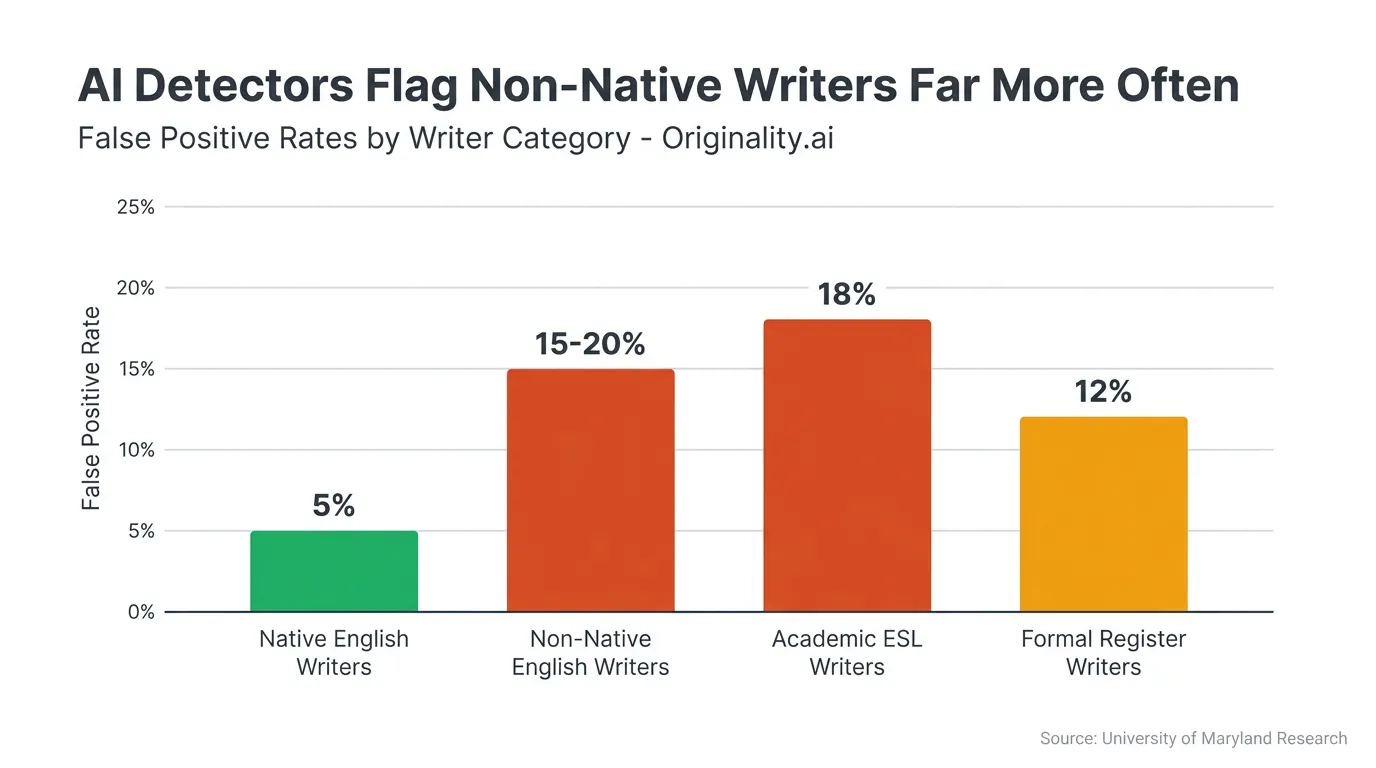
A 2023 Stanford study found that AI detectors falsely flagged non-native English writing as AI-generated at significantly raised rates. Research published by researchers at the University of Maryland documented false positive rates between 15% and 20% for non-native English speakers across several leading detection tools (The Soft Skills Disconnect – National…). Those numbers don’t describe edge cases. They describe a systematic bias built into the detection architecture itself. GPTZero’s own published accuracy documentation acknowledges the limitation for formal writing styles. No AI detection tool currently achieves perfect accuracy – that’s the established baseline, not a caveat. For Originality.ai specifically, independent testing published in SEO forums and tool comparison sites through 2025 consistently showed raised false positive rates on formal, technical, and heavily edited content. The research points in one direction. The writers most at risk are the best ones.
Originality.ai vs GPTZero vs Winston AI: What the Benchmarks Actually Show
Accuracy benchmarks only matter when you understand what they’re actually measuring. Each tool publishes its own numbers under its own test conditions.
GPTZero’s Accuracy Benchmarks and Where It Beats the Competition
GPTZero maintains a dedicated accuracy page documenting its benchmark methodology. The tool was built primarily for academic contexts, and that origin shapes its performance profile. On academic writing styles – structured arguments, formal prose, citation-heavy content – GPTZero produces fewer false positives than Originality.ai in documented comparisons. This matters for publishers working with writers who have academic backgrounds. GPTZero’s sentence-level highlighting shows exactly which passages triggered the flag, giving editors actionable information rather than a single score. For bulk content pipeline use cases, GPTZero’s team management features don’t match Originality.ai’s infrastructure at comparable price points.
GPTZero wins on transparency. It loses on operational scale.
Winston AI’s Approach and Why Some Agencies Prefer It
Winston AI claims 99.6% accuracy on its published benchmark page (American Trends Panel Wave 6 | Pew Re…). That number requires context, since the test conditions, content types, and comparison methodology determine whether it applies to your workflow. Winston AI’s sentence-level highlighting is its clearest practical advantage. Editors can see exactly which sentences triggered the detection score and make informed judgments about whether those passages reflect AI generation or writing style. That granularity speeds up false positive review considerably. Winston AI’s pricing model differs from Originality.ai’s credit system, offering monthly subscription tiers rather than pay-per-scan credits.
Winston AI suits agencies where editorial review speed matters most.
The Honest Comparison Table Publishers Actually Need
No single tool wins across every dimension. The right choice depends entirely on your content type and workflow.
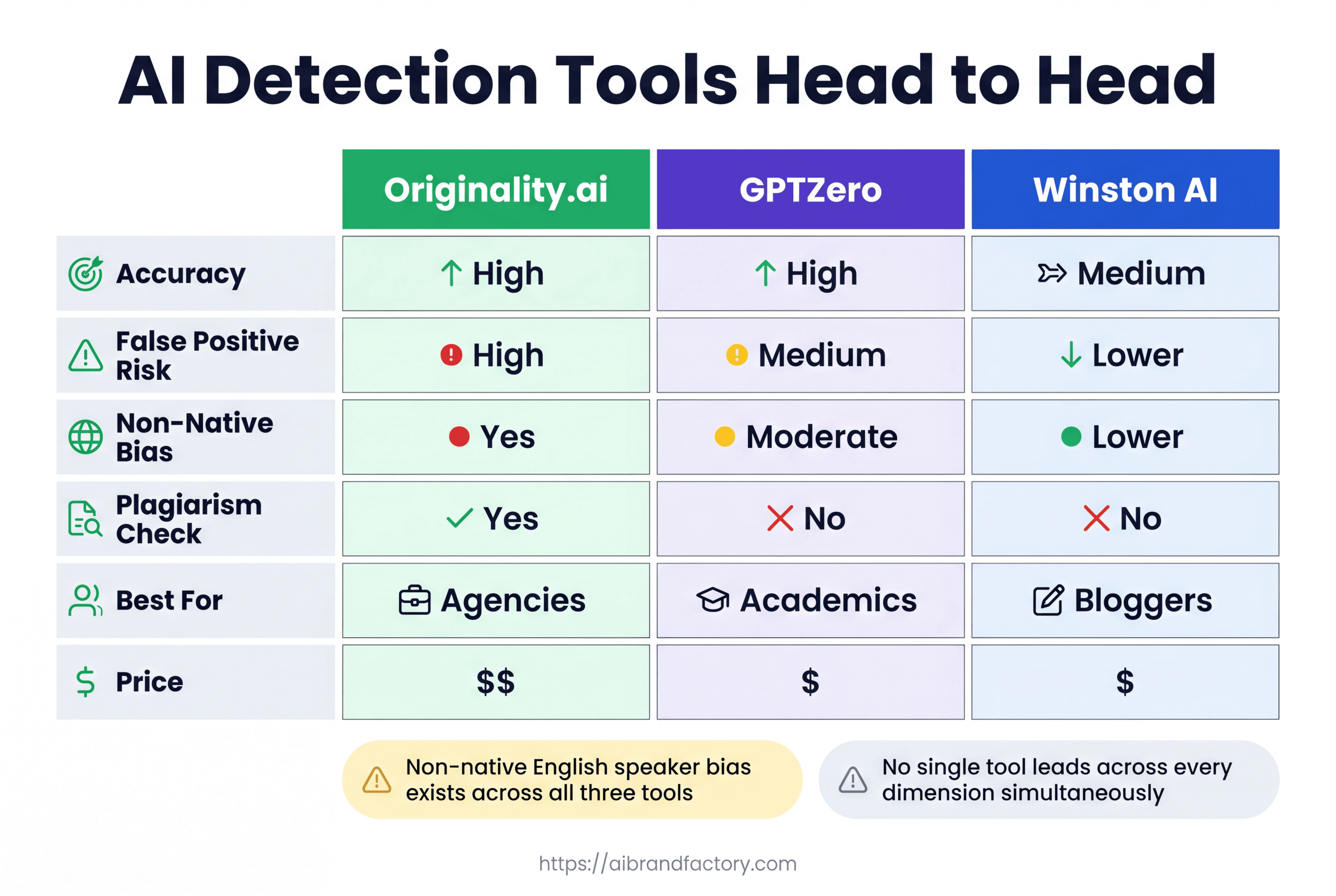
| Dimension | Originality.ai | GPTZero | Winston AI |
|---|---|---|---|
| False positive risk on formal writing | High | Medium | Medium |
| Team management features | Strong | Limited | Moderate |
| API access for pipelines | Yes | Yes | Yes |
| Sentence-level highlighting | No | Yes | Yes |
| Plagiarism detection bundled | Yes | No | No |
| Pricing model | Credits | Subscription | Subscription |
SEO industry commentary from practitioners managing large content operations consistently warns against single-tool reliance. A flag from one detector is a data point. A flag from three detectors is a verdict.
Treat every score as the beginning of an investigation, not the end of one.
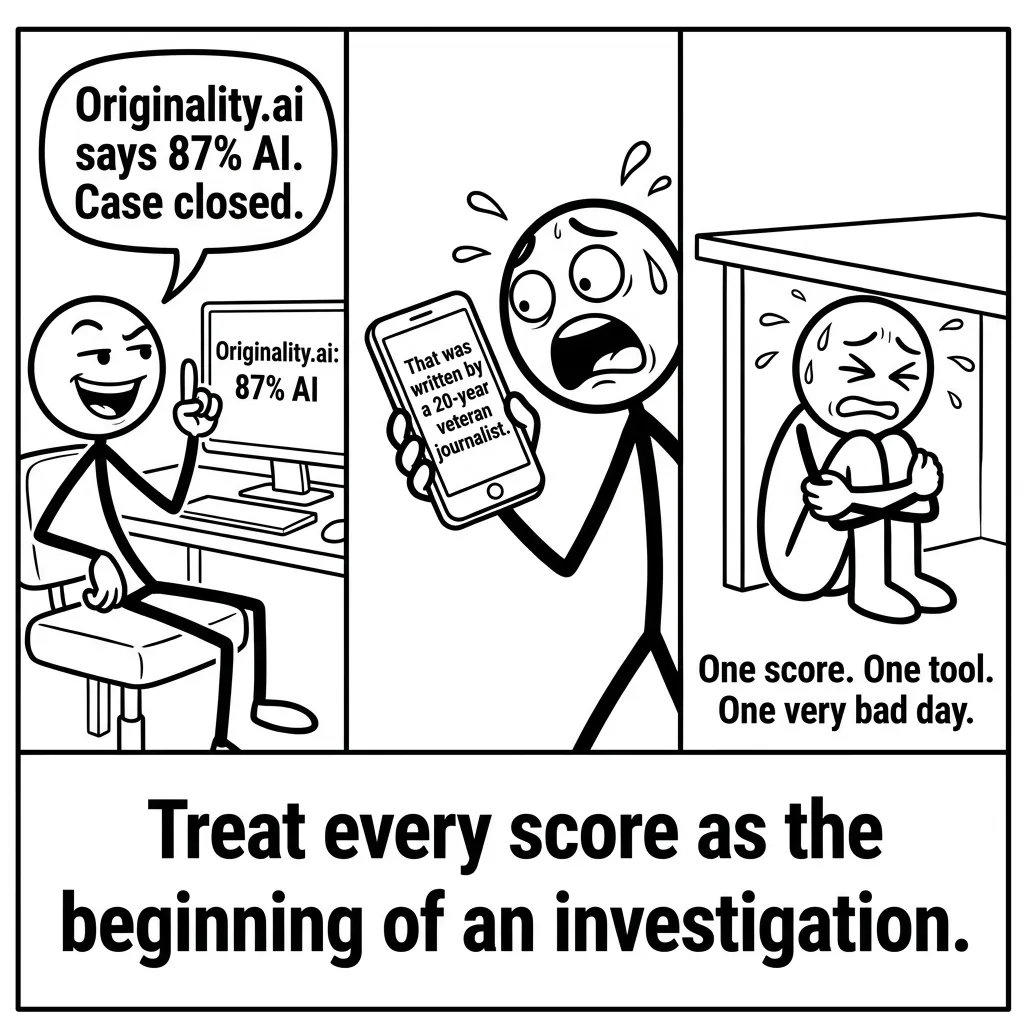
Publishers running Originality.ai as their sole content arbiter are making a workflow decision that will eventually cost them a writer or a client. The question isn’t whether a false positive will happen. It’s whether your protocol handles it before the damage is done.
What Originality.ai Gets Right That Its Critics Ignore
Fair criticism starts with acknowledging what works.
The Plagiarism Plus AI Detection Bundle Is a Genuine Advantage
Running separate tools for plagiarism and AI detection doubles review time and doubles cost. Originality.ai cuts that duplication with one dashboard showing both scores at once. For editorial teams processing dozens of pieces weekly, that consolidation saves real hours. The API integration into CMS workflows is more mature than most competing tools – publishers who built automated screening pipelines in 2023 and 2024 built them on Originality.ai’s infrastructure for good reason. No other tool at this price point delivers comparable combined functionality. The single-dashboard view of content integrity (plagiarism percentage and AI score side by side) genuinely shifts how editors triage incoming work. That’s a product advantage, and dismissing it misses the point entirely.
Originality.ai built the right product. Accuracy calibration is where it needs work.
For agencies with mixed content pipelines – some human, some AI-assisted, some fully AI-generated – the combined detection is operationally stronger than any single-function alternative. The team management features support agencies distributing scanning credits across multiple account users. That infrastructure reflects real understanding of how content agencies actually function.
Where Originality.ai’s Detection Is Actually Reliable
Unedited AI output gets caught with high reliability. A raw ChatGPT response submitted without editing will score 90% or higher, consistently (The 90+ Study – UCI MIND). That’s the use case the tool was built for, and it delivers on that promise. Content marketplaces screening submissions for completely unedited AI content get solid performance from this tool. Bulk content pipelines benefit from the team management and API features alongside dependable detection for obvious AI output. The problem isn’t that Originality.ai fails at detecting AI content – it’s that it also flags skilled human writers at rates the industry hasn’t fully reckoned with. For publishers whose primary concern is catching low-effort, unedited AI submissions, the tool performs well. Set realistic expectations, and it serves that specific use case reliably.
How Smart Publishers Are Building Detection-Proof Content Workflows
Single-tool detection creates single-point-of-failure editorial workflows. Publishers who learned this lesson from false positives are building multi-tool verification protocols. Teh operational investment is small. The protection it provides is significant.
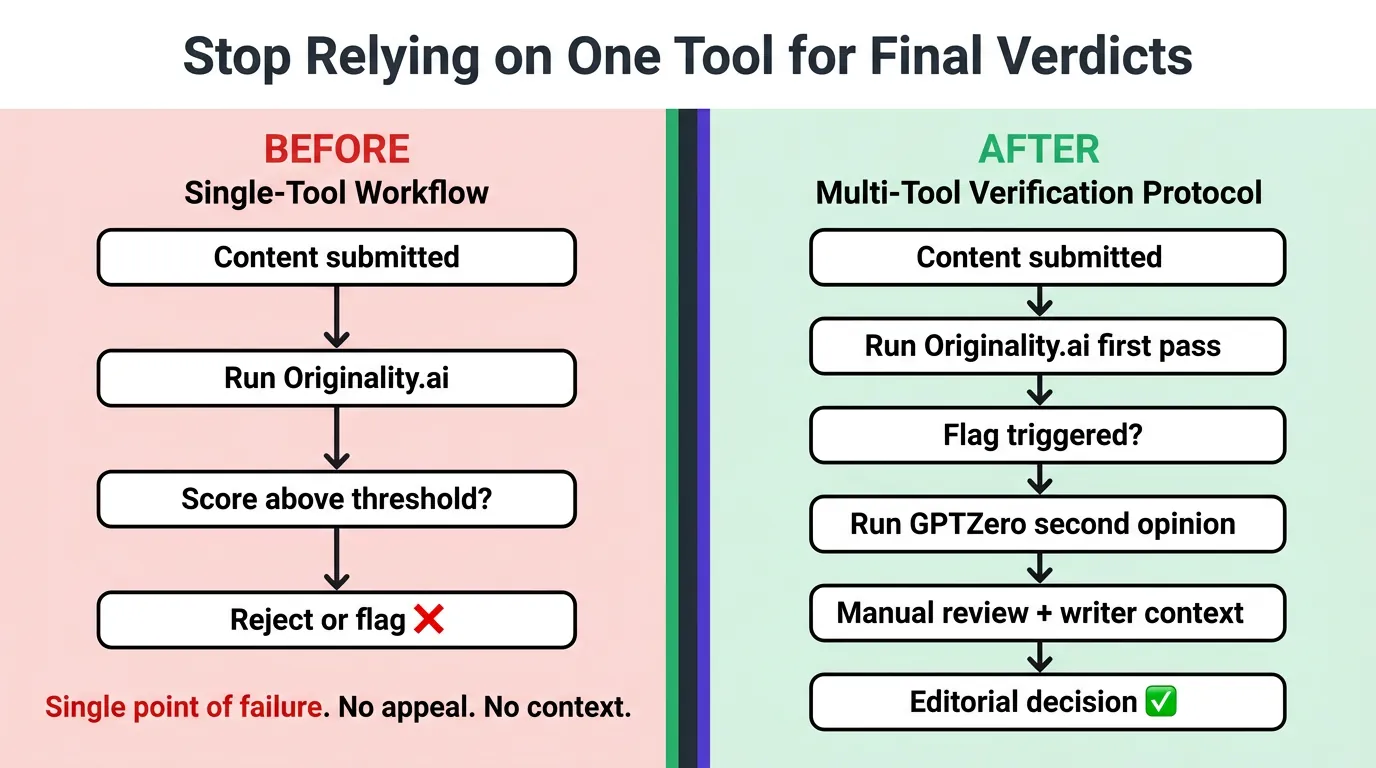
No detection score should end a client conversation without a second opinion.
Why Running Two Detectors Catches What One Misses
Different detectors use different model architectures. When two tools disagree on a piece, that disagreement is meaningful data. A piece flagged at 85% by Originality (Paul Glasziou and Iain Chalmers: Is 8…).ai but cleared by GPTZero and Winston AI is almost certainly a false positive – three independent systems using different methodologies won’t systematically agree on a mistake. Multi-tool verification adds 10 to 15 minutes to the review workflow for disputed pieces. That time investment prevents editorial disputes that take hours to resolve. The practical protocol is straightforward: Originality.ai as the first-pass screening tool, with GPTZero or Winston AI as the second opinion on any piece scoring above 50% (Paul Glasziou and Iain Chalmers: Can…).
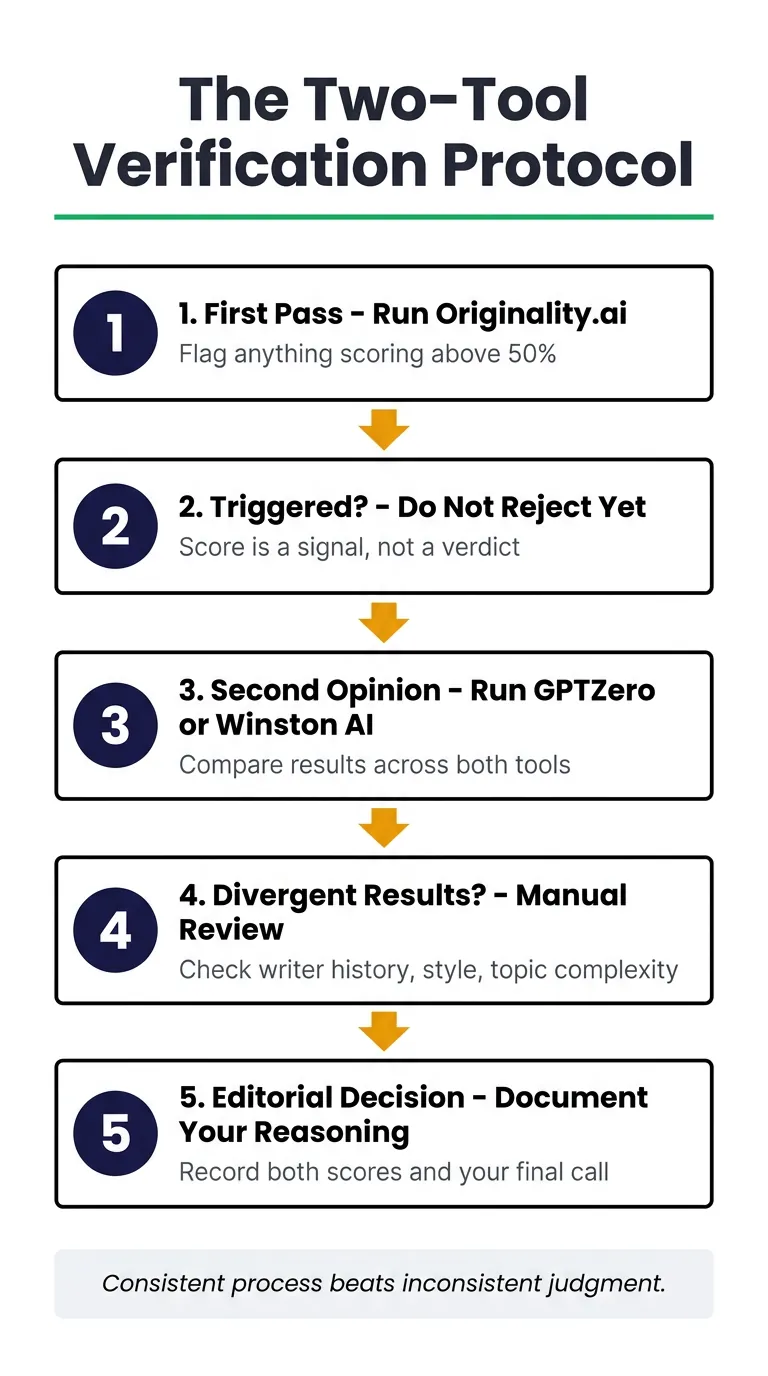
Two-tool verification is the minimum standard for agencies working with skilled writers.
The Editorial Protocol That Protects Writers From False Accusations
Document the writing process before submitting any piece to a client. Timestamps on drafts, research notes, and outline files create a paper trail that a detection score cannot override. Writers who maintain this documentation have concrete evidence when a false positive surfaces. Agencies should establish a written policy: no detection flag triggers a client conversation until a second tool confirms the finding. That policy protects writers, protects agency relationships, and keeps editorial disputes internal rather than escalating to clients. For content teams evaluating their full production stack, AI BrandFactory runs a 7-layer humanization system designed to produce content that holds up across multiple detectors – worth reviewing alongside a multi-tool comparison before making detection stack decisions. The platform’s approach to detection-optimized output reflects the same multi-tool thinking this protocol recommends.
Build the protocol before you need it.
Publishers who wait for a false positive to create their response process are already behind. A written two-tool verification policy takes 30 minutes to create and prevents hours of damage control.
When to Trust the Flag and When to Challenge It
Research indicates that high scores from multiple verification tools should be carefully evaluated.y (The 90+ Study – UCI MIND). A single-tool flag on formal or technical content from a writer with a documented track record is almost always a false positive. Context informs every decision: the writer’s history, the content type, the score distribution across sentences, and whether a second tool agrees. A 65% score from Originality.ai on a technical white paper from a known expert writer is a false positive until proven otherwise. A 94% score from three tools on a piece with no sentence-level variation is a legitimate finding.The Verdict on Originality.ai After Stress-Testing It Against Real Content
Content marketplaces and publishers screening for completely unedited AI submissions get strong performance here. The plagiarism bundling, team management features, and API infrastructure make it the strongest operational choice for bulk screening workflows. Agencies working with senior writers producing formal, technical, or heavily edited content face something different: false positive rates in this category run high enough to damage writer relationships without a second-tool verification protocol in place. For those agencies, Originality.ai functions best as a first-pass filter, not a final verdict. SEO agencies running mixed content pipelines, human writers alongside AI-assisted content, get the most value from pairing it with GPTZero or Winston AI for disputed pieces.
Who Should Use Originality.ai and Who Should Not
Content marketplaces and publishers screening for completely unedited AI submissions get strong performance here. The plagiarism bundling, team management features, and API infrastructure make it the strongest operational choice for bulk screening workflows. Agencies working with senior writers producing formal, technical, or heavily edited content face something different: false positive rates in this category run high enough to damage writer relationships without a second-tool verification protocol in place. For those agencies, Originality.ai functions best as a first-pass filter, not a final verdict. SEO agencies running mixed content pipelines, human writers alongside AI-assisted content, get the most value from pairing it with GPTZero or Winston AI for disputed pieces.
The tool fits some workflows well. Others, poorly.
No AI detection tool currently on the market should serve as the sole arbiter of content authenticity. That’s the honest answer. Originality.ai’s market position and pricing suggest a level of authority its accuracy doesn’t yet support across all content types. Formal writers, technical specialists, and non-native English speakers face disproportionate false positive risk, and that risk isn’t disclosed prominently in the product’s marketing. An agency building workflows around this tool without grasping that limitation is one false positive away from a preventable editorial crisis. The tool has genuine strengths, real ones, but the gaps require accounting for.
The One Change That Would Make Originality.ai Worth Its Premium Price
Publishing a transparent false positive rate benchmark broken down by content type would shift the conversation entirely. A confidence interval display alongside the single percentage score would give editors more honest information to act on. Originality.ai holds the market position to lead the industry on accuracy transparency. Choosing not to publish that data is a deliberate decision, one that shields marketing claims at the direct expense of editorial trust.
Conclusion
Originality.ai is a capable tool with a documented false positive problem that hits skilled writers hardest. Treating its scores as final verdicts rather than data points damages workflows and client relationships.
Build a two-tool verification protocol now.
Run Originality.ai as first-pass screening, then confirm any flag with GPTZero or Winston AI before it reaches a client conversation. Document your writers’ processes so a false positive becomes a manageable editorial event rather than a relationship-ending accusation. The false positive problem is real, documented in published research, and falls hardest on the writers producing your best content.
- Test a second AI text detector this week
- Establish a written escalation policy
- Stop treating any single Originality.ai score as the final word on a piece’s authenticity